If you’re a numismatist, the British Gold Sovereign is an absolute must-have for your collection. But, before you actually put down your money and buy these beautiful collectable gold coins, it’s important to know more about them, how to buy them and what to look for. In this article, we take you through all that you need to know about buying a Sovereign. Also, be sure to read our beginners guide to buying gold.
The gold sovereign
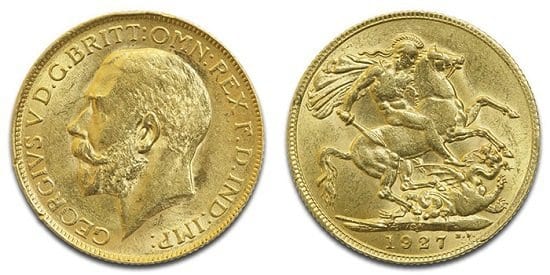
The Sovereign is a 22-carat gold coin that is the flagship product of the Royal Mint, which also manufactures the gold Britannia. It measures 22.05 mm across and has a thickness of 1.52 mm. The coin weighs 7.98 grams, with a fineness of 916.7. Over centuries, the Sovereign has remained an integral part of the coinage of Britain and has never lost its unmistakable charm.
Early days…
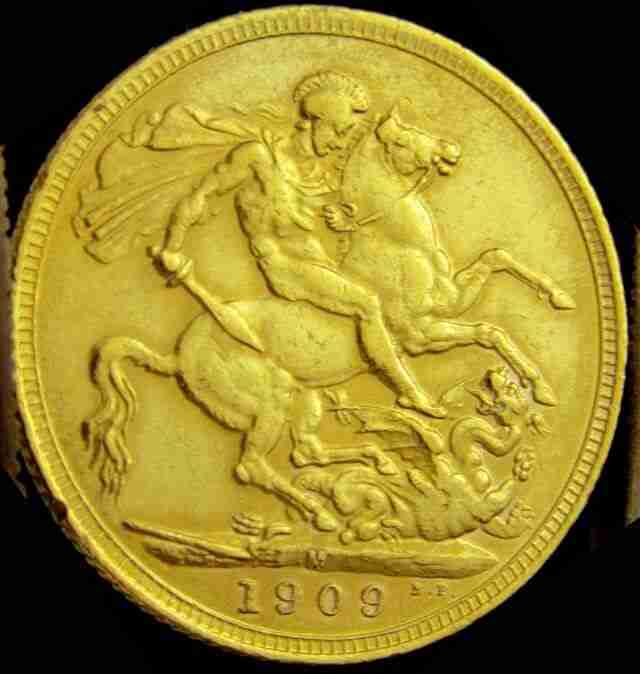
The sovereign was first introduced in 1817 and had a nominal value of a pound. The coin was earlier in circulation but has now been accepted as a bullion coin. The 1817 edition features the iconic design of St. George and the dragon on the reverse. The design was created by world-famous designer, Benedetto Pistrucci, as part of the great re-coinage and the coin has his initials on it as well. The sovereign was taken off circulation in 1914 at the start of World War I. It was never reintroduced after the war, but the circulation of the already issued editions continued in other parts of the world, including the Middle East. Due to rising demand across the world, the Royal Mint struck new sovereigns in 1957. One of the reasons behind the popularity of the sovereign across the world was the fact that it was a reputed and trusted coin, containing an amount of gold that was known and could be easily verified.
The sovereign is an iconic landmark of British coinage
Buying gold sovereigns
When you buy gold sovereign coins, you are investing in gold bullion. This is a very stable and secure asset class and is classified as a Capital Gains Tax (CGT) free investment in the UK. Gold sovereigns are more divisible than gold bars, with a 1 kilo gold bar being out of the reach of many investors.
However, when investing in gold, it’s important to find a reliable and trusted dealer. Buying gold sovereigns from Physical Gold is very easy. We provide you with a certificate of authenticity and all the sovereigns we sell are vetted by numismatists. We are also able to offer you storage facilities, along with insurance that protects your purchase and underwrites any risks.
Should I buy new or old Sovereigns?
With their long and illustrious history, there are a lot of choices when it comes to purchasing gold Sovereigns. The simplest choice is to buy the current year of issue. As a mass-produced bullion coin, the latest Sovereign coin is easy to find. All the reputable gold dealers will likely have plentiful stock so price comparisons are simple and transparent. The condition of the coin will be brand new so you have peace of mind knowing exactly what to expect. Delivery will also likely be the next day due to its high availability. Prices for buying the latest Sovereign coin are also likely to be low as the coin has little scarcity and no history yet.
But that’s not the full story…
Older Sovereign coins can be classed as semi-numismatic. In other words, their value now consists not only of its gold content and production values but also possesses an element of scarcity and history. Coins may be less shiny than brand new Sovereigns, but due to their optimum 22-carat alloy mix, they’re far more resilient than 24-carat coins which can mark more easily. Prices are generally higher than for new Sovereigns due to these elements, however, their resale value is also higher, and there’s a greater chance that the older coins will appreciate in value quicker than new ones, especially if supply becomes particularly tight in the secondary market.
How about buying Halves, Fulls, or Double Sovereigns?
Another choice you need to consider when buying Sovereigns is which size to buy. For many years now, the UK Sovereign has been produced in four sizes. The smallest is the half Sovereign, next up is the classic full Sovereign coin, then the Double Sovereign (also known as £2 gold coin), and finally the largest is the Quintuple Sovereign (or £5 gold coin). All have their merits, with the half Sovereigns providing extra divisibility, and the £5 coins offering unparalleled satisfaction due to their impressive size. Generally, the smaller coins are more expensive per gram to buy, due to their relatively higher production cost. However, some £2 and £5 coins are also commemorative coins, so can trade at far higher values than simply their multiple of the full Sovereign.
How can I best use this info?
Depending on how much you wish to invest in gold Sovereigns, and your particular objectives and timeframe, we always recommend buying a mix of Sovereign sizes and ages. The newer and larger coins can help bring down the overall cost of your portfolio. The smaller coins can provide flexibility to sell small quantities in the future. Older coins and collector’s editions can help achieve quick possible price rises if the coins become scarce. As with investments in general, a mixed portfolio will always be preferable to owning all of the same assets.
Call us to buy sovereigns
You can order gold sovereigns online via Physical Gold. Our online process can provide you with great value for money. We have a membership of the British Trade Numismatic Association (BNTA), allowing you to buy with confidence. The buying process is very simple, however, if you would first like to speak with a member of our team of experts, call us on 020 7060 9992.
In our video, we answer the question – “Gold Britannias or Gold Sovereigns – which is the best investment?”
We endeavour to provide the best customer service and can offer you great deals on gold sovereigns, particularly for bulk purchases. Since we do not deal with any form of online or paper gold, you can rest assured that the gold you buy from us is physical gold of the highest quality, which can be a prized investment in your portfolio for years to come.
Mintmarks are small indentations that have been stamped onto a coin to show from which mint it has been produced. They were originally introduced so that if there was a problem with a coin – i.e it was underweight or contained less metal than specified, then the owner could tell exactly which mint was responsible. In other words, a mintmark is a guarantee or mark of authenticity to prove that a coin has been produced exactly as has been specified.
Mintmarks throughout history
The first mintmarks were produced by the ancient Greeks and were known as Magistrate marks. At the time Magistrates were among the top-ranking government officers in Ancient Greece and were responsible for the production of coins. The magistrate mark symbolised the name of the magistrate who had overseen the production of that particular coin.
Proof of origin
The ancient Romans also used marks to determine from where a coin was produced, and mint marks were a regular feature of Roman coinage. Often these marks could be found at the bottom of the reverse side of a coin and contained three parts. The name and location of the mint and the workshop contained within the mint.
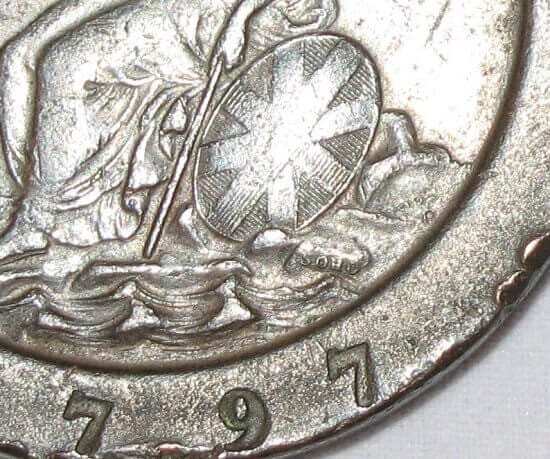
An example of a Soho mintmark on an old British Cartwheel Twopence
The importance of mintmarks for coin collectors
Certain collectors who display an interest in numismatic coins take particular interest in mintmarks. Sometimes it can make a huge difference in the value of a coin and knowing what makes certain mintmarks more collectable and where to locate them is part of what makes a coin collecting such an exciting pastime. A rare mintmark mark can add thousands to the value of a coin.
British Mintmarks
The Royal Mint has been responsible for minting coins in Britain since its original inception as the London Mint back in 886 AD. After operating from London until the 1960’s, it is now located in Llantrisant in South Wales. Several hundred years ago there were coins being minted in towns all over the UK. These Medieval mints tended to use pictures or small symbols to represent which particular-mint they came from.
What’s the story with modern coins?
One defining factor of the Royal Mint is that it doesn’t often use a mintmark for British coins. For example, gold Sovereigns that are minted in the UK feature no mintmark at all whereas sovereigns that have been minted in branch mints overseas all feature their own unique lettering to represent where they have been produced. For example, sovereigns minted in Sydney feature the letter S, Melbourne M, Perth P, Ottawa C and so forth.
Purchasing gold and silver coins through Physical gold
Physical Gold is one of the leading dealers of gold and silver in the UK. We offer investors the chance to invest in a wide range of gold and silver coins including our huge selection of gold Sovereigns. For more information or any additional advice on how to invest in gold and silver, please give us a call on 020 7060 9992.
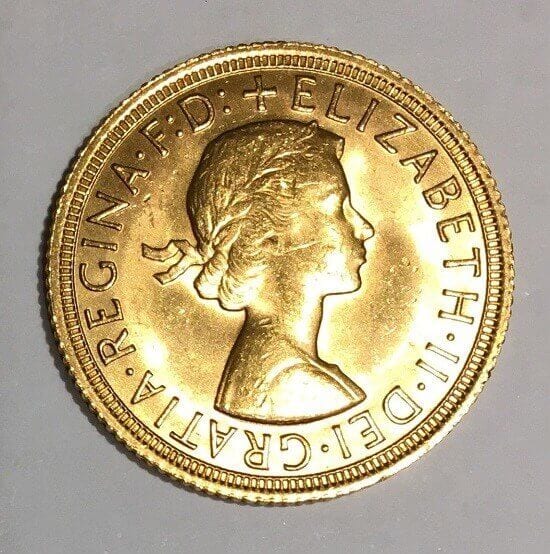
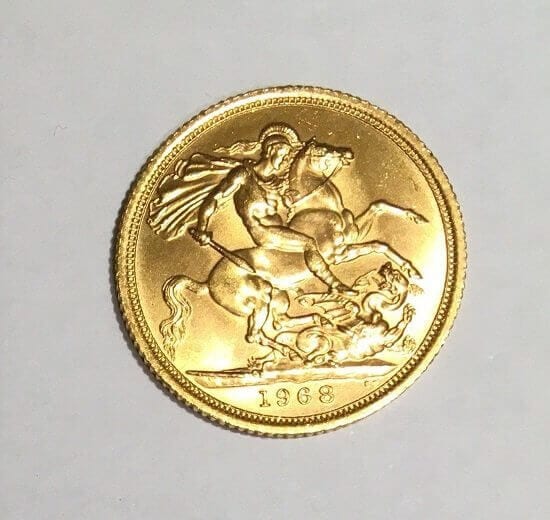
This year marks the 50th anniversary of the 1968 gold sovereign. The last gold sovereign to portray a young Queen Elizabeth II and the last sovereign to be issued before decimalisation (in 1971).
Following the King Henry VII sovereign, succeeding monarchs each chose to strike a new version of the gold sovereign as a way of displaying their own power and strength, however, this practice died out after the reign of Elizabeth I. It wasn’t until George III decided to replace the guinea with a new gold sovereign 214 years later that the coin was reintroduced into circulation. Since then the sovereign has gone on to become one of the UK’s most prized, most sought-after coins and it is still highly valued by many coin collectors today.
The reverse of 1968 UK Gold Sovereign
Why gold sovereigns make great investments
Gold sovereigns are one of Britain’s most striking and beautiful coins, reflecting a time when the country was still at the height of its strength. Collectors who value gold sovereigns typically appreciate the incredible wealth of history behind them as well as their stunning designs. For some investors, gold sovereigns represent a way to invest in physical gold without the requirement of having to pay Capital Gains Tax, as all British legal tender is tax-exempt. Other investors look to capitalize on the scarcity value of certain rare gold sovereigns and will often pay particular attention to rare dates and issues.
Due to the fact that gold sovereigns are classed as semi-numismatics, (coins whose value is based on their numismatic value as well their bullion value) they often trade above the gold value, making them attractive investments for collectors. Gold sovereigns are also fairly liquid should you need to raise funds quickly and investors from all over the world are interested in purchasing them which means that you won’t have any trouble finding a buyer.
To learn more watch our related video – “5 Reasons to buy gold sovereigns”
Purchase gold sovereigns through physical gold
We stock a huge selection of gold sovereigns including those produced from 1957-1968. Click here to browse our complete collection. Whatever your requirements, whether you’re looking for single investment opportunities or help to select a mixed portfolio of gold bullion coins, we can assist. Why not give us a call on 020 7060 9992?
Opportunity for gold bars and coins in China
China is one of the largest buyers of gold bars and coins in the world. A global report on gold consumption released by the World Gold Council for Q3 2017 found that China set the record for the highest demand for gold bars and coins, up by 57% to 64.3 tonnes. The report found that Chinese investors invested heavily in gold, due to fears about the falling price of the Yuan, Chinas national currency. In addition to this, there were other factors such as rising inflation, restrictions on the real estate market imposed by the government and the Chinese governments ban on Bitcoin exchanges across the country. As there were fewer investment options available to Chinese investors, the logical conclusion was to invest money in gold in order to hedge risks.
The year of the dog 2018
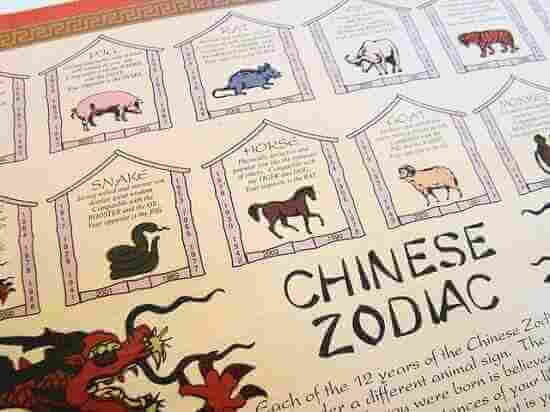
The Chinese zodiac plays an important role in investment decisions made by gold investors in the country. 2018 is the year of the dog and there are lucky days like the 7th and 28th of every Chinese lunar month. Lucky numbers included combinations of the integers 3, 4 and 9. Lucky months were the 6th, 10th and 12th month of the Chinese lunar calendar. Studies found that people born in the year of the dog along with the gold element made them attractive to members of the opposite sex. According to Chinese astrology, the yellow metal has influences on people born in the year of the dog. When gold is worn by these people, it is said to make them firm in their convictions, with high principles, noble and charitable. Previous years of the dog since the 1970s were 1970, 1982, 1994 and 2006.
The Chinese zodiac is a powerful influence on gold buyers in China
Year of the dog gold coin issues
The Australian Gold Lunar Series 2 Year of the Dog coins are available in 1oz, 1/4 oz. and 1/10 oz. These are a great series of coins issued by the Perth Mint with 99.9% pure gold. The 2016 Year of the Monkey gold 1oz. coins enjoyed immense popularity and are currently priced at £1,035. The Australian issue for 2018 also features a one-kilo coin made of 99.9% pure gold, the largest and heaviest coin in the series. The coins feature a portrait of Queen Elizabeth II on the obverse and a lovely Labrador retriever dog on the reverse. The coins were designed by Ing Ing Jong at the Perth Mint and are legal tender across Australia.
Not to be left behind in the race to commemorate the Year of the Dog from the Chinese Zodiac, the UKs Royal Mint has also issued their design of the 1oz. gold bullion coin. The coins are VAT free for investors across Europe, as well as CGT (Capital Gains Tax) exempt in the UK. The Royal Mint has created a series called the Shengxiao Collection and this coin is the fifth lunar design to feature in that collection.
The Canadian Mint has also issued a limited edition gold coin to commemorate the Chinese Year of the Dog. The coins have a face value of 150 CAD, made with 18-carat gold and weighs 11.84g. The edition is limited to 1500 coins worldwide. It is the 9th coin in the lunar series issued by the Canadian Mint.
Call us to invest in Chinese Zodiac gold coins
Our team of experts at Physical Gold are always available to advise you on buying gold bullion. Call us on 020 7060 9992 or get in touch via email before investing in gold coins. We deal in collectible gold coins and may be able to procure specific gold coins for your collection. One of our advisors can guide you through the process of investing in gold and help you make an informed decision before you invest your hard-earned money.
Image Credit: Flickr
PyeongChang 2018 is the highly prestigious winter Olympic sporting event due to take place in Pyeongchang County, South Korea between 9 to 25 February 2018. It is the 23rd Winter Olympics and South Korea’s first. PyeongChang is only the third Asian city to host the winter games. The first two were held in Japan in 1972 and 1998.
To commemorate the event, South Korea has issued a set of coins made in gold, silver and bronze. The coins were issued in 2016 and have evoked quite a bit of international interest from collectors and investors across the world.
The 30,000 Won gold coin is among the first series of coins issued to commemorate the event. The coin features the Olympic logo, as well as the PyeongChang winter games logo on the obverse. The face value of the coin is shown on the reverse along with a motif showing Gorosoi skis and people using it.
The Gorosoi ski is a popular means of transportation in the snowy mountainous region of the Gangwon province. It is considered to be the traditional skis of the region. They are meant to be used along with snowshoes with a hardwood frame called Seolpi. A stick is used by the user to move in the right direction along with a spear at the other end, used for hunting.
The coin contains 31.10 g of pure gold that is 99.9% pure, along with a diameter of 35 mm. While the face value of the coin shows 30,000 won, the coin is priced internationally at £2042 (2,96,000 KRW).
PyeongChang is the first Asian city outside of Japan to host the winter games
Other editions
Apart from the 30,000 Won issue of the Winter Games gold coin, there are other similar coins that have been issued to commemorate the event. The 20,000 Won gold coin is smaller and weighs 15.55 g. It has a size of 28mm in width and is made of 99.9% solid gold. It is available as part of an 11 coin set issued to commemorate the games, featuring both the 30,000 Won and the 20,000 Won gold coins along with a 5,000 Won silver and a 1,000 Won brass coin.
A set of 10 coins has also been issued that does not contain the large 30,000 Won gold coin. This set features only the 20,000 Won version and all silver and brass coins from the first series. The set of 10 is well presented in an oval-shaped case, which has been designed to replicate the ice rink, where all the skating events will take place at the games. The set is priced at £1406 (2,038,000 KRW). These sets, as well as the individual coins, are of great interest to numismatists across the world. Some collectors have painstakingly put together a thematic collection of gold and silver coins commemorating previous Olympics and Winter Olympics. Needless to say, these coins would be of immense interest to them as a new addition.
Call Physical Gold for help with your collection
Our experts at Physical Gold have the expertise and experience to advise you on how to build a valuable collection over the years. We are always happy to discuss your goals in building a prized collection of gold and silver coins that can be your legacy and an heirloom you can pass on to future generations. We may even be able to procure certain coins that you need but are unable to get. We are also able to advise you on valuations when you need to sell. Call us now on 020 7060 9992 and speak to one of our experts.
Country: USA
Face Value: $50 USD
Gold Content: 1 ounce (31.104g)
Purity: 99.99% (24 karat)
Gross Weight: 31.108g
Coin Diameter: 32.70mm
First year of issue: 2006
The American Buffalo Coin is the first .9999 fine 24-karat gold coin ever struck by the United States Mint and has been produced every year since its first issue in 2006.
These are among the world’s purest gold coins in terms of the fineness of the metal they contain. The American Buffalo Coin is one of only a handful of 24 karat bullion gold coins and is one of the reasons for its worldwide appeal. By law, the gold in Buffalo Gold Bullion Coins must originate from newly mined sources in America. All the coins are struck at the United States Mint at West Point, New York, but do not have a mint mark.
The Buffalo coin is a modified version of James Earle Fraser’s design for the Indian Head nickel issued in early 1913, regarded as among the best and most collectable designs of any U.S. coins.
The American Buffalo Gold Coin was opened to coin dealers on 20th June, 2006. Collectors placed their orders by July 22, 2006, in order to acquire the proof versions directly from the mint. Only 300,000 of these were minted, making them rare today. At the time, US coins were using 91.67% gold in their bullion coins like the American Gold Eagle. Due to this, investors opted for non-US coins, like the Canadian Gold Maple Leaf. In order to woo investors away from non-US coins, the American Buffalo coins were minted with 99.99% 24 karat gold. The US mint clearly wanted to sell into the 24 karat gold market, which accounts for about 60% of the world’s gold market.
The coin was an instant hit among the public, collectors and buyers. The value of the coin escalated at an unprecedented pace, and in just a few years the price shot up from $800 in 2006, which was the initial price to $2010 in 2011. It is interesting to note that all bullion coins made in the US are struck at New York’s West Point Mint. The proof versions of the buffalo gold coins are stamped with a ‘W’ mark on the front of the coin, while the bullion version does not have this mark. One ounce versions were released by the US Mint in 2006 and 2007. However, by 2008 the mint decided to issue 1/10 oz., ¼ oz. and ½ oz. gold buffalo coins with face values of $5, $10 and $25 respectively.
2008 financial crisis
During the 2008 financial crisis, investors started investing heavily in gold. The US sub-prime mortgage crisis had reached its peak and become a global financial crisis that spread across continents. Investors all over the world were turning to gold and silver to hedge their risks. Unable to keep up with the escalating demand at the time, the US Mint announced on September 26, 2008, that it would temporarily halt the issue of American Buffalo Gold coins.
The obverse of this coin is a profile of a classic Native American Indian which is said to be created as a mixture of the features of three chiefs from different Indian American tribes.
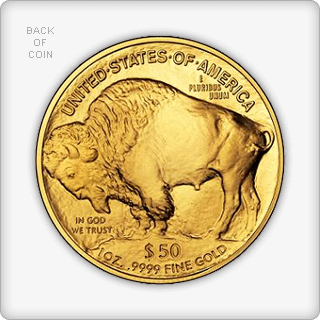
The reverse features an American Bison, which commonly are referred to as buffalo. The motto, “In God We Trust”, appears to the left of, and beneath, the buffalo’s head. This motto has featured on all U.S. gold coins since 1908.
The coin has a face value of $50 USD and is afine addition to a coin portfolio.
The Bloomsbury Coin Fair
The Bloomsbury Coin Fair is a hugely popular event that is held 8 times a year in central London. With a highly affordable entry charge of only £2.00, it is a great place to visit and connect with the world of numismatists. It is a veritable treasure trove for those with a passion for collecting. They can not only see great coins first hand at the fair, but also connect with experienced collectors. There is plenty of advice available about coin investments and of course, the opportunity to browse catalogues and participate in auctions during the day. The Bloomsbury fair usually has around 40 dealers present and the owners of the event are John Philpotts and Sophie Dickenson, who are also responsible for running the show.
The fair is held regularly at the Bloomsbury Hotel, situated at 16-22, Great Russell Street in central London. Tottenham Court Road is the nearest tube station for visitors arriving via public transport. The hotel is a short walk away from the station. For those driving in, parking is available in a multi-storey car park down Great Russell Street or in the Bloomsbury Square car park.
Numismatic fairs are a great place to mingle and network with like-minded collectors
Timings of entry are 9:30 AM to 2 PM. Exhibitors can also book tables to display their wares and do need to inform the organisers well in advance in order to ensure that a table will be available. Table prices range from £130 for a table 6 ft. long up to £250 for a 12-foot table. The fair covers many interesting periods in coin history. Visitors can find Tudor coins, Norman and Anglo Saxon coins and even coins that date back to Roman times and the Iron Age. A list of regular exhibitors can be found here.
Call us for helpful advice when you build your collection
There are many exhibitions across the world where collectors congregate to find out more about coins and gain knowledge about numismatics and investing. Of course, the Bloomsbury Coin Fair is one of the popular ones in the UK to attend.
However, expert knowledge is always helpful before you dash off with your hard earned money to a coin fair to make investments. You need to have deep knowledge about the subject before you put your money on it and this does not come easy.
The good news is that our experts at Physical Gold are always at your service to give you valuable advice, help you build your collection and even procure specific coins that you may want for your collection. Call us on 020 7060 9992 to talk to one of our experts who can help you learn more about numismatics and make the right investment decisions.
British Sovereigns have existed since ancient times, but the modern-day Sovereign has been minted since Great Recoinage of 1816. Sovereigns have been produced for each Monarch since this time with King Edward VII being no exception. In this article, we provide various facts and insights about King Edward VII sovereigns.
Date of King Edward VII Sovereigns
King Edward VII was king of the UK and British Dominions from 22nd January 1901 through until 6th May 1910. Therefore, King Edward VII Sovereigns were minted at this time with coins being available with dates from 1902 (when King Edward was crowned) until his death in 1910.
The King Edward VII Sovereign
Sovereign design
This sovereign features the following design on the obverse/reverse:
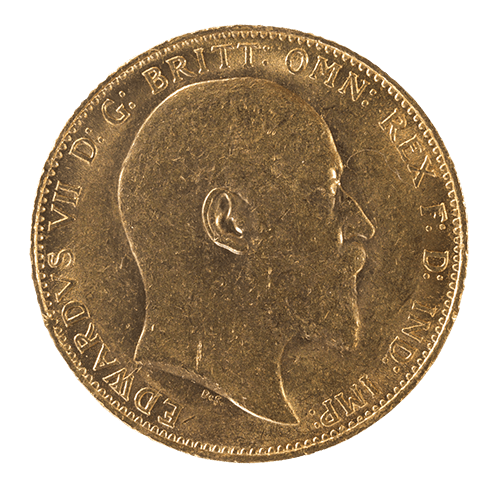
Obverse – The obverse features a portrait of Edward VII
Reverse – The reverse displays a St. George and Dragon design
Where were they minted?
There are five possible mint locations for King Edward VII sovereigns, these are listed below with the quantities minted (around 200 million in total):
London – 105 million
Australia:
Melbourne – 31 million
Perth – 42 million
Sydney – 22 million
Ottawa, Canada – Only 45,000
Example of the obverse side of a 1909 King Edward VII Sovereign
Production quantities by year
The following were the production quantities of gold sovereigns for each year:
Until the first world war sovereigns were used as £1 coins. The majority of the population could not afford to keep them as collectibles, so many sovereigns became worn through active use. Therefore, to this day the quality of sovereigns is extremely variable with matte proof and extra fine examples commanding a significant price premium.
Investment approach
The gold amount within a King Edward VII sovereign weighs about 0.2354 troy oz. (i.e. just less than quarter of an oz. When calculating as an investment it’s easy to see that a premium is paid for these Sovereigns over the market price for gold. This is the balance between the current gold price and its numismatic value. When buying coins like this it’s important to remember for your investment you are not only becoming a gold owner, but also will benefit from the future collectors’ demand for these Sovereigns. If in doubt just give us a call and we can advise on the best investment approach for your circumstances.
Buying King Edward VII Sovereigns through Physical Gold
If you are looking to buy this famous and highly collectible Sovereign, then why not contact us here at Physical Gold on 020 7060 9992? We, of course, stock this Sovereign, but what we hold does fluctuate, so contact us for our latest holdings and price. If you need a specific year or level of quality, please let us know.
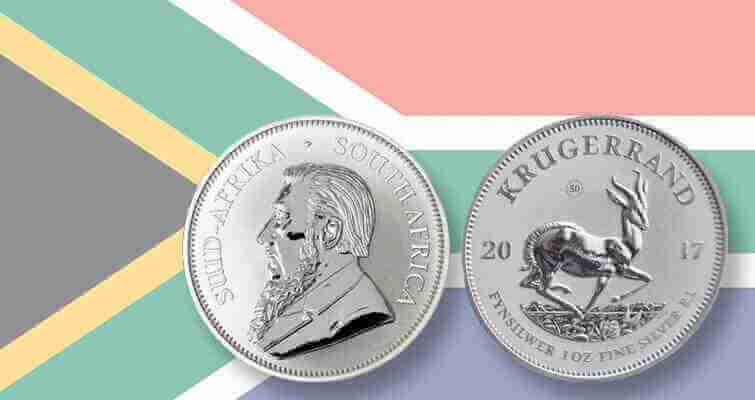
The 3rd July 1967 was an important date in the world of gold coins as it saw the release of the Krugerrand by the South African Mint. The Krugerrand was an important vehicle for South Africa to release its gold reserves worldwide. At the time South Africa was mining c75% of the world’s annual gold supply and this coin was a convenient and collectible way for the gold to be used and was more affordable to the man on the street than gold bars.
The Krugerrand has a name origin, split into two parts, which are:
Kruger – Named after Paul Kruger, the president of the South African Republic from 1883 to 1900. His portrait features on one side of the coin
Rand – The rand is a currency used in South Africa and is named after the “White waters’ ridge” (Witwatersrand in Afrikaans). This area is prolific for gold mining and is the origin of in excess of 50% of the gold ever mined on earth
Investing in gold Krugerrands is a solid investment idea
10 amazing facts and stats about the Krugerrand
The Krugerrand was the world’s first 1oz. weight gold coin, where weight was used as the denomination
They have no face value, instead, the coin’s value is actively known across the world and is based on its precious metal content
The Krugerrand is easily the most recognisable gold coin worldwide
In 1980, ½ oz. ¼ oz. and 1/10 oz. versions of the Krugerrand were released to help investors with more restricted budgets
The Krugerrand has been mass produced, with more than fifty million being minted to date
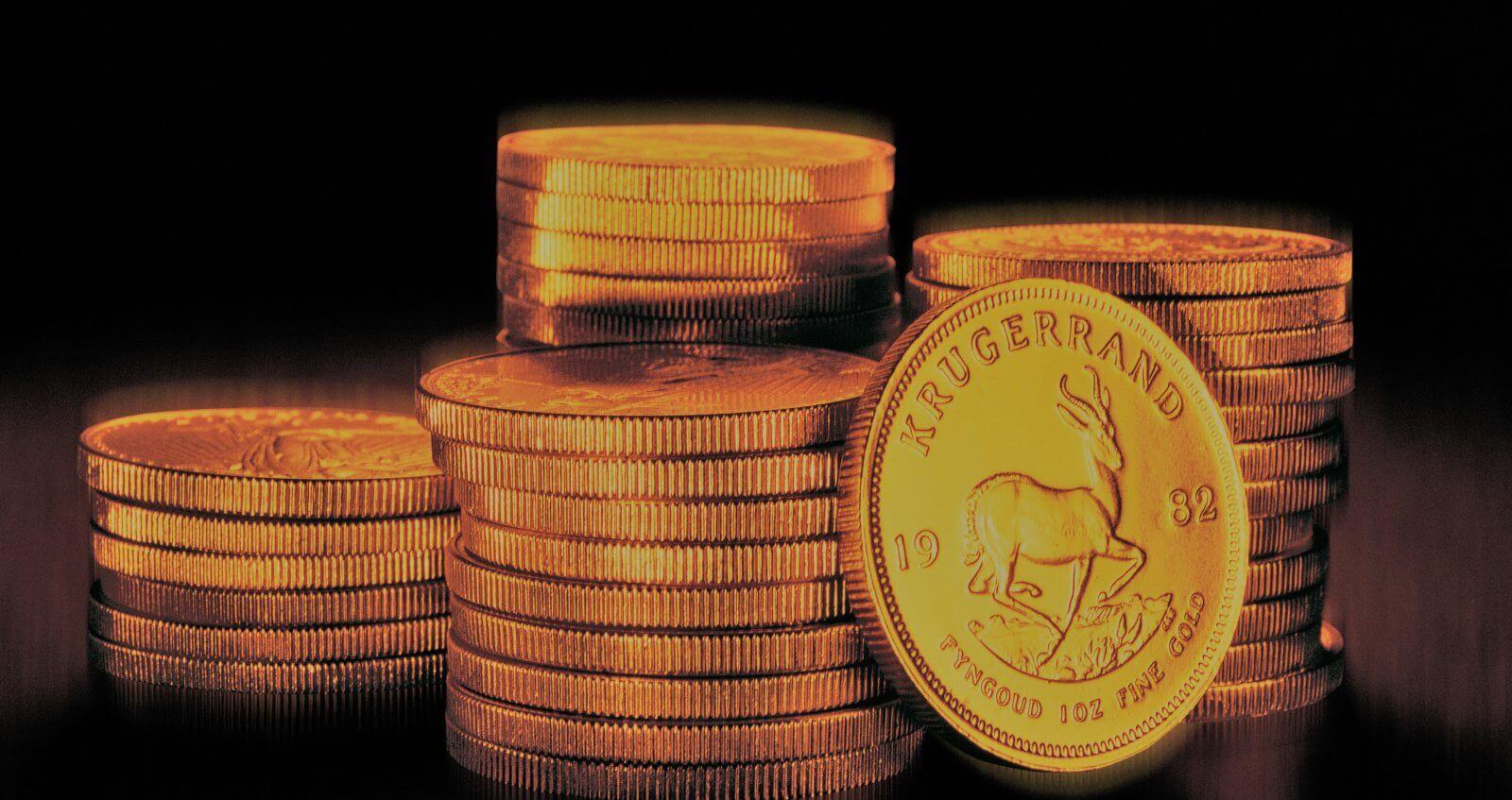
The reverse side of a Krugerrand features a springbok, a type of South African antelope and symbol of the country
The coin is gold alloy featuring 91.67% 22-Karat gold and 8.33% copper (this is quite like the constitution of a British Sovereign)
Proof versions of the coin have been produced with collectors in mind as opposed to a primary motive of investment. Proof coins have 220 serrations on the edge of the coin whereas the standard bullion coins have just 160
A special 50oz. version of the coin was minted for the fiftieth anniversary, these are highly collectible as only fifty were ever minted
It’s the 50th anniversary of the South African Krugerrand in 2017
Here’s to another fifty years
Whilst other countries have released their own national coins (e.g. the Canadian Maple Leaf (1979), the American Golden Eagle (1986) and the Britannia (1987), etc.) demand worldwide for the Krugerrand is still extremely strong. This coin has well and truly stood the test of time and has not disappointed happy investors. Here’s looking forward to another fifty years of the Krugerrand.
Further reading
For further information about the South African Krugerrand also read our recent insight article by clicking South African Krugerrand.
Buying Krugerrands from Physical Gold
It’s the 50th (or Golden anniversary) of the Krugerrand, so why not buy some now from us here at Physical Gold? Call us today on 020 7060 9992 to place your order or discuss your requirements or email us via our contact form here.
An incredible collection of valuable gold sovereign coins has been discovered hidden in an old piano.
The piano, originally sold in Essex in 1906, was sent for retuning and repairing by the current owners, when the life-changing hoard of coins was discovered hidden inside it.
Found just before Christmas, experts believe the coin collection was probably carefully hidden there as far back as 1915, and the value is said to be life-changing. It includes an undisclosed number of full and half sovereigns, dated 1847 to 1915.
Peter Reavill, the Finds Liaison Officer at Shropshire Museums said it had “The potential of yielding a life-changing sum of money. It’s not the sort of money you would tuck away and forget,” he said. “It is a lifetime of savings and it’s beyond most people.”
Due to conclude later this month, the inquest has heard how the piano, made by Broadwood & Sons of London, was initially sold to a Messrs Beavan and Mothersole of Saffron Walden, Essex, in 1906.
Ownership of the piano between 1906-1983 is a mystery, with the coroner seeking information about its location during that period.
Declared as treasure
It will be decided on April 20th whether the ‘pot of gold’ can be declared as treasure. The conclusion has been delayed to allow more time for anyone from the Essex area, with information about ownership of the piano, to come forward.
If the coroner believes they have been hidden with the intent of future recovery, the objects will qualify as treasure and be the property of the Crown. However, the Crown’s claim will be void, if the original owner or their heirs can establish their title to the find.
Daniel Fisher of www.physicalgold.com, said, Its not the first time I’ve heard of obscure places to store gold. Full sovereigns are worth anything between 250 – 300 each, so a significant find like this means someone out there is due to receive quite a substantial pot of gold.
Gold Information
Live Gold Spot Price in Sterling.
Gold is one of the densest of all metals. It is a good conductor of heat and electricity. It is also soft and the most malleable and ductile of the elements; an ounce (31.1 grams; gold is weighed in troy ounces) can be beaten out to 187 square feet (about 17 square metres) in extremely thin sheets called gold leaf.
Silver Information
Live Silver Spot Price in Sterling.
Silver (Ag), chemical element, a white lustrous metal valued for its decorative beauty and electrical conductivity. Silver is located in Group 11 (Ib) and Period 5 of the periodic table, between copper (Period 4) and gold (Period 6), and its physical and chemical properties are intermediate between those two metals.