How to Sell Gold Britannia Coins for the Best Price
10/09/2026Daniel Fisher

Accumulate gold coins on a regular basis for home delivery or storage.
Let our experts hand-pick a gold investment portfolio for you.
Free & fully insured UK Delivery. Learn more

Secure & flexible payments. Learn more

Buyback Guarantee Learn more

A cost-effective way to buy silver bullion with off-shore storage
Let our experts hand-pick a silver investment portfolio for you.
Free & fully insured UK Delivery. Learn more
Secure & flexible payments. Learn more
Buyback Guarantee Learn more
Free & fully insured UK Delivery. Learn more
Secure & flexible payments. Learn more
Buyback Guarantee Learn more


Accumulate gold coins on a regular basis for home delivery or storage.
Let our experts hand-pick a gold investment portfolio for you.
A cost-effective way to buy silver bullion with off-shore storage
Let our experts hand-pick a silver investment portfolio for you.
Free & fully insured UK Delivery. Learn more
Secure & flexible payments. Learn more
Buyback Guarantee Learn more
Free & fully insured UK Delivery. Learn more
Secure & flexible payments. Learn more
Buyback Guarantee Learn more
Gold Britannia coins are among the UK’s most recognisable and widely traded bullion coins. But when the time comes to sell, how do you know what your Britannias are actually worth – and whether you’re being offered a fair price?
For most standard bullion Britannias, the answer starts with the value of the gold contained in the coin. But that isn’t necessarily where it ends.
The coin’s size, type, age and rarity can all influence its selling price, while market demand and your choice of buyer can affect the amount you’re ultimately offered.
Whether you own a single Britannia or an entire portfolio, this guide explains how Gold Britannias are valued, where to sell them and the practical steps you can take to maximise your return.
If you’re ready to sell now, you can also visit our dedicated Sell Gold Britannias page.
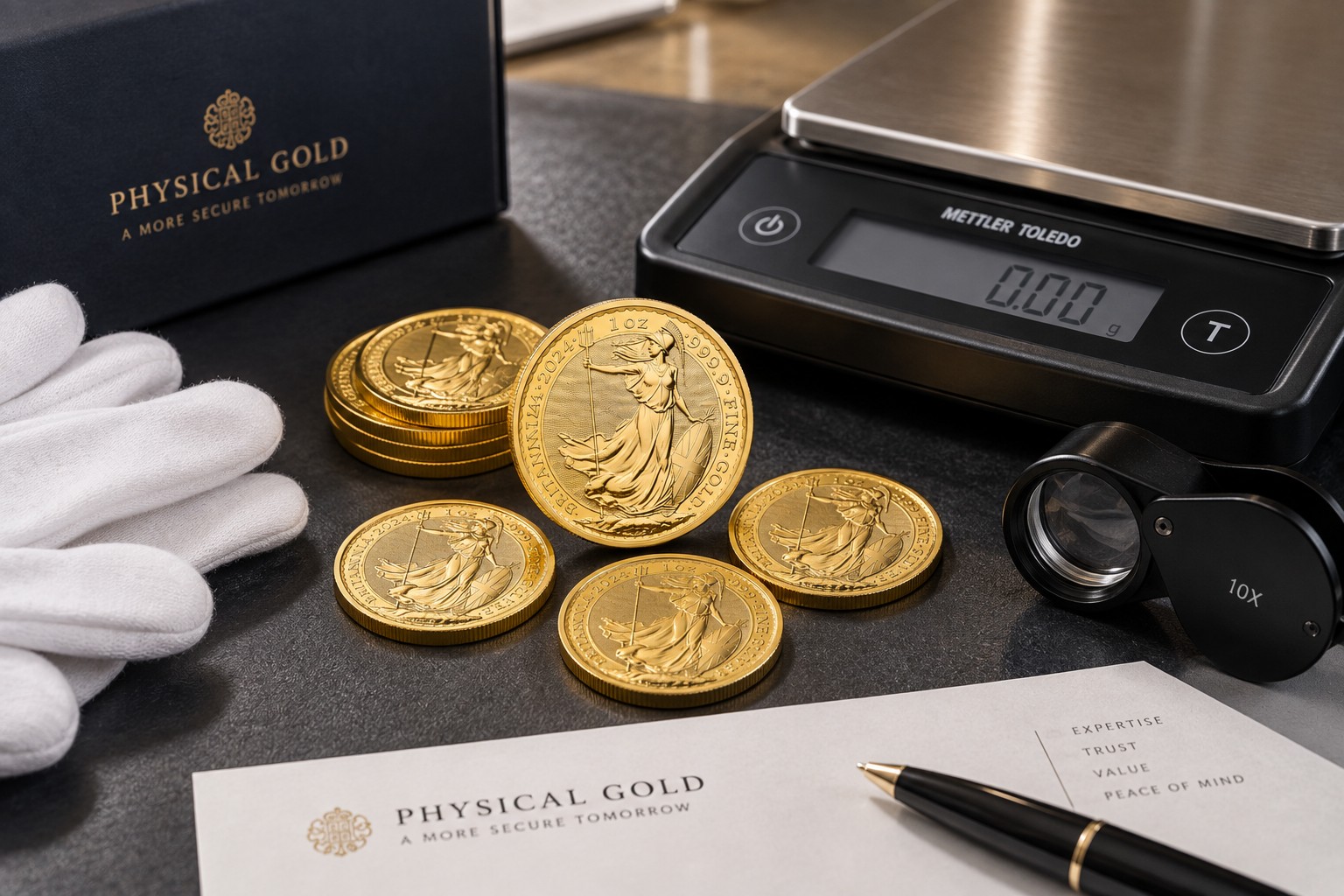
The starting point for valuing most Gold Britannias is simple:
How much fine gold does the coin contain, and what is that gold worth today?
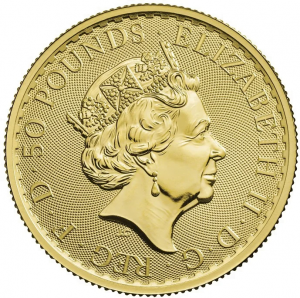
A standard one-ounce Gold Britannia contains one troy ounce – 31.1035g – of fine gold. Its intrinsic value therefore moves broadly in line with the underlying gold price.
But the spot value of its gold is not necessarily the price you’ll receive.
When buying and selling physical bullion, dealers apply premiums and spreads to reflect factors such as supply, demand, stock levels and the costs involved in trading physical metal.
In strong markets, where dealers have plenty of buyers and need additional stock, the price offered for Britannias can become particularly competitive.
The opposite can occur if dealers already have ample stock or there are more sellers than buyers.
You can check the current Sterling value of gold using our UK gold price chart.
Several factors can affect the amount you’re offered for your coins.
For standard bullion Britannias, some matter considerably more than others.
The most important factor is generally the underlying gold price.
Gold is traded internationally and its price changes continually during market hours. As the gold price rises or falls, the intrinsic value of your Britannia moves with it.
For a standard bullion coin, this underlying metal value will usually account for the vast majority of its worth.
This is why two identical Britannias sold months or years apart could achieve very different prices.
Gold Britannias are produced in several sizes, so make sure you know exactly which coins you own before comparing offers.
The core investment sizes include:
Fractional Britannias typically cost more per ounce when purchased because manufacturing and distribution costs are spread over a smaller amount of gold.
Don’t assume, however, that you will recover the entire additional premium when you sell. Dealer buying prices tend to be much more closely related to the fine-gold content and current demand for the coin.
If you’re unsure which size you own, you can compare your coins with our 1oz Gold Britannias, ½oz Gold Britannias, ¼oz Gold Britannias and ¹⁄₁₀oz Gold Britannias.
This distinction is important.
Most Britannias owned by investors are bullion coins. Their value is driven predominantly by their gold content and current bullion demand.
Other Britannias may have additional collectable value.
These can include proof coins, limited editions, boxed sets, unusually scarce issues and professionally graded examples.
Before accepting a standard bullion valuation, therefore, establish exactly what you own.
Sometimes – but usually less than sellers expect.
If you own a standard bullion Britannia from an ordinary year, its age alone does not necessarily make it significantly more valuable.
A 20-year-old bullion Britannia isn’t automatically a rare coin simply because it is old.
There are, however, specific issues that may attract additional collector interest because of their design, mintage or historical significance.
Examples include Oriental Border Britannias, which were produced with a distinctive decorative border and restricted mintages, and certain coins associated with changes of monarch.
The 2023 Britannias are particularly interesting because the year saw coins featuring both Queen Elizabeth II and King Charles III, including a special Coronation Britannia.
Whether these coins will command a significant premium in the future ultimately depends on collector demand. A commemorative story does not automatically guarantee an investment premium.

This is a common source of confusion.
Gold Britannias issued from 1987 to 2012 were struck in 22-carat gold, while Britannias from 2013 onwards are struck in 999.9 fine, or 24-carat, gold.
But that doesn’t mean an older one-ounce Britannia contains less pure gold.
A pre-2013 one-ounce Britannia is physically heavier because other metals are included in its alloy, but it still contains one full troy ounce of fine gold.
A post-2013 one-ounce Britannia also contains one troy ounce of fine gold.
So, for bullion valuation purposes, both contain the same amount of pure gold.
You can read more about gold purity and carats, but when comparing selling prices, focus on fine-gold content rather than simply looking at the carat number.
It depends on the type of Britannia you’re selling.
For a standard bullion coin being bought primarily for its gold content, small marks or signs of normal handling may have relatively little impact on its underlying bullion value.
That’s different from a proof, graded or genuinely collectable Britannia.
With these coins, condition can be an important component of value. Scratches, damage to the surface, marks on the rim or missing original packaging can potentially reduce collector appeal.
Post-2013 Britannias are struck in very pure 24ct gold, which is relatively soft, so careful handling is sensible.
If you own a potentially collectable Britannia, avoid unnecessary handling and do not clean or polish it before seeking a valuation. Attempting to make an old coin look shiny can actually reduce its numismatic appeal.
Most Gold Britannias are investment bullion and should be valued accordingly.
But there are exceptions.
A Britannia may command a premium above its underlying bullion value if there is genuine collector demand for the particular issue.
Examples can include:
The crucial word is demand.
A limited mintage doesn’t automatically make a coin valuable. Someone still needs to want it enough to pay more than its bullion value.
If you suspect your Britannia may be collectable, seek a specialist assessment before selling it simply as scrap or standard bullion.
The gold spot price provides a useful benchmark for the value of the fine gold contained in your coin.
But it isn’t a guaranteed buying or selling price.
A dealer’s offer may be above or below the spot value depending on the particular product and market conditions at the time.
This distinction is important when comparing offers. Rather than simply asking, “What percentage of spot are you paying?”, establish the actual Sterling amount you’ll receive after any relevant charges.
The LBMA publishes benchmark precious-metal price information, while our live UK gold price chart lets you monitor the gold price in Sterling.
International gold markets typically quote gold in US dollars.
UK investors, however, buy and sell Britannias in pounds.
The Sterling gold price is therefore influenced by both the international US-dollar gold price and the GBP/USD exchange rate.
This creates situations where gold might be relatively flat in US-dollar terms but rise in Sterling because the pound has weakened against the dollar.
Equally, a strengthening pound can reduce some of the impact of a rising dollar gold price for UK holders.
Fortunately, you don’t need to calculate this manually each time. A Sterling-denominated gold price already incorporates the currency conversion.
Insider tips to ensure you always achieve the best price
You don’t need to be a numismatist to perform some useful checks before asking for a quote.
Establish the denomination, year and type of each Britannia.
If you have original packaging, certificates or documentation for proof or special-edition coins, keep them with the coins.
Calculate the approximate intrinsic value of the fine gold contained in your coins using the current Sterling gold price.
That gives you a useful benchmark against which to assess dealer offers.
Before selling an unusual Britannia at a standard bullion price, investigate whether it is a proof, limited issue, special design or part of a set.
Ask how much you will actually receive rather than relying solely on an advertised percentage or indicative price.
If you’re selling a substantial holding, comparing credible offers can be worthwhile.
The best selling route depends largely on what type of Britannia you own.
For ordinary investment Britannias, an established specialist bullion dealer will usually provide the simplest route.
Specialist dealers understand the products, monitor the gold market continuously and have established channels through which bullion can be resold.
A dealer such as Physical Gold can buy either individual coins or larger portfolios through a defined Gold Britannia selling process.
This is generally where we would start for standard bullion Britannias.
If you own a genuinely rare Britannia, proof set or particularly desirable graded coin, a numismatic dealer or specialist auction may be more appropriate.
An auction can expose a scarce coin to collectors prepared to compete for it.
But commissions and other costs need to be considered, and this route is unlikely to make sense for ordinary bullion Britannias whose value is predominantly derived from their gold content.
Selling locally can be convenient, but convenience doesn’t necessarily produce the strongest price.
A general jeweller or cash-for-gold business may value your Britannia principally as gold rather than recognising it as an internationally traded bullion coin.
Always establish how the offer compares with the coin’s underlying fine-gold value before accepting it.
Selling directly to another investor or collector can potentially achieve a higher headline price because there is no dealer between the two parties.
But there is a trade-off.
You need to find the buyer, establish trust, arrange payment and deal with the security risks associated with selling a valuable physical asset to a stranger.
For particularly collectable coins, the additional effort may sometimes be worthwhile. For a large portfolio of ordinary Britannias, a specialist dealer is usually considerably simpler.

Achieving a good price isn’t necessarily about predicting the very top of the gold market.
There are several factors you can control.
Don’t sell a proof, scarce issue or valuable boxed set as ordinary bullion because you haven’t identified it properly.
Check the Sterling gold price shortly before requesting a quote.
This gives you a benchmark and makes it much easier to assess whether an offer is competitive.
A buyer who already has customers for Britannias may be able to recognise more of their resale value than a general gold buyer.
When choosing a buyer, look beyond the headline price and consider reputation, experience and the security of the transaction.
Our guide to choosing a reputable gold dealer explains some of the checks worth making.
Make sure you’re comparing the net amount you will receive.
Check whether there are valuation, postage, insurance, auction or other charges that could reduce an apparently attractive offer.
Don’t clean, polish or unnecessarily handle potentially collectable Britannias.
For bullion coins, a fingerprint is unlikely to destroy their intrinsic gold value. For a collectable coin, enthusiastic polishing could do considerably more harm than good.
The underlying gold price will normally be the dominant factor, but dealer demand can influence the premium or discount around it.
A dealer short of Britannia stock in a busy market may price more competitively than one already holding substantial inventory.
If you aren’t in a hurry, it can therefore be worth discussing your intended sale with a specialist before committing.
Free ultimate guide for keen gold investors
For UK investors, this is one of the major advantages of Gold Britannias.
Gold Britannias are UK legal-tender coins and gains made by UK individuals on their disposal are generally exempt from Capital Gains Tax.
This can become particularly valuable for investors who have built substantial holdings or experienced significant increases in the gold price.
It also means that the tax treatment of a Britannia can differ from that of some gold bars or foreign bullion coins.
Importantly, because gains on Britannias are generally exempt, you should not assume that a loss on selling them can simply be used as an allowable capital loss against taxable gains elsewhere.
Tax rules depend on individual circumstances and can change, so read our detailed guide to the tax implications of gold and silver investment or seek professional tax advice where necessary.
You can also read more about why Gold Britannias are UK legal tender.
You’re potentially sending or handing over thousands of pounds’ worth of physical gold, so security deserves as much attention as price.
If you’re selling remotely, establish the dealer’s process before sending anything.
Check:
Keep records of your coins and any relevant documentation before sending them.
If selling privately, the risks can be greater. Be particularly careful about revealing where gold is stored, meeting unknown buyers or accepting payment methods that can subsequently be reversed.
Our guide to 10 important considerations when selling gold and silver covers the wider selling process in more detail.

If you’re ready to sell, Physical Gold buys Gold Britannias directly from investors.
Whether you have one coin, a collection of fractional Britannias or a larger investment portfolio, our team can help identify your coins and provide a current valuation based on the gold market and demand for your particular Britannias.
You can see how our Gold Britannia selling service works or learn more about Physical Gold as a UK gold and silver dealer.
For more general guidance, you can also explore our gold coin selling service.
Call us on 020 7060 9992, contact us online or book a chat with a member of our team.
A one-ounce Gold Britannia contains one troy ounce of fine gold, so its underlying bullion value is closely linked to the current Sterling gold price. The actual amount you’ll receive can be above or below the spot value depending on the particular coin, dealer demand and prevailing market conditions.
For standard investment Britannias, a specialist bullion dealer will usually provide the most straightforward combination of competitive pricing, product knowledge and secure processing. Rare, proof or highly collectable Britannias may warrant assessment by a numismatic specialist or auction house.
Not necessarily. Age alone does not make an ordinary bullion Britannia rare. Some specific years, designs, proof coins and limited issues can attract collector premiums, but most standard Britannias remain primarily valued according to their fine-gold content.
Not simply because they are 22ct. Pre-2013 one-ounce Britannias are 22ct but contain one full troy ounce of fine gold. Post-2013 one-ounce coins are 999.9 fine and also contain one troy ounce of fine gold. The older coin is simply heavier overall because its gold is alloyed with other metals.
Condition matters most for proof, graded, rare and collectable Britannias. Minor handling marks on a standard bullion coin may have much less impact because its value is predominantly based on its fine-gold content.
Generally, no. Cleaning or polishing can scratch or alter a coin’s surface and may reduce the value of collectable Britannias. If you’re unsure what you have, leave the coin as it is and let a specialist assess it first.
Ordinary bullion Britannias can generally be sold without their original packaging because their value is principally derived from their gold content. Boxes, capsules and certificates can be more important for proof coins, limited editions and collectable sets.
Gold Britannias are UK legal-tender coins, so gains made by UK individuals on their disposal are generally exempt from Capital Gains Tax. Individual circumstances can vary, so seek professional advice where required.
Potentially. Dealer demand, scarcity and collector interest can result in some Britannias being bought above their underlying spot value. However, there is no guarantee that a coin will achieve a premium, and standard bullion prices fluctuate with market conditions.
Recognised bullion Britannias have an established secondary market and can generally be sold readily through a specialist bullion dealer. The process can take longer for rare or collectable Britannias where you are seeking a specialist buyer willing to pay a premium.

Live Gold Spot Price in Sterling. Gold is one of the densest of all metals. It is a good conductor of heat and electricity. It is also soft and the most malleable and ductile of the elements; an ounce (31.1 grams; gold is weighed in troy ounces) can be beaten out to 187 square feet (about 17 square metres) in extremely thin sheets called gold leaf.
Live Silver Spot Price in Sterling. Silver (Ag), chemical element, a white lustrous metal valued for its decorative beauty and electrical conductivity. Silver is located in Group 11 (Ib) and Period 5 of the periodic table, between copper (Period 4) and gold (Period 6), and its physical and chemical properties are intermediate between those two metals.


