
What is Paper Gold Investment?
27/04/2026Daniel Fisher

Accumulate gold coins on a regular basis for home delivery or storage.
Let our experts hand-pick a gold investment portfolio for you.
Free & fully insured UK Delivery. Learn more

Secure & flexible payments. Learn more

Buyback Guarantee Learn more

A cost-effective way to buy silver bullion with off-shore storage
Let our experts hand-pick a silver investment portfolio for you.
Free & fully insured UK Delivery. Learn more
Secure & flexible payments. Learn more
Buyback Guarantee Learn more
Free & fully insured UK Delivery. Learn more
Secure & flexible payments. Learn more
Buyback Guarantee Learn more


Accumulate gold coins on a regular basis for home delivery or storage.
Let our experts hand-pick a gold investment portfolio for you.
A cost-effective way to buy silver bullion with off-shore storage
Let our experts hand-pick a silver investment portfolio for you.
Free & fully insured UK Delivery. Learn more
Secure & flexible payments. Learn more
Buyback Guarantee Learn more
Free & fully insured UK Delivery. Learn more
Secure & flexible payments. Learn more
Buyback Guarantee Learn more

In summary
The right choice depends on whether you prioritise convenience and trading, or security and ownership
Investors often turn to gold when they want diversification, inflation protection or a potential safe-haven asset. But not every type of gold investment involves owning a physical bar or coin. Paper gold gives investors exposure to the gold market without taking direct possession of bullion.
In simple terms, paper gold is any financial product designed to track, reflect or benefit from the price of gold, while the investor owns a contract, share or security rather than the metal itself. Perhaps counter-intuitively, the term ‘paper gold’ can be interchangeably used with the expression ‘electronic gold’. Common examples include gold ETFs, gold funds, gold certificates, mining shares and gold futures.
For some investors, paper gold offers convenience and lower dealing costs. For others, the lack of direct ownership is a major drawback. Understanding the difference between paper gold and physical gold is essential before deciding which route is right for your portfolio.
Paper gold refers to investments that provide exposure to gold without you physically owning gold bars or coins. Instead of taking delivery of bullion, you hold a financial instrument whose value is linked in some way to the gold price.
Paper gold can include:
These products can appeal to investors who want easy access to the gold market through a broker or investment platform. It may also appeal to those wishing to actively trade the sector, rather than simply buy and hold. However, paper gold is very different from holding physical bullion in your hand or storing it in a vault under your name.

When you invest in paper gold, you are usually buying into a product that either tracks the price of gold or is connected to the gold industry.
For example:
The key point is that your investment depends on a provider, fund structure, issuer or market mechanism. You are not normally taking personal ownership of specific gold bars or coins.
Free ultimate guide for keen precious metals investor
Paper gold comes in several forms, each offering different levels of risk, complexity and exposure to the gold price. Understanding these types is key to choosing the right approach for your investment goals.
Gold ETFs are among the most popular forms of paper gold. They are traded on stock exchanges and are designed to give investors exposure to movements in the gold price.
Some gold ETFs are backed (or partially backed) by physical bullion, while others use different structures or instruments to achieve their objective. Investors like ETFs because they are easy to buy and sell, can be held in investment accounts and usually do not involve arranging storage yourself.
However, owning a gold ETF is not the same as owning gold coins or bars directly. You own shares in a fund, not necessarily specific bullion in your own name. Speculation persists that some ETFs claiming to be backed by real bullion, are only partially backed and rely heavily on leverage.
Gold funds are professionally managed investment funds that may hold a mix of gold-related assets. That could include mining companies, refiners, streaming firms, royalty businesses or, in some cases, bullion-backed holdings.
A gold fund can offer broader exposure to the gold sector, but performance may differ from the gold price itself because company shares are affected by business costs, management decisions, debt levels and wider stock market sentiment.
While gold funds represent a different exposure than simply tracking the gold price, they can play an appealing role in diversification while maintaining exposure to the sector as a whole.
Mining shares are often grouped under paper gold, but they are not a pure play on the gold price. When you buy a mining stock, you are buying shares in a business, not gold itself.
That means returns may rise faster than gold in a strong market, but the reverse can also be true. Mining companies face operational, political, regulatory and cost risks that do not apply to a physical coin or bar sitting in a vault.
Gold futures are contracts to buy or sell gold at a set price on a future date. These products are widely used by traders and institutions, but they are more complex than standard bullion investing.
Futures can magnify gains, but they can also magnify losses. They are generally more suitable for experienced investors who fully understand margin, volatility and contract expiry.
Gold certificates are another form of paper gold. These documents represent a claim connected to gold, but the structure and investor rights can vary. The important issue is whether the gold is specifically allocated to you or whether your claim depends on a broader pool or provider promise.
This distinction matters because it affects ownership, redemption rights and risk exposure. Learn more about gold ownership with our article on allocated vs unallocated gold.
Paper gold and physical gold can both provide exposure to the gold market, but they serve different purposes and can appeal to a different type of investor.

Paper gold may appeal to investors because it can offer:
For short-term traders or investors who want flexible market exposure, paper gold can seem convenient.
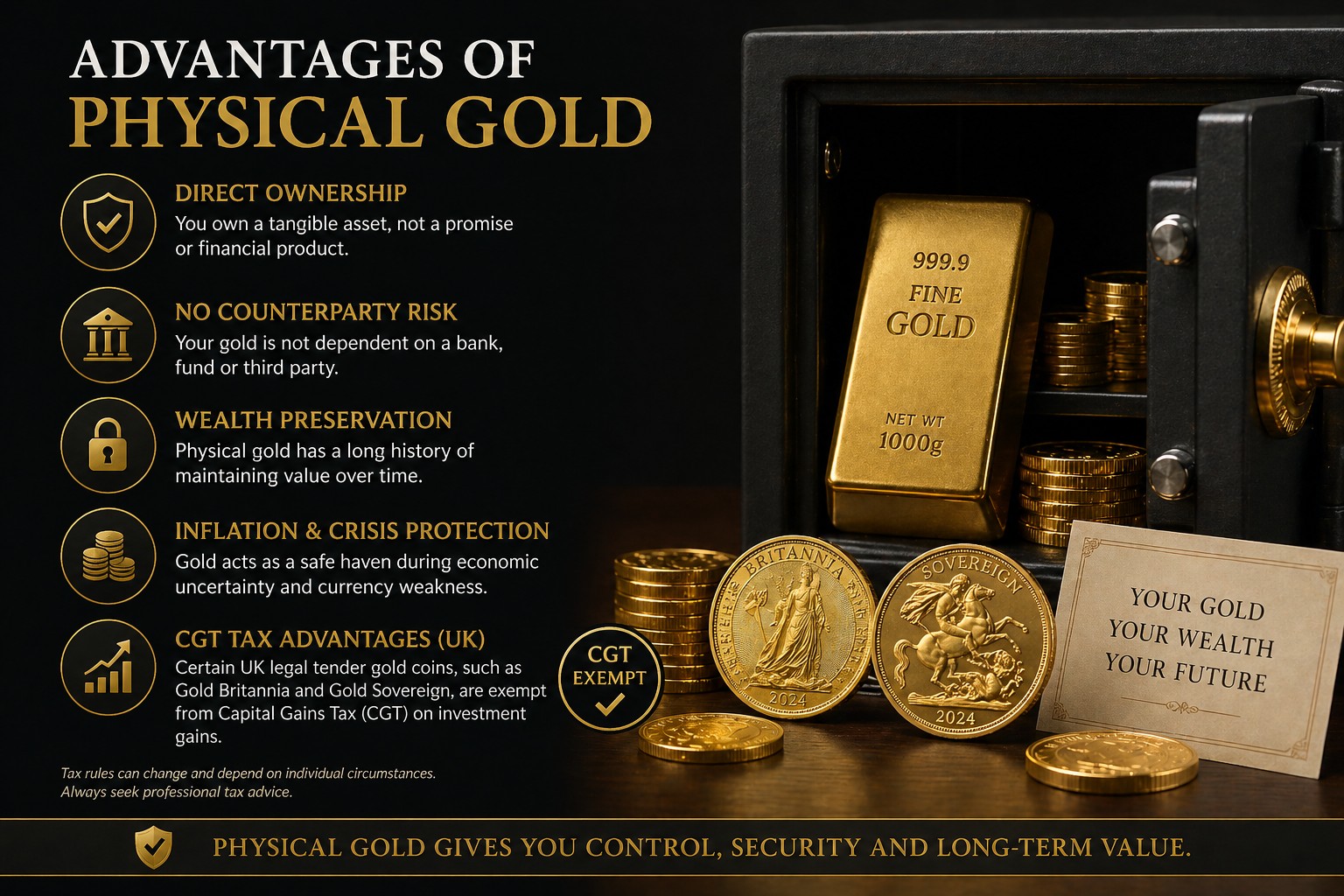
Physical gold appeals to investors who want direct ownership of a tangible asset. When you buy investment-grade bullion (whether coins or bars), you own real gold rather than a promise, contract or fund unit. It holds an intrinsic value, and as such, unlike paper gold, it’s value can never fall to zero.
Many long-term investors prefer physical gold because it is outside the financial system in a way paper products are not. It can be stored privately, passed on to future generations and does not rely on a fund manager, issuer or broker in the same way as paper gold.
The bonus benefit of owning certain types of gold coins is their qualification as legal tender. This technicality proves very valuable as it means any profits are free from Capital Gains Tax (CGT). Unlike most paper gold investments.
Learn more about the tax benefits of gold and silver here.
While paper gold offers convenience and accessibility, it also introduces additional risks that investors should carefully consider before investing.
One of the biggest disadvantages of paper gold is counterparty risk. This means your investment may depend on another institution, fund, custodian, issuer or intermediary doing what it is supposed to do.
If a provider fails, freezes redemptions, changes terms or suffers financial distress, your investment may not behave as expected. This is one of the main reasons many investors choose physical bullion instead.

Although gold itself can be volatile, paper gold products may introduce extra layers of risk. A gold mining fund, for example, can fall because of stock market weakness even if gold holds steady. A futures position can produce significant losses if the market moves quickly in the wrong direction.
With paper gold, investors usually have no say over how a fund is managed or how assets are allocated. You are relying on the manager’s strategy, the product structure and the provider’s operational strength.
Perhaps the simplest drawback is this: paper gold is not gold in your hand. If your reason for buying gold is wealth preservation, crisis protection or owning a tangible asset, paper gold may not fully achieve that aim. Remember, gold becomes most relevant during times of crisis, the very time when paper assets present the biggest liquidity risks.
Direct ownership of physical precious metals is the only way to ensure a solid hedge during times of crisis management.
Use our automated portfolio builder to get suggestions based on various investment objectives, including tax efficiency.
In short, no. If safety and low risk are high on your list of priorities, then physical gold wins hands down.
Paper gold may feel convenient because it is easy to buy, easy to sell and does not need home storage. But from an ownership perspective, physical gold removes many of the third-party risks that come with financial products.
Physical gold does not depend on the performance of a mining company, the structure of a fund or the promises of a counterparty. If it is genuine bullion that you own outright, it remains a tangible asset in your possession or in secure storage under your control.
For many investors, that is the core reason to own gold in the first place.

In the UK, investment gold is exempt from VAT, and HMRC publishes guidance on which gold coins qualify as investment gold for VAT purposes.
HMRC also states that coins which are legal tender are treated as currency, which is why certain UK legal tender bullion coins are commonly viewed as having Capital Gains Tax advantages compared with many other forms of investment.
By contrast, paper gold products do not generally offer the same straightforward ownership and tax characteristics as qualifying physical investment gold. Because tax treatment depends on the product and the investor’s personal circumstances, investors should always take up-to-date tax advice before investing.
Paper gold may suit investors who:
Physical gold may be more suitable for investors who:

Paper gold can be a practical way to gain exposure to the gold market, especially for investors focused on convenience, liquidity or short-term trading opportunities. But it is not the same as owning physical bullion.
If your main goal is to hold an asset with no direct counterparty risk, something tangible that you can store and own outright, physical gold bars and coins remain the clearer option.
For those who like the thought of a long-term fund such as a pension, but also value the ownership of real gold bullion, then a Self-Invested Personal Pension (SIPP) could be a great choice. Certain SIPPs permit you to add gold bullion bars, which is administered within a convenient pension under the same roof as any paper assets your hold within the pension.
The right choice depends on what you want gold to do in your portfolio. If you want market exposure, paper gold may be worth considering. If you want real ownership and tax benefits, physical gold is usually the more direct route.
Interested in owning real gold instead? Explore our range of investment gold bars and coins, or speak to our team for guidance on buying physical gold in the UK 020 7060 9992.


Paper gold refers to financial products that give you exposure to the gold price without owning physical gold. This includes ETFs, gold funds, mining shares, futures and certificates.
Sometimes. Some ETFs are backed by physical gold, but many paper gold products rely on contracts, derivatives or company performance rather than direct bullion ownership.
Paper gold can be relatively safe when held through regulated platforms, but it carries risks such as market volatility and counterparty risk. Your investment depends on third parties, unlike physical gold.
Counterparty risk is the possibility that a financial institution involved in your investment, such as a fund provider or broker, fails to meet its obligations, potentially affecting your returns.
Paper gold is a financial asset linked to the gold price, while physical gold is a tangible asset you own outright, such as bars or coins. Physical gold does not rely on third parties in the same way.
It depends on your goals. Paper gold may suit short-term trading and convenience, while physical gold is often preferred for long-term wealth preservation and direct ownership.
In most cases, no. Many paper gold investments settle in cash rather than allowing you to take delivery of physical gold, although some specialised products may offer this option.
Paper gold often has lower upfront costs because there are no storage or insurance fees. However, ongoing management fees or trading costs may apply.
Investment-grade gold is VAT-free in the UK. In addition, certain UK legal tender gold coins, such as Britannias and Sovereigns, are typically exempt from Capital Gains Tax (CGT).
Investors often choose physical gold for its tangible nature, lack of counterparty risk, long-term value preservation and potential tax advantages in the UK.
Yes, some paper gold products such as ETFs and funds can be held within ISAs or SIPPs, depending on the provider and product eligibility.
Not always. While some ETFs closely track the gold price, other paper gold investments, such as mining shares or funds, may perform differently due to additional factors like company performance or market conditions.

Share this post on:


Latest Posts:
Live Gold Spot Price in Sterling. Gold is one of the densest of all metals. It is a good conductor of heat and electricity. It is also soft and the most malleable and ductile of the elements; an ounce (31.1 grams; gold is weighed in troy ounces) can be beaten out to 187 square feet (about 17 square metres) in extremely thin sheets called gold leaf.
Live Silver Spot Price in Sterling. Silver (Ag), chemical element, a white lustrous metal valued for its decorative beauty and electrical conductivity. Silver is located in Group 11 (Ib) and Period 5 of the periodic table, between copper (Period 4) and gold (Period 6), and its physical and chemical properties are intermediate between those two metals.