Is the World Cup Real Gold? Weight, Value & Gold Content Explained
05/06/2026Daniel Fisher

Accumulate gold coins on a regular basis for home delivery or storage.
Let our experts hand-pick a gold investment portfolio for you.
Free & fully insured UK Delivery. Learn more

Secure & flexible payments. Learn more

Buyback Guarantee Learn more

A cost-effective way to buy silver bullion with off-shore storage
Let our experts hand-pick a silver investment portfolio for you.
Free & fully insured UK Delivery. Learn more
Secure & flexible payments. Learn more
Buyback Guarantee Learn more
Free & fully insured UK Delivery. Learn more
Secure & flexible payments. Learn more
Buyback Guarantee Learn more


Accumulate gold coins on a regular basis for home delivery or storage.
Let our experts hand-pick a gold investment portfolio for you.
A cost-effective way to buy silver bullion with off-shore storage
Let our experts hand-pick a silver investment portfolio for you.
Free & fully insured UK Delivery. Learn more
Secure & flexible payments. Learn more
Buyback Guarantee Learn more
Free & fully insured UK Delivery. Learn more
Secure & flexible payments. Learn more
Buyback Guarantee Learn more
When football’s greatest players lift the FIFA World Cup trophy above their heads, millions of viewers around the globe watch one of sport’s most iconic moments. But one question is asked every tournament:
The answer is yes, but not quite in the way many people think.
While the FIFA World Cup Trophy contains almost 5 kilograms of genuine gold, it is not a solid block of gold. If it were, it would be far too heavy for players to lift and celebrate with.
So how much gold is really in the World Cup, what is it worth, and how does it compare to other famous sporting trophies?
Let’s take a closer look.
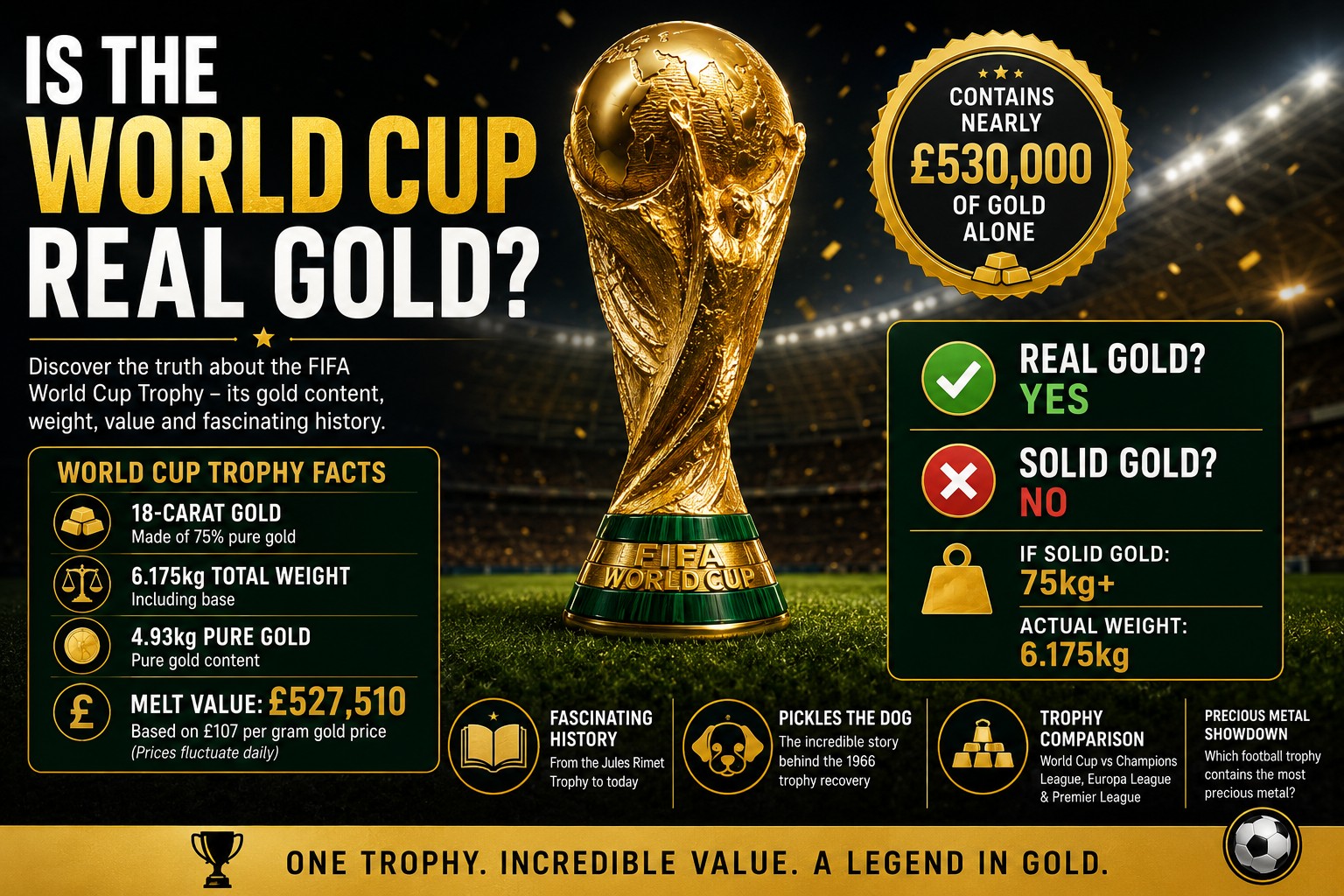
Yes. The current FIFA World Cup Trophy is made from 18-carat gold, equivalent to 75% pure gold.
The trophy was introduced in 1974 after the retirement of the original Jules Rimet Trophy and was designed by Italian sculptor Silvio Gazzaniga. It depicts two human figures holding up the Earth and has become one of the most recognisable sporting trophies in the world.
Unlike many sporting trophies that are silver-plated or gold-plated, the World Cup trophy genuinely contains thousands of grams of precious metal.
However, it is not solid gold.
No.
Although FIFA has historically referred to the trophy as a gold trophy, experts agree that it is largely hollow.
The reason is simple: gold is extremely dense.
The World Cup trophy stands 36.8cm tall and weighs 6.175kg. If the trophy were completely solid and made entirely from 18-carat gold, it would weigh roughly 70–80kg.
That would make it heavier than many professional footballers and virtually impossible to lift above your head in celebration.
Scientists and materials experts have therefore concluded that the trophy must be hollow internally while still being constructed from genuine 18-carat gold.
Free ultimate guide for keen precious metals investor
The FIFA World Cup Trophy weighs approximately:
This means the trophy contains around:
4,930 grams of pure gold
To put that into perspective, that’s equivalent to:
For a sporting trophy, that’s an extraordinary amount of precious metal.

There are two ways to value the FIFA World Cup Trophy.
Based purely on its precious metal content, the World Cup Trophy is worth a substantial sum.
The trophy contains approximately 4,930 grams of pure gold. Using a gold price of £107 per gram, the intrinsic gold value works out at:
4,930g × £107 = £527,510
This means the World Cup Trophy contains over half a million pounds worth of gold alone.
Of course, the actual melt value fluctuates daily as gold prices rise and fall. During periods of record gold prices, the trophy’s precious metal value could be considerably higher.
Follow the live and historical gold prices with our interactive Gold Price Chart.
However, valuing the World Cup Trophy solely on its gold content misses the bigger picture.
As arguably the most recognisable trophy in world sport, its significance extends far beyond the precious metal it contains. The trophy represents football’s greatest achievement and has been lifted by legends such as Pelé, Diego Maradona, Zinedine Zidane and Lionel Messi.
For this reason, experts estimate that the trophy’s true value is many millions of pounds. In reality, it is effectively priceless, as it cannot legally be sold and would be impossible to replace.
Surprisingly, no.
The winning nation is allowed to celebrate with the original trophy immediately after the final, but FIFA retains ownership.
The genuine trophy is then returned to FIFA and displayed at the FIFA World Football Museum in Zurich.
The winning team receives an official gold-plated replica known as the World Cup Winners’ Trophy.
This policy was introduced after the original Jules Rimet Trophy was permanently awarded to Brazil in 1970 and later stolen.
Before 1974, teams competed for the Jules Rimet Trophy.
Unlike today’s trophy, it was made from:
The trophy became famous for disappearing twice.
While on display in London before the 1966 World Cup, the trophy was stolen.
A dog named Pickles famously discovered it wrapped in newspaper beneath a parked car in South London.
After Brazil permanently retained the trophy, it was displayed at the Brazilian Football Confederation headquarters in Rio de Janeiro.
In 1983, thieves stole it again.
This time it was never recovered and is widely believed to have been melted down.

Many fans assume the UEFA Champions League trophy is more valuable because of its prestige.
In reality, the World Cup trophy is worth dramatically more due to its gold content.
*Approximate values based on precious metal content only.
The World Cup sits in a league of its own.

There are several reasons:
Pure gold is extremely dense. A solid gold trophy of this size would be incredibly heavy and impractical.
Pure 24-carat gold is relatively soft and susceptible to dents and scratches.
Using 18-carat gold provides greater strength while maintaining the trophy’s luxurious appearance. Read more about the properties of gold as a metal.
A solid gold World Cup could contain over 70kg of gold, making it worth several million pounds in metal value alone.
The security and insurance requirements would be immense.
So, is the World Cup real gold?
Absolutely.
The FIFA World Cup Trophy is crafted from genuine 18-carat gold and contains almost 5kg of pure gold. However, it is not a solid gold trophy. Experts believe it is hollow, which keeps the weight manageable while still making it one of the most valuable and recognisable sporting trophies ever created.
Its precious metal content alone is worth hundreds of thousands of pounds, but its true value lies in what it represents: football’s ultimate prize and a symbol of sporting excellence recognised across every corner of the globe.

Share this post on:


Latest Posts:
Live Gold Spot Price in Sterling. Gold is one of the densest of all metals. It is a good conductor of heat and electricity. It is also soft and the most malleable and ductile of the elements; an ounce (31.1 grams; gold is weighed in troy ounces) can be beaten out to 187 square feet (about 17 square metres) in extremely thin sheets called gold leaf.
Live Silver Spot Price in Sterling. Silver (Ag), chemical element, a white lustrous metal valued for its decorative beauty and electrical conductivity. Silver is located in Group 11 (Ib) and Period 5 of the periodic table, between copper (Period 4) and gold (Period 6), and its physical and chemical properties are intermediate between those two metals.