Silver Price History and Performance
09/08/2026Daniel Fisher

Accumulate gold coins on a regular basis for home delivery or storage.
Let our experts hand-pick a gold investment portfolio for you.
Free & fully insured UK Delivery. Learn more

Secure & flexible payments. Learn more

Buyback Guarantee Learn more

A cost-effective way to buy silver bullion with off-shore storage
Let our experts hand-pick a silver investment portfolio for you.
Free & fully insured UK Delivery. Learn more
Secure & flexible payments. Learn more
Buyback Guarantee Learn more
Free & fully insured UK Delivery. Learn more
Secure & flexible payments. Learn more
Buyback Guarantee Learn more


Accumulate gold coins on a regular basis for home delivery or storage.
Let our experts hand-pick a gold investment portfolio for you.
A cost-effective way to buy silver bullion with off-shore storage
Let our experts hand-pick a silver investment portfolio for you.
Free & fully insured UK Delivery. Learn more
Secure & flexible payments. Learn more
Buyback Guarantee Learn more
Free & fully insured UK Delivery. Learn more
Secure & flexible payments. Learn more
Buyback Guarantee Learn more
Silver has been valued for thousands of years, but its modern role extends well beyond its traditional status as a precious metal. Today, silver is both an investment asset and an important industrial material, with demand coming from sectors including electronics, automotive manufacturing, power infrastructure and technology.
This combination makes silver unusual. Its price can respond to many of the same economic factors that influence gold, while also being affected by changes in industrial demand and global supply.
For investors considering buying silver, understanding how the silver price has behaved historically – and what drives it – can provide useful context. However, past performance does not guarantee future returns.
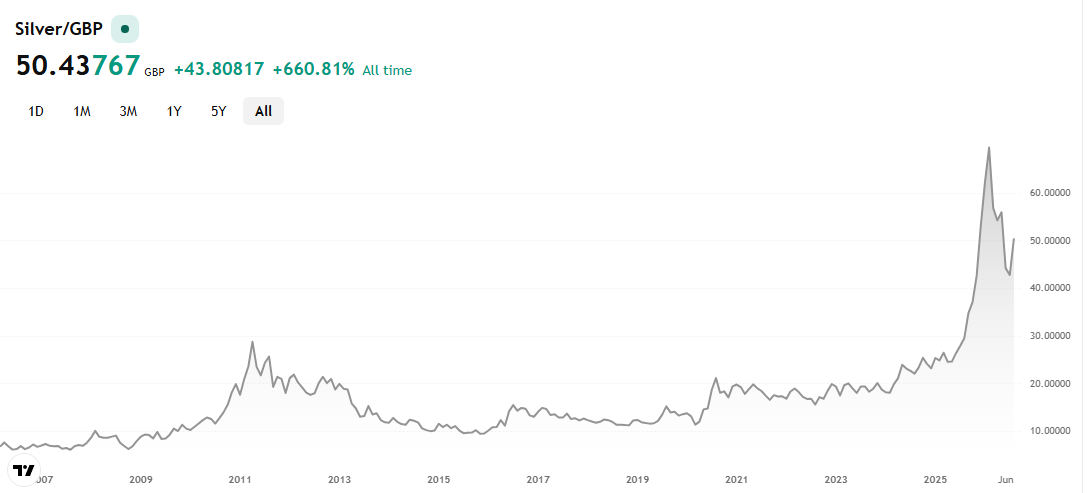
Silver price in GBP per ounce, 2007–2026. The chart demonstrates the significant periods of growth and correction experienced by silver over the past two decades.
The silver price changes continuously as the metal is traded around the world.
One of the principal global benchmarks is the LBMA Silver Price, which is set in London once each business day at 12 noon through an independently administered electronic auction. The benchmark is expressed in US dollars per troy ounce. (LBMA)
The price an investor actually pays for physical silver will generally differ from the underlying market price.
When buying silver coins or silver bars, the final price can include a premium reflecting factors such as refining, production, distribution and dealer costs. The type and quantity of silver purchased can also affect the premium.
Similarly, when selling silver, the amount offered by a dealer may be below the prevailing retail purchase price. This difference between buying and selling prices is an important consideration for physical silver investors.
You can follow the current price in pounds, dollars and euros using our live silver price chart.
There is no single factor responsible for movements in the silver price. Instead, several economic and market forces can interact.
This combination of investment and industrial demand is one of the important differences between silver and gold.
Silver has experienced some dramatic price movements over the past two decades.
Rather than following a consistent upward trajectory, the market has gone through substantial rallies and corrections.

Annual percentage change in the silver price in pounds sterling, showing the significant fluctuations in performance from year to year. 2026 figures are year-to-date.
The annual figures illustrate how variable silver’s performance can be. In sterling terms, silver fell by 37.0% in 2013 but rose by 40.1% in 2016 and 43.2% in 2020. The most significant recent movement came in 2025, when the silver price increased by 150.9% in GBP terms. In 2026, the market has subsequently experienced another period of substantial volatility.
Silver’s industrial role has become increasingly significant.
According to the Silver Institute’s World Silver Survey 2026, total global silver demand was approximately 1.13 billion ounces in 2025. Industrial demand accounted for 657.4 million ounces, despite falling by 3% from the previous year.
Silver is used across electrical and electronic applications, automotive manufacturing and power infrastructure. Longer-term demand is also expected to be supported by areas including artificial intelligence infrastructure, data centres and electric vehicles.
At the same time, supply is constrained by mine production and recycling. In 2025, global silver demand exceeded supply for the fifth consecutive year.
For 2026, the Silver Institute expects the market to remain in deficit for a sixth consecutive year, although both demand patterns and prices can change considerably.

Global silver demand by sector in 2025. Industrial uses accounted for the majority of demand, followed by physical investment in coins and bars and jewellery. Source: Silver Institute, World Silver Survey 2026.
Silver and gold are both precious metals, but their markets have different characteristics.
Silver has a smaller market and a significant industrial component to its demand. This can make its price particularly sensitive to changes in both investor sentiment and expectations for the global economy.
Silver’s lower price per ounce also makes physical silver accessible to investors who may not want to commit the larger sums generally required to purchase comparable quantities of physical gold.
However, the lower unit price shouldn’t be confused with lower investment risk. Silver can experience substantial short-term price movements, as its recent performance demonstrates.
Investors considering the two metals can read our guide to the gold-silver ratio for another way of comparing their relative prices.

Investors wanting direct ownership of silver will generally choose between coins and bars.
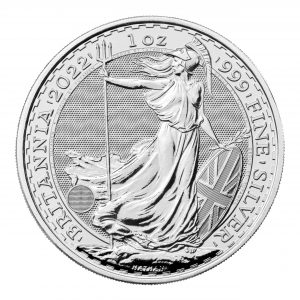
Silver coins are available in different sizes and designs and can provide greater divisibility than larger bars. This means an investor can potentially sell part of a holding without having to sell a large amount of silver at once.
There can also be a UK tax advantage to certain coins. Qualifying UK legal-tender silver coins, including Silver Britannias, are exempt from Capital Gains Tax for UK residents.
Coins can, however, carry higher premiums than larger bullion bars.
Silver bars are available in a range of sizes and can provide a cost-effective way of acquiring larger quantities of physical silver.
Larger bars will generally have lower premiums per ounce than purchasing the equivalent weight through numerous smaller coins. However, bars do not benefit from the CGT exemption applicable to qualifying UK legal-tender coins.
Tax is another important consideration when comparing silver with investment gold.
Physical silver purchased for delivery in the UK is generally subject to VAT, whereas qualifying investment gold benefits from a VAT exemption. HMRC confirms the VAT exemption applying to qualifying investment gold. (GOV.UK)
This means investors should consider the total acquisition cost rather than simply comparing the underlying gold and silver prices.
Physical Gold also offers VAT-free silver for qualifying silver held in bonded storage outside the UK.
For a fuller explanation, read our guide to the tax implications of gold and silver.
There is no single answer because the suitability of silver will depend on an individual’s objectives, investment horizon and tolerance for risk.
Physical silver offers some characteristics that investors may find attractive. It provides ownership of a tangible asset, has substantial industrial uses and can provide diversification alongside other assets, including gold.
There are also disadvantages to consider. Silver prices can be volatile, physical holdings require storage, silver does not generate income or dividends and UK-delivered silver will generally attract VAT.
Anyone considering silver should therefore look beyond predictions about where the price might move next and consider the costs and characteristics of owning the metal.
For investors who decide that physical silver suits their objectives, there are several options.
You can buy silver through Physical Gold, including:
Before purchasing, consider the premium over the underlying silver price, VAT and CGT treatment, storage arrangements and the likely cost and ease of eventually selling the investment.
The silver market has changed considerably over the past 20 years and will continue to be influenced by investment demand, industrial consumption, mine production and wider economic conditions.
Historical performance can provide useful context, but it cannot tell us with certainty where the silver price will move next.
You can monitor the latest movements using our live silver price chart or browse our range of physical silver.

Share this post on:


Latest Posts:
Live Gold Spot Price in Sterling. Gold is one of the densest of all metals. It is a good conductor of heat and electricity. It is also soft and the most malleable and ductile of the elements; an ounce (31.1 grams; gold is weighed in troy ounces) can be beaten out to 187 square feet (about 17 square metres) in extremely thin sheets called gold leaf.
Live Silver Spot Price in Sterling. Silver (Ag), chemical element, a white lustrous metal valued for its decorative beauty and electrical conductivity. Silver is located in Group 11 (Ib) and Period 5 of the periodic table, between copper (Period 4) and gold (Period 6), and its physical and chemical properties are intermediate between those two metals.