King George V Sovereign – A Complete Guide
02/09/2026Daniel Fisher

Accumulate gold coins on a regular basis for home delivery or storage.
Let our experts hand-pick a gold investment portfolio for you.
Free & fully insured UK Delivery. Learn more

Secure & flexible payments. Learn more

Buyback Guarantee Learn more

A cost-effective way to buy silver bullion with off-shore storage
Let our experts hand-pick a silver investment portfolio for you.
Free & fully insured UK Delivery. Learn more
Secure & flexible payments. Learn more
Buyback Guarantee Learn more
Free & fully insured UK Delivery. Learn more
Secure & flexible payments. Learn more
Buyback Guarantee Learn more


Accumulate gold coins on a regular basis for home delivery or storage.
Let our experts hand-pick a gold investment portfolio for you.
A cost-effective way to buy silver bullion with off-shore storage
Let our experts hand-pick a silver investment portfolio for you.
Free & fully insured UK Delivery. Learn more
Secure & flexible payments. Learn more
Buyback Guarantee Learn more
Free & fully insured UK Delivery. Learn more
Secure & flexible payments. Learn more
Buyback Guarantee Learn more
King George V Sovereigns are among the most recognisable historic British gold coins. First issued in 1911, they were struck during a fascinating period of British history that included the First World War and the final years of widespread Sovereign circulation.
Today, George V Sovereigns appeal to both gold investors and coin collectors. Each full Sovereign contains 0.2354 troy ounces of pure gold and, like other UK Sovereigns, is made from 22-carat gold.
As British legal tender, Sovereigns also have an important advantage for UK investors – any gains made when selling them are exempt from Capital Gains Tax (CGT).
If you are looking to invest, you can browse and buy King George V Sovereigns or explore our complete range of Gold Sovereign coins.
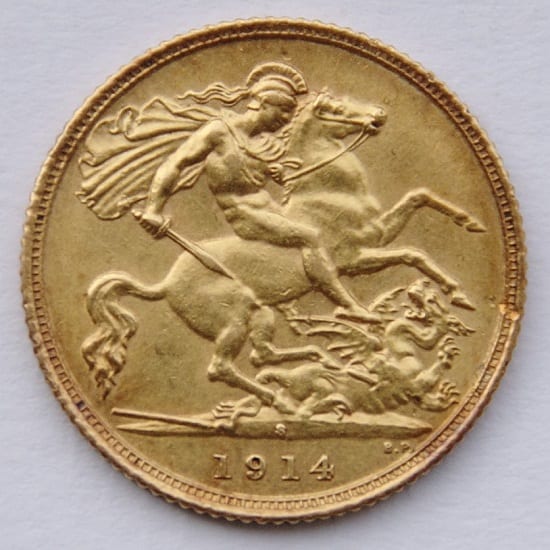
King George V reigned from 1910 until his death in 1936. The first Sovereigns bearing his portrait were issued in 1911 and were produced during a period of significant political, economic and social change.
The Sovereign was still an important circulating gold coin at the beginning of George V’s reign. However, the First World War fundamentally changed Britain’s monetary system. Gold coins largely disappeared from everyday circulation as the public was encouraged to exchange gold for banknotes and the government sought to conserve its gold reserves.
This gives George V Sovereigns particular historical significance. They represent the final generation of Sovereigns to have been widely used as circulating currency in Britain before the role of the Sovereign evolved primarily into that of a bullion and collectable gold coin.
Production was not confined to London. George V Sovereigns were struck at Royal Mint branches across the British Empire, creating numerous combinations of dates and mint marks for collectors to seek out.
George V Sovereigns were produced at several mints around the world, reflecting the international reach of the British Empire and the importance of gold Sovereigns in international trade.
Coins were struck in:
The mint can usually be identified by the mint mark on the reverse of the coin, positioned above the date beneath St George and the dragon.
London Sovereigns have no mint mark. Sovereigns produced elsewhere can carry the following marks:
Different dates and mints had significantly different production levels. This means that while many George V Sovereigns trade primarily according to their gold content and condition, particular combinations of date and mint can have additional numismatic value.
Bombay Sovereigns are particularly interesting because Sovereign production in India was short-lived. The Bombay branch produced Sovereigns in 1918 as Britain sought to increase gold coin production during the First World War.
Pretoria subsequently became another major source of Sovereign production, with George V Sovereigns struck there between 1923 and 1932.
George V Sovereigns are made from 22-carat gold, equivalent to 91.67% gold purity. A full Sovereign weighs approximately 7.98g and contains approximately 7.32g, or 0.2354 troy ounces, of pure gold.
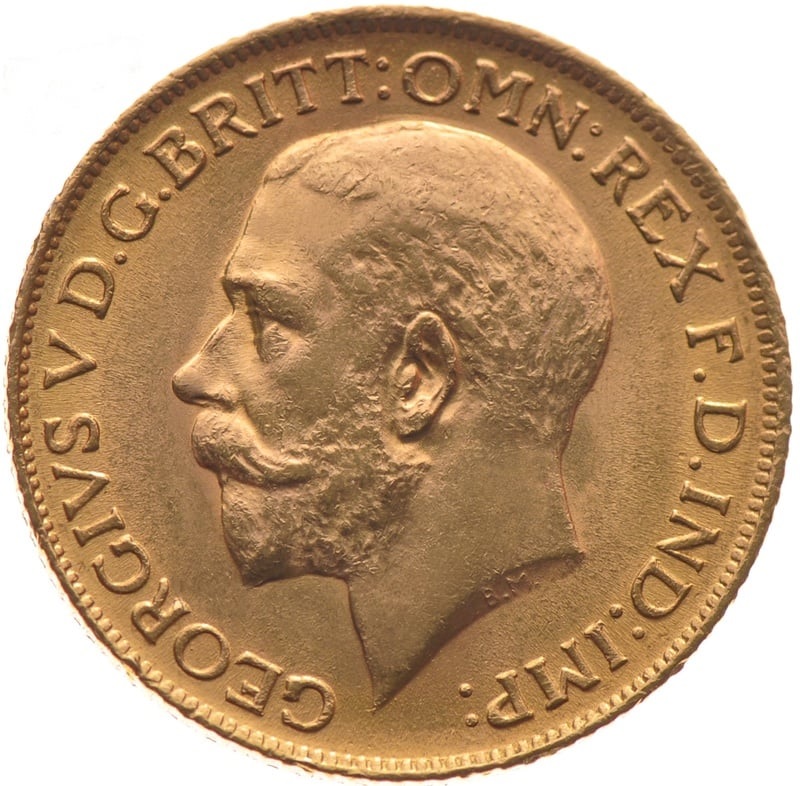
The obverse features a portrait of King George V designed by Australian-born sculptor Sir Edgar Bertram Mackennal. His initials, BM, can be seen on the truncation of the King’s neck.
George V faces left. This follows the longstanding convention that successive British monarchs face in alternating directions on their coinage.
The inscription surrounding the portrait reads:
GEORGIVS V D.G.BRITT:OMN F.D.IND
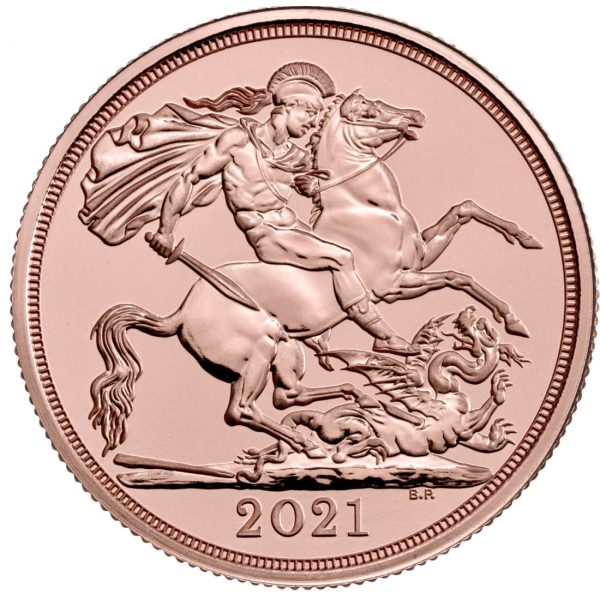
The reverse features Benedetto Pistrucci’s famous depiction of St George slaying the dragon – a design closely associated with the Sovereign and still used on modern versions of the coin.
George V Sovereigns have a milled edge. Historically, this also made it easier to identify coins whose edges had been clipped or tampered with to remove small amounts of gold.
There were subtle changes to the George V portrait during the production period. A modified, slightly smaller portrait was introduced on later issues, making the precise date and mint another point of interest for collectors.
You can learn more about the wider coin series in our guide to Gold Sovereigns.
Get free insider tips to ensure you achieve the best investment returns
One of the best-known rarities from George V’s reign is the 1917 London Sovereign.
Although Sovereigns were struck in London in 1917, many were subsequently melted, contributing to the scarcity of surviving examples. Genuine 1917 London Sovereigns can therefore command a substantial numismatic premium depending on their condition and provenance.
However, a 1917 date alone does not necessarily mean that a Sovereign is exceptionally rare. George V Sovereigns were also produced at overseas mints, so the mint and date need to be considered together.
This is an important distinction for anyone assessing an older Sovereign. Two coins bearing the same monarch and date can have very different values depending on their mint, rarity and condition.
For a broader explanation of the factors affecting Sovereign prices, read our guide to how much Gold Sovereign coins are worth.
Every genuine full George V Sovereign contains the same underlying quantity of gold, giving it an intrinsic bullion value linked to the prevailing gold price.
Some examples can be worth more than their underlying gold content because of their numismatic appeal.
Factors that can influence the value of a George V Sovereign include:
Common-date circulated Sovereigns may trade relatively close to their underlying bullion value, while rarer dates, mint marks or high-grade examples can attract considerably higher premiums.
This distinction is important when deciding whether you are buying primarily as a gold investor or as a collector.
Our portfolio Creator shows you the best precious metal investment for your budget.
Yes. Gold Sovereigns are British legal tender and are therefore exempt from Capital Gains Tax for UK individuals.
This applies to George V Sovereigns as well as modern Sovereigns and can make them attractive to UK investors who want to own physical gold while retaining the ability to realise gains without creating a CGT liability.
Investment gold is also exempt from VAT in the UK, meaning qualifying Gold Sovereigns can be bought without VAT.
You can find a more detailed explanation in our guide to the tax implications of gold and silver for UK investors.
George V Sovereigns offer collectors considerably more variety than a standard modern bullion coin.
Coins were produced across several mints and over numerous years, allowing collectors to build sets based on dates, individual mints or both.
Some collectors may focus on obtaining an example from each mint, while others seek particular years or higher-grade coins.
Condition is especially important where a Sovereign has numismatic value. Because many George V Sovereigns circulated as currency, signs of wear are common. Better-preserved examples can therefore attract higher premiums, particularly when combined with a scarce date or mint.
For investors who are primarily interested in gold rather than rarity, paying a significant collector’s premium may not always be necessary. Common-date Sovereigns can provide exposure to physical gold while retaining the recognisability and tax advantages associated with British Sovereigns.
Before buying a George V Sovereign, consider why you are purchasing the coin.
If your primary objective is investing in physical gold, the premium you pay above the coin’s underlying gold value is an important consideration. A common-date Sovereign in good condition may be more appropriate than paying a substantial premium for a rare collector’s coin.
If you are buying for numismatic reasons, the date, mint mark, condition and rarity become much more important.
You should consider:
If your focus is primarily investment, our guide to Gold Sovereign coin premiums explains how premiums can affect the overall cost of buying physical gold.
George V Sovereigns combine several characteristics that can appeal to physical gold investors.
Each full Sovereign contains 0.2354 troy ounces of pure gold. This gives the coin an underlying bullion value that moves broadly in line with the gold price.
Because Sovereigns are British legal tender, gains made by UK individuals when selling them are exempt from CGT.
Qualifying investment gold is exempt from VAT in the UK.
The Sovereign is one of Britain’s best-known gold coins and has an established international market among bullion dealers and collectors.
Unlike newly minted bullion coins, George V Sovereigns have a direct connection with an important period of British and international history. This can provide additional collector demand for particular coins.
Scarcer dates, mint marks and high-grade examples may attract a premium above their underlying bullion value.
However, rarity should not be assumed simply because a coin is old. Many George V Sovereigns were produced in substantial numbers, so investors should consider the individual coin rather than age alone.
For investors choosing between a George V Sovereign and a newly minted Sovereign, the fundamental gold content is the same.
Both are 22-carat gold and contain approximately 0.2354 troy ounces of pure gold.
The main difference is the potential numismatic element. A modern bullion Sovereign will generally be valued primarily according to its gold content and market premium, whereas certain George V coins may command an additional premium because of their date, mint, condition or rarity.
For investors whose priority is simply acquiring physical gold at a competitive price, our best value Gold Sovereigns can provide a straightforward way to compare available options.
Physical Gold stocks a range of pre-owned British Sovereigns, including King George V coins when available.
Our pre-owned Sovereigns are checked for authenticity and condition before being offered for sale, and our team can help explain the differences between bullion-focused Sovereigns and coins carrying an additional numismatic premium.
Browse our current King George V Gold Sovereigns or view the complete range of Gold Sovereign coins.

Live Gold Spot Price in Sterling. Gold is one of the densest of all metals. It is a good conductor of heat and electricity. It is also soft and the most malleable and ductile of the elements; an ounce (31.1 grams; gold is weighed in troy ounces) can be beaten out to 187 square feet (about 17 square metres) in extremely thin sheets called gold leaf.
Live Silver Spot Price in Sterling. Silver (Ag), chemical element, a white lustrous metal valued for its decorative beauty and electrical conductivity. Silver is located in Group 11 (Ib) and Period 5 of the periodic table, between copper (Period 4) and gold (Period 6), and its physical and chemical properties are intermediate between those two metals.


