The Indian government has been trying to reduce its citizens demand for imported gold through a number of means over the last few years. This is part of a wider crackdown on the currency used in the black market, that included the withdrawal and replacement of its two largest-denomination banknotes in early November. The strategy will likely have some unintended consequences if we take our cues from the events of 1910.
Indians famous love for gold has created serious and ongoing economic issues for the nation. In 2011, Australian investment bank Macquarie estimated that 78% of Indias household savings were held in gold.
In effect, this means that India has a dual currency system where people choose to save mostly in gold rather than rupees. This is unlike any other major economy and begs the question: how do you wean a population off a precious metal?
Bling and buy sale
Building up savings in gold rather than deposits in a bank creates a permanent drag on Indias growth. This happens because the savings do not increase the available funds for lending within the banking system. One reason it is so difficult to put this gold to work as investment capital is that 79% of it is bought as jewellery, rather than bars or coins.
India is the worlds largest consumer of gold jewellery at nearly 700 tonnes in 2015 according to the GFMS Gold Survey 2016. However, it mines less than two tonnes of gold a year. This means India must import gold worth US$25 billion each year, pushing up its current account deficit and pulling down the value of the rupee.
In 2015, prime minister Narendra Modis government introduced a Sovereign Gold Bond scheme which allowed gold holders to swap their gold for an interest-bearing bond. At the end of the bonds life, investors would effectively be returned the same amount of gold. This move reduced the minimum amount of gold necessary to participate in such a scheme to two grams. As of November 2016, 14 tonnes of gold had been subscribed to the two gold bond issues, with another five tonnes collected through the older gold monetisation scheme (which has a larger minimum deposit of 30 grams).
However, relative to Indias estimated privately held gold stock of 20,000 tonnes, these deposits represent tiny amounts and it still doesnt seem like a solution.
Unintended consequences
An alternative would be to permanently reduce gold imports. To that end, in 2013, the government started to increase import taxes on gold imports to 6%; this now stands at 10%. However, falling gold prices during that period meant that there was still a 12% increase in gold imports in 2015 as consumers snapped up what they saw as bargain prices.
And here is where we go back more than 100 years to see how this all worked out last time. You see, India has battled precious metals imports for quite some time. In 1910 the government of India increased the import tariffs on silver from 5% to 11%. A market report in 1912, by Pixley & Abell, a gold wholesaler, pointed to a 28% fall in silver demand in the Indian bazaars in the three years following the increase. They attributed this to not just a fall in demand for silver due to tax increases, but also a substitution of gold for silver in peoples savings as gold became more attractive on a relative basis.
Between 1910 and 1930 net imports of silver in India fell from 98m ounces to 31m, according to British Geological Survey reports. After this time India gradually became the worlds largest gold consumer, a position it finally lost to China in 2015.
And it seems a return to silver as a major investment for consumers in India may be on the cards. Following the recent import tax hikes for gold, 2015 saw Indian silver imports grow to almost 8,000 tonnes, 14% up on the previous 2014 record. At the same time, demand for gold jewellery, which accounts for 75% of all Indian gold demand, is down 30% for the 12 months to the end of September 2016, according to the World Gold Council. This points to a possible shift back to silver as a more prominent investment in India.
Gold makes up the vast majority of Indian jewellery sales. But the graph below shows the rapid growth in silver jewellery demand in India, which is up over 600% in ten years, relative to the marginal growth of only 25% in gold jewellery demand.
Of course, silver is not the only precious metal investment option available. If investors want a more compact form of wealth, then platinum, worth 56 times more per ounce, might suit. But a swap to silver in India, as was the norm pre-World War I, seems more likely and could have a major effect on prices. For a sense of scale, the Indian gold jewellery market in 2015 was worth US$25 billion, while the total world silver jewellery market was worth only US$3.5 billion.
Even a small substitution from gold to silver would result in a massive increase in the price of silver. A 10% reallocation from gold jewellery investment to silver in India would nearly double world silver jewellery demand. Mines and other sources would not be able to fill the gap immediately; prices would rise, further fuelling demand and creating a new, shiny headache for those trying to marshal Indias unusual economy.
A breakthrough was made this week at the World Islamic Banking Conference in Bahrain to ensure gold is an accepted product under strict Sharia finance rules. This news is a major boost to the gold market after recent rumours circulating that India are considering restricting gold imports. While many gold bugs feared the news coming out of India, gold has once again proven it’s endurance as a huge new market opens its doors.
What’s been agreed?
After lengthy negotiations, the World Gold Council (WGC) and the Accounting and Auditing Organisation for Islamic Financial Institutions (AAOIFI) have agreed guidelines for gold and silver to be actively traded by Islamic financial institutions. Negotiations have taken more than a year to finally lay out uniform Sharia finance guidelines for gold. The previous fragmented and ambiguous treatment of gold was a major hindrance to its development within the Islamic world. The WGC anticipate the new ruling will ensure gold is a more widely accepted investment.
Parameters have been laid out to satisfy strict Islamic restrictions on speculation. Any gold trades must be fully backed with physical gold and settled the same day to qualify as economic activity rather than a speculative investment. Trading gold for future value is not permitted. The rules allow purchasing gold through agents which will permit buying gold backed Exchange-Traded funds (ETFs), Gold Certificates, mining shares and online retail platforms. Full acceptance of gold within Sharia finance is overdue, joining the previously approved asset classes of property, equities, Islamic bonds (Sukuk) and insurance products (Takaful).
Boost to gold demand
Muslims total 1.6 billion globally, representing 23% of the world population,
and Islam is the fastest growing major religion. Sharia acts as the legal system to the entire Islamic world. While desire for gold has existed within the Muslim community, fear of infringing Islamic law has held back demand. The clarity of the new directives is anticipated to significantly boost gold demand and therefore the gold price.
Demand for physical gold is expected to be the biggest beneficiary of the new ruling due to the strict parameters placed on alternative gold backed investments like mining shares.
The huge historical Indian demand for gold demonstrates the potential the Islamic world has for precious metals. If only 1% of Islamic financial institution funds were assigned to gold, that would equate to roughly 500-1000 tonnes per year. With an estimated current surplus of only 172 tonnes, upward pressure would be placed on the gold price.
The possible significance of the $2 trillion Islamic markets for gold demand is only matched with the impact that gold may have on Islamic finance, with the gold market worth an estimated $2.4 trillion.
Further impact
The new directive will increase the diversity of gold investment types available within Sharia law. It will also introduce gold to those Muslims who have always been reticent of breaching laws.
While the guidelines are likely to support the gold price, the sheer size and influence of the Islamic community may also have other influence. Speculation has dominated the gold market due to the huge size of the Chicago Mercantile Exchange (COMEX) and London markets. The Sharia gold standard may well redress that balance. Certainly, Islamic finance will have a greater say in the setting of the gold price over the coming years.
Conclusion
While it’s always tempting to focus on gold’s day-to-day volatility, it acts as an effective hedge against volatile markets and inflation over the long term. With 1.6 billion Muslims set to benefit from the greatest access to the gold market in modern history, gold once again demonstrates its universal appeal and longevity.
Thinking of investing in gold or silver? Download our free cheat sheet ‘7 crucial considerations before you buy gold or silver’ by clicking the banner below
So was it a golden Autumn Statement or more a wintry outlook in terms of investments? How might investments in gold combat the chancellor’s policies?
On Wednesday 23rd November, Philip Hammond delivered his first and last Autumn Statement, having decided to restructure the timetable of financial statements in the future.
Uncertainty
The Chancellor’s speech certainly opened with positive news; the Government borrowed £4.8bn less than expected in October. The IMF had also confirmed that the UK would be the fastest-growing major developed economy in the world this year and had demonstrated its resilience against recession despite the vote to leave the EU.
Nevertheless, there is still a ‘black hole’ in the nation’s finances with estimates of the amount needed to fill it ranging from £25bn to £100bn. In total, growth would be 2.4% lower because of the uncertainty caused by Brexit and Mr Hammond admitted that the forecast carried a ‘higher degree of uncertainty’ than previously.
Uncertainty is always a driving force for the gold price. While, as with any stocks and shares, the gold price will inevitably go up and down, it has been demonstrated over time that it remains a safe haven and ‘inflation-proof’. As a tangible asset, gold is a solid investment that you can pass to the next generation without it eroding in value.
Investments in gold as a Tax Efficient Saving method
The Chancellor also announced an increase in the tax-free personal allowance to £11,500 and the higher rate threshold to £45,000. There was good news for savers with the announcement of a new bond through National Savings and Investments, with a fixed return of 2.2% for three years, limited to a maximum investment of £3,000 initially. While these are all welcome, the National Institute of Economic and Social Research (NIESR) has predicted that tax rises will almost certainly be needed to plug the gap in the deficit. All this highlights that gold remains a tax efficient way of saving with UK gold coins being VAT exempt and Capital Gains Tax free.
In terms of pensions, post-withdrawal contributions have been reduced from £10,000 to £4,000 annually to clamp down on those seeking ‘double tax relief.’ This affects over 55s who used George Osborne’s ‘pensions freedom’ to take cash from pension pots. With up to 45% income tax relief on SIPP investments in gold, pension gold is a sensible course of action to consider.
As predicted, the Chancellor stated that
investment in infrastructure would rise from its current 0.8% of GDP to between 1% and 1.2% from 2020 and confirmed an extra £1.3bn for the nation’s roads. There may not be plans to pave the streets with gold but this is certainly a much needed and welcome initiative!
Next Year
So what of the future? 2017 promises to be every bit as uncertain as 2016 has been. Brexit is on the horizon, President-Elect Trump will be sworn into office on 20th January and there will be elections in France and Germany. All these are likely to make the markets jittery. So while the Statement did not make specific reference to precious metals, maybe it’s worth considering adding gold and silver to add balance to your portfolio in these potentially volatile times and in time for next year’s Budget in March (before it moves to being merely a Spring statement!).
It may feel like gold has always been around, after all the Aztecs and the Egyptians produced a fair amount of gold supply for a very long time and it’s said that the first gold coins were minted around 550BC. However, Gold artefacts like the Bronze Age Ringlemere Cup, dated around 1600 BC, were discovered in Kent in 2001 – suggesting a thriving gold industry throughout ancient Britain.For thousands of years, gold has been globally cherished as the most precious of metals but gold is a finite resource. In fact, Warren Buffett, one of the world’s most renowned investors, estimates that the total amount of gold mined in the world so far could fit into a cube with sides of just 20m (67ft).
With an increase in demand, a downward trend in new gold discoveries and an increasing number of years for them to become operational, is there a real possibility that demand may, one day, outstrip supply?
No physical gold supply
Recently, we saw headlines of, ‘lines around the block to buy gold in London‘ and, ‘banks placing unusually large orders for physical gold’, as institutional investors were seen to be rushing to buy it again, fearing the world was on the brink of another financial crash. This was especially true in light of some central banks moving toward negative interest rates, the US dollar weakening and the lack of alternative investments.
Central bank demand, as well as Chinese investors (seeking protection from their own weakening currency), contributed towards the increased demand for gold – exacerbating the likelihood of a shortage.
One such example of this happened in Germany recently, with a very real lack of physical gold. Xetra-Gold, a bond on the Deutsche Borse commodities market, claims that every virtual gram of gold is backed by the same amount of physical gold, yet clients were recently refused the precious metal, due to ‘business policy.’
Similarly, Deutsche Bank experienced troubles with delivering even small amounts of gold to retail clients, all of which could be signals indicating that a global physical gold shortage is possible. The way to avoid such a risk is to consider physical gold versus electronic gold.
Dwindling new gold supply
Mining.com gives supporting figures for the low gold supply; looking at the past twenty years, exploration spending for gold peaked in 2012 when mining companies spent a total of US$6.05 billion. This yielded only four major gold deposits being discovered, compared to an average of ten per year leading up to 2012.
Whilst any major gold discovery could be heralded as significant, the time it takes to bring a deposit into production is increasing significantly. Such discoveries are now expected to take an average of 19.5 years from discovery to production, due to increased legalities and more socially acceptable infrastructures.
At the same time, China, Russia and India are currently buying tons of gold as it becomes increasingly attractive as an alternative to reserve currencies. According to the IMF, China bought monthly amounts of around 11 tons in January to April 2016 and Russia registered 14 tons a month, between January and June 2016. And for the trading week ending on 6th November last year, 45 tons of gold was withdrawn out of the Shanghai Gold Exchange (SGE) vaults – which is the equivalent of the total wholesale gold demand in China.
A US Geological Survey estimated there to be around 52,000 tonnes of mineable gold still in the ground, but when you factor in the lack of recent discoveries and the increased production time; for the individual, private buyer of gold, the above situation is largely good news. For many, the potential lack of supply may suggest similarities between gold investment and buying property.
In summary, the natural mechanics of supply and demand mean only one thing when you consider the points mentioned above. Physical gold maintains its value over the long term and this tangible commodity would, therefore, seem to be a valuable, long-term investment. Especially when it appears demand may outstrip supply in the coming years.
“Buying gold – 5 reasons to invest” a YouTube video from Physical Gold Ltd.
Whilst it may be tempting to amuse ourselves in the UK by watching the heated TV-debates between Hillary Clinton and Donald Trump, should we really be so relaxed? Surely this US election fever over the pond won’t affect our savings and investments. We take a look.
How can the US election impact me and my wealth?
In today’s hugely globalised economy, it’s inevitable that a major event somewhere in the world will impact the rest of the global economy. When that place is the worlds largest economy, the impact can be far more severe than usual. Any volatility in US markets could have both a direct and indirect impact on your investments. Many UK funds, whether equity ISAs, pensions or managed funds, will invest heavily in US stocks. Even more worryingly, the UK companies comprising the FTSE 100, derive almost 70% of their income from overseas. A large proportion of it from the US.
Volatility and outcome
Its very common for US markets to suffer volatility in the weeks and months leading up to a US election. Markets hate uncertainty, so the closer the race, the less sure the market is of the outcome. The unpredictability of Trump, with no track record in politics and extreme views, means the markets are also unsure and scared of what a Trump victory would bring. It would be a journey into the unknown.
The fact that neither candidate is pulling ahead clearly, suggests that neither is unanimously popular. The outcome may be the best of a bad choice. Certainly, a Clinton win would likely impact markets less, as she would be more predictable. Meanwhile, a Trump victory could initially send markets south very quickly, but would then likely recover to a degree.
It’s also worth considering the individual sectors in which your money invested. For instance, Trump promises to relax legislation on fracking and emissions, likely leading to a boost for the gas and oil industries. In contrast, Clinton is focussed on supporting green energies. Both candidates are focussing on investing in infrastructure, so we may see a short to medium-term rise in building stocks.
How can you prepare for the result and protect your savings?
Clearly, the key strategy with uncertainty is to spread risk. That way, a fall in one sector, asset or geographic region will be offset by a rise in another. Its also worth keeping a close eye on the election result and the months which follow, to determine if you need to adjust your asset split.
Gold investment plays a key role in providing portfolio balance. Firstly, it tends to perform inversely to the stock markets and the US Dollar. If you purchase physical gold versus electronic gold, you also benefit from owning a tangible asset instead of relying on supposed the value of paper assets.
What are we seeing in the gold market?
After barely pausing for breath after the Brexit decision, the gold market has once again heated up over the past few weeks in preparation for the US election. As the natural safe haven asset, we’ve seen a 42% increase in enquiries in October from the previous month. Just as telling, we’ve observed a theme of investors moving large proportions of their wealth into gold. Their motivation is driven by the worry of a Trump victory and the lack of viable savings account alternatives to beat interest rates.
Conclusion
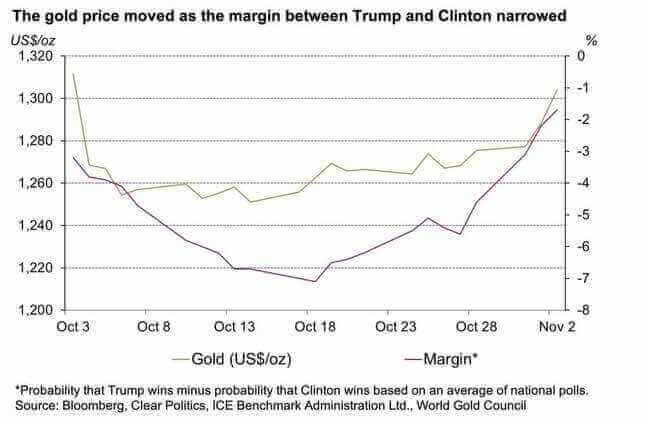
No doubt, the markets fear a Trump victory more than anything. HSBC said this week that a Trump win would add $200/oz to the gold price. Perhaps many of us have convinced ourselves of a Clinton victory. But we must learn lessons from history. The Brexit result earlier this year demonstrates how the unlikely can happen. Poor preparation for that can lead to big losses. Meanwhile, gold holders benefited to the tune of a 15% rise overnight.
The relationship between the US Dollar, the US election and the gold price is nicely illustrated with this chart by the World Gold Council. With investigations into Clinton’s past, Trump pulled ahead in some polls.
Who knows who will win on 8 November. All I know is that I’ve learnt from Brexit. After the credit crunch and global recession, voters are looking for scapegoats and change. I know that balance is the only preparation and gold is still worth investing in.
This ultimate insider’s guide will;
Reveal how to profit from gold and silver without paying any tax
Uncover the real benefits of precious metals in today’s volatile market
Share 4 investment opportunities to suit everyone’s needs
This free cheat sheet will;
Reveal the best coins and bars to maximise profit potential
Tell you how to buy (and sell) your metals at the best possible prices
Help you decide between electronic and physical gold
You’ve probably heard that Tax-Free Gold offers balance and portfolio protection,
but do you know about the other benefits of gold, such as being:
VAT-Exempt
CGT-free
Liquid and flexible
This means you can make significant savings, on any gains, given the current rate of VAT.
Video Transcript:
You’ve probably heard that gold offers balance & portfolio protection, but did you know about its other benefits?
Here at Physical Gold.com, all our gold coins are V-A-T exempt AND Capital Gains Tax free, so you won’t have to share any profit with the taxman.
And because we only sell world-renowned coins, they’re as liquid as cash – especially with our ‘Buyback Guarantee’.
We specialise in making it incredibly easy to invest in real, solid, tax-efficient gold coins. And our purchasing power means we can offer you tax-free Royal Mint coins at market leading rates…
If you want brand new coins, look no further than our ‘Bullion Coins’ category. These uncirculated coins provide the lowest-cost option for those seeking the most tax free gold for their money.
Our ‘Enhanced Performance’ coins are pre-owned, Royal Mint coins, offered at discounted prices. These have an intrinsic value – reflecting their increased scarcity and desirability. This option maximises your opportunity for increased returns when the markets rise, and offers protection if the gold price should fall.
If you like the idea of the ‘Enhanced Performance’ coins but don’t know which ones to choose, then our ‘Director’s Pick’ is a great solution. Our experts will hand-pick a mix of coins from this category – creating a bespoke portfolio, especially for you.
Regardless of which tax free coins you choose, you can rest assured that they’ve undergone diligent checks by our team of experts – so you own the best quality gold on the market.
We also offer secure, insured delivery to your home, or you can opt to use our segregated storage facility.
So if you’re interested in gold – to hedge against unstable markets, and want something tangible, easy to sell, and tax efficient,…then Tax Free Gold Coins tick ALL the boxes.
www.physicalgold.com. Tax-free gold at market leading prices.
Add Pension Gold to your portfolio
With pension liberations enabling you to take more of your pension pot as a cash lump sum, now is the time to plan ahead.
Adding gold bullion to your SIPP provides balance and reduces overall volatility, so your future pension value is more predictable.
Make your pension work harder for you;
This guide will help you:
Learn how to make your pension work harder for you
Plan a tax-efficient future
Add balance and protection to your other assets
Video Transcript:
Planning for your retirement can sometimes be complicated and full of uncertainty.
With the threat of volatile markets, many people these days are unsure if they’ll be able to retire when they’d planned; or have the standard of living they’d anticipated.
www.physicalgold.com specialise in making it easy to invest in tax-efficient, solid, physical gold as part of your pension.
Gold bars reduce the overall risk to your pension by providing stability to any other investments you may have; giving you a balanced pension, for increased peace of mind.
As part of a pension investment, gold receives tax relief of up to 45% for higher tax payers; and is free from capital gains tax on any profits made on your gold bullion SIPP.
Not only that, gold is quick and easy to transfer, so if you need to change your holding at anytime you have the liquidity and flexibility to do so.
With www.physicalgold.com your pension gold is securely stored in one of the UK’s leading metals depositories and fully insured through Lloyds of London.
All this combined makes gold bullion the perfect ingredient for a long term balanced pension.
So whether you already have a pension or need to set one up, www.physicalgold.com have a solution to suit you.
www.physicalgold.com – Bringing stability and balance to your long term pension
Gold Monthly Saver
Our Monthly Saver is a new way of looking at your saving needs. With interest rates at record lows, sticking to what you’ve always done and saving with your bank or in an ISA, will provide almost no returns at all. When you factor in inflation, your hard earned money is actually losing value. In today’s uncertain world, building a nest egg for unexpected events is more crucial than ever. So is the time now right to consider something different – saving with gold!?
This guide will help you;
Make your savings work harder, with no VAT and no CGT
Make regular, easy monthly payments, from as little as £250
Consider a tax-efficient alternative to an ISA or bank savings
Cost average gold
This means you can make significant savings, on any gains, given the current rate of VAT.
Video Transcript:
Gold and silver are renowned for offering balance and portfolio protection, but did you know that you can invest in relatively modest amounts, on a regular basis?
www.physicalgold.com specialise in offering a monthly scheme to invest in real, solid, tax-efficient gold & silver coins.
Saving with gold or silver is safe, secure and has historically delivered great returns. And you can start saving regularly with us, from as little as £150 per month for silver or £250 for gold.
The gold and silver coins in our Monthly Saver are free from both UK V-A-T and Capital Gains Tax... A significant saving for savvy investors.
With interest rates still low, the returns on gold & silver may prove to be a better option than high street banks. And saving with us is just as easy, and flexible, as a regular savings account or ISA.
We also realise things can change. So, if you need to stop saving for any reason, just let us know. Then, when you’re ready to start again, simply give us a call. It couldn’t be easier.
So, if you’re tired of low returns in the bank, why not be more tax-efficient & start saving in gold or silver.
www.physicalgold.com – helping you build a tax-efficient nest egg for your future.
Gold Information
Live Gold Spot Price in Sterling.
Gold is one of the densest of all metals. It is a good conductor of heat and electricity. It is also soft and the most malleable and ductile of the elements; an ounce (31.1 grams; gold is weighed in troy ounces) can be beaten out to 187 square feet (about 17 square metres) in extremely thin sheets called gold leaf.
Silver Information
Live Silver Spot Price in Sterling.
Silver (Ag), chemical element, a white lustrous metal valued for its decorative beauty and electrical conductivity. Silver is located in Group 11 (Ib) and Period 5 of the periodic table, between copper (Period 4) and gold (Period 6), and its physical and chemical properties are intermediate between those two metals.