
What is gold investment? A guide for UK investors
15/09/2026Daniel Fisher

Accumulate gold coins on a regular basis for home delivery or storage.
Let our experts hand-pick a gold investment portfolio for you.
Free & fully insured UK Delivery. Learn more

Secure & flexible payments. Learn more

Buyback Guarantee Learn more

A cost-effective way to buy silver bullion with off-shore storage
Let our experts hand-pick a silver investment portfolio for you.
Free & fully insured UK Delivery. Learn more
Secure & flexible payments. Learn more
Buyback Guarantee Learn more

Free & fully insured UK Delivery. Learn more
Secure & flexible payments. Learn more
Buyback Guarantee Learn more


Accumulate gold coins on a regular basis for home delivery or storage.
Let our experts hand-pick a gold investment portfolio for you.
A cost-effective way to buy silver bullion with off-shore storage
Let our experts hand-pick a silver investment portfolio for you.
Free & fully insured UK Delivery. Learn more
Secure & flexible payments. Learn more
Buyback Guarantee Learn more
Free & fully insured UK Delivery. Learn more
Secure & flexible payments. Learn more
Buyback Guarantee Learn more
Gold has been used as a store of wealth for thousands of years. Today, investors can buy physical gold coins and bars or gain exposure to the gold price through financial products such as exchange-traded funds and shares in gold mining companies.
But what does investing in gold actually mean, how does it work and why do investors choose it?
Gold investment is generally about preserving or growing wealth through exposure to the value of gold. Unlike shares or bonds, physical gold does not pay dividends or interest. Instead, its investment value depends primarily on what happens to the gold price and the price at which you can ultimately sell your holdings.
For some investors, gold is primarily a potential long-term store of value. For others, it is a way to diversify a portfolio, own an asset outside the traditional banking system or reduce reliance on shares, bonds and cash.
This guide explains the main forms of gold investment, their advantages and disadvantages and what UK investors should consider before buying.
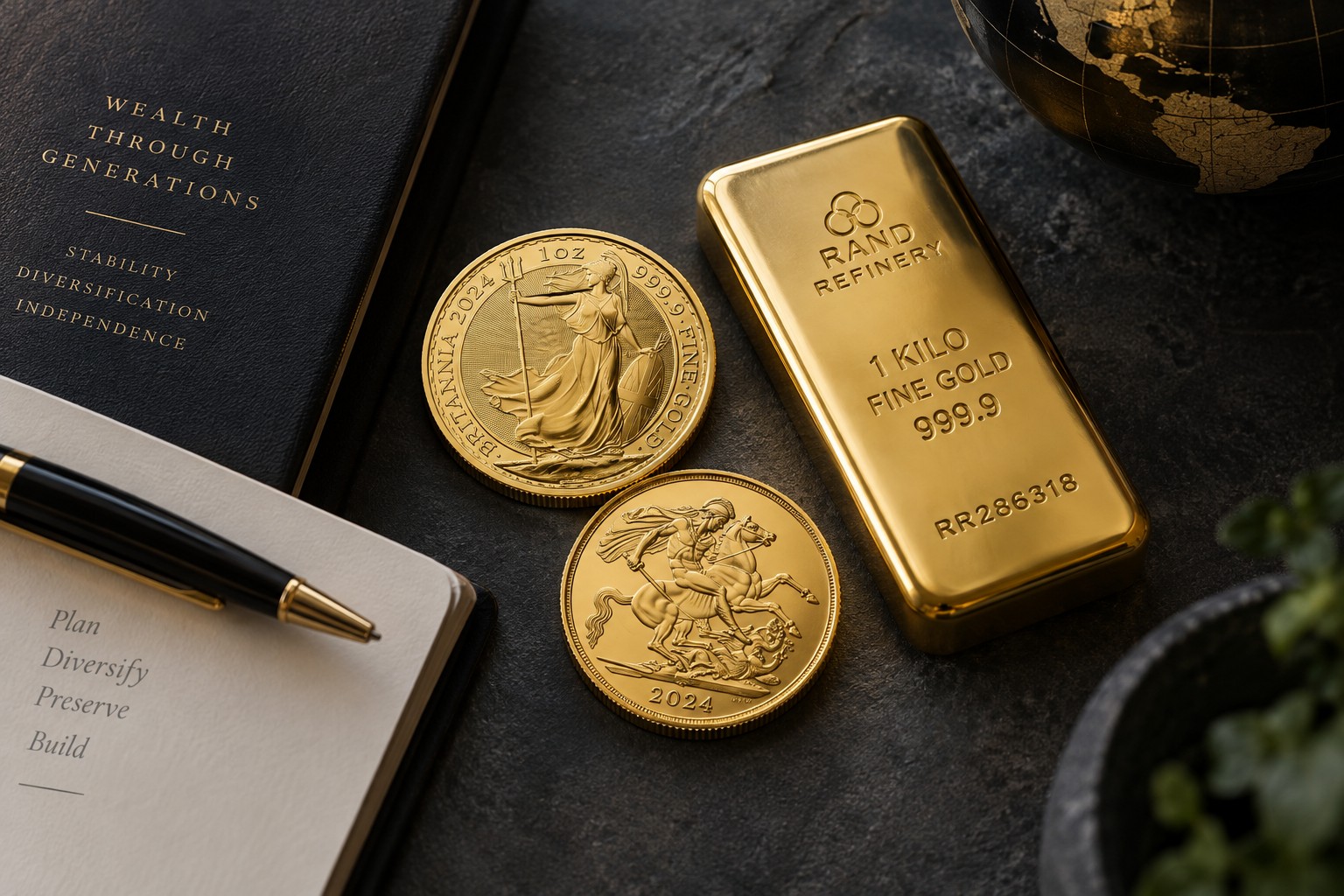
Gold investment means allocating money to gold with the aim of preserving wealth, diversifying investments or potentially benefiting from an increase in the gold price.
There are two broad ways to do this.
The first is to buy physical gold, usually in the form of investment gold coins or gold bars. You own the underlying metal and can choose whether to take delivery or arrange secure storage.
The second is to gain financial exposure to gold without directly owning coins or bars. This can include gold ETFs or ETCs, gold-related funds and shares in gold mining companies.
These investments may all be described as ‘gold investments’, but they work in very different ways. Understanding that distinction is an important starting point.
If you’re completely new to precious metals, our complete guide to buying gold provides a useful introduction to buying physical gold.
There is no single reason to own gold. Investors may buy it for several different purposes depending on their objectives, financial circumstances and attitude to risk.
One of gold’s most established investment uses is diversification.
A portfolio concentrated in one asset class can become vulnerable when conditions turn against that particular market. Holding different types of assets can spread this risk.
Gold has different price drivers from shares and bonds and does not always move in the same direction as traditional financial assets. This can make it useful as one component of a broader investment portfolio.
Gold should not be expected to rise every time stock markets fall. However, its different characteristics can help reduce reliance on the performance of any single asset class.
Gold has been valued across different cultures and economic systems for centuries.
Unlike a currency, company or bond, physical gold is not somebody else’s financial promise. Its value does not depend on a company remaining profitable or a borrower repaying a debt.
This is one reason investors have historically used gold as a potential long-term store of wealth.
You can explore this further in our guide to the history of gold investment.
Gold is frequently described as an inflation hedge, but the relationship is more complicated than simply assuming that gold rises whenever inflation rises.
Over shorter periods, the gold price can be affected by many other factors, including interest rates, investor sentiment, currency movements and geopolitical events.
Over longer periods, however, some investors hold gold because its supply cannot be expanded in the same way as a fiat currency and because they want an asset that may help preserve purchasing power over time.
Demand for gold can increase when investors become concerned about financial markets, currencies, banking systems or geopolitical instability.
This has led to gold often being described as a ‘safe-haven’ asset.
That does not mean its price cannot fall during periods of uncertainty. Rather, gold has characteristics that can make it attractive to investors seeking an alternative to conventional financial assets.
Investment gold benefits from an established international market.
Widely recognised bullion products can generally be sold to precious-metal dealers, although the price an investor receives will depend on the prevailing gold price, the product and the dealer’s buyback price.
Liquidity is one reason we generally favour well-known bullion coins and bars over obscure products for investors whose priority is straightforward resale.
Physical gold does not produce an income.
There are no dividends, rental payments or interest payments simply for owning a gold coin or bar.
Instead, an investor’s return generally depends on the difference between the total price paid to acquire the gold and the net price received when it is sold.
This distinction is important because investors do not normally buy physical gold at the exact spot price.
The price paid usually includes a premium over the underlying value of the metal. When the gold is sold, a dealer will have a separate buyback price.
That means the gold price may need to rise before an investor reaches their break-even point.
For this reason, investors should consider more than simply whether they think the gold price will increase. Product premiums, dealing spreads, storage and other costs can all affect the eventual return.
You can follow current movements using our UK gold price chart.

Your break-even point is not necessarily the gold price at the time you bought. Premiums, spreads and other costs should also be considered.
Like other globally traded assets, the gold price is influenced by supply and demand.
Gold supply comes primarily from newly mined gold and recycled metal. Unlike currencies, new gold cannot simply be created in response to increased demand. Mining new deposits can require significant capital, planning and time.
Demand comes from several sources, including:
Financial conditions can also have a significant influence. Interest rates, inflation expectations, currency movements, economic confidence, geopolitical risk and investor sentiment can all affect demand for gold.
No single factor determines the gold price in isolation.
This is why attempting to predict short-term movements can be difficult, even for experienced investors
Gold investment can take several forms. The most obvious is to purchase physical gold coins and bars. Gold investment can also be achieved through buying Gold ETFs, gold mining shares, and gold mutual funds. Generally, the aim is for capital appreciation in line with the gold price and to profit from selling the gold at a higher price than when bought. As well as outright profit, motivations for investing in gold can be to provide balance and protection to other assets and as a store of wealth to beat inflation.
There are several ways investors can gain exposure to gold. Let’s explore the three main investment vehicles available.
Investors can gain exposure to gold in several ways, but the underlying characteristics can differ considerably.
The main options are physical gold, gold ETFs or ETCs and gold mining shares.
Buying gold coins provides direct ownership of physical gold.
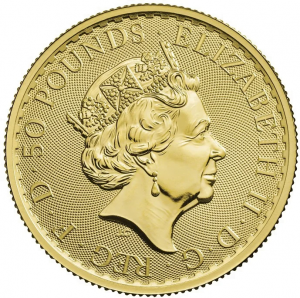
Popular investment coins include the British Gold Britannia, Gold Sovereign, South African Krugerrand and Canadian Maple Leaf.
Coins can be particularly attractive to UK investors because they are available in different sizes and can therefore provide greater flexibility when an investor eventually wants to sell part of their holding.
Certain UK legal-tender coins also have a significant tax advantage, which we cover below.
Gold bars are another straightforward way to own physical gold.
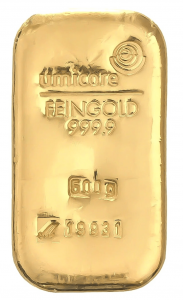
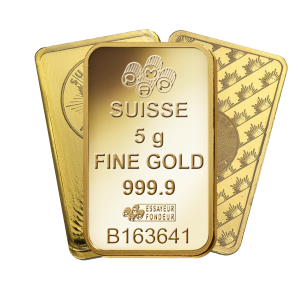
They are available in a wide range of sizes, from small gram-denominated bars through to 1oz gold bars, 100g gold bars and 1kg gold bars.
Larger bars will often provide more gold for your money because the manufacturing premium tends to represent a smaller proportion of the purchase price.
However, smaller bars and coins can provide greater divisibility. If you own one large bar and need to release only part of its value, you cannot sell half of it. A portfolio containing several smaller units provides more flexibility.
Our guide to the cheapest way to buy gold explains how product choice and premiums can affect the amount of gold you receive for your budget.
Exchange-traded gold products allow investors to gain exposure to gold through an investment that can be bought and sold through an investment platform or broker.
This can provide convenient exposure to movements in the gold price without the investor personally taking possession of coins or bars.
They can be useful for investors who prioritise ease of trading and do not specifically want to hold physical metal.
However, owning a financial product that tracks gold is not necessarily the same as personally owning allocated physical bullion. Investors should understand the structure, fees, counterparties and underlying assets of any product before investing.
Read our dedicated guide to gold ETFs for a more detailed explanation.
Another option is to buy shares in companies that mine gold.
This provides exposure to the gold industry rather than direct ownership of the metal.
A rising gold price can improve the economics of a mining business, potentially increasing profits. But the opposite can also occur.
Importantly, a gold mining share is still a company share. Its performance can be affected by management decisions, operating costs, debt, political risk, mine quality, regulation and many other factors unrelated to the spot price of gold.
Mining shares should therefore not be treated as equivalent to owning physical gold.
The right approach depends on what the investor is trying to achieve.
Physical gold has characteristics that financial gold products cannot fully replicate.
When you buy a physical gold coin or bar outright, you own the gold itself.
There is no company that needs to remain profitable and no borrower that needs to repay you for the underlying metal to continue to exist.
Physical bullion can be held directly or stored securely on an investor’s behalf.
For investors who specifically want to diversify not only between asset classes but also away from purely electronic financial assets, this can be an important distinction.
Gold has a deep global market.
Recognisable investment coins and bars can generally be valued according to their gold content and the prevailing market price rather than relying solely on demand from collectors.
A physical gold portfolio does not have to consist of one type of coin or bar.
Investors can combine larger, lower-premium products with smaller coins or bars that provide greater flexibility when selling.
For example, an investor might combine larger bars with Britannias or Sovereigns rather than putting their entire allocation into a single large bar.
For UK investors, the tax treatment of certain British bullion coins can make physical gold particularly attractive.
That brings us to an important consideration.
Gold can be tax efficient in the UK, but it is important to distinguish between VAT and Capital Gains Tax (CGT).
Qualifying investment gold is generally exempt from VAT in the UK.
HMRC’s definition includes qualifying gold bars and certain gold coins that meet the requirements for investment gold.
This is one of the important differences between investing in gold and buying physical silver, which is generally subject to VAT when purchased for delivery in the UK.
Not all physical gold is exempt from Capital Gains Tax.
Certain British legal-tender gold coins, including qualifying Gold Britannias and Sovereigns, are exempt from CGT for UK taxpayers because of their status as sterling currency.
Gold bars do not receive this same blanket CGT exemption.
Other gold coins, including foreign bullion coins, can also have different CGT treatment.
This means that the most tax-efficient product is not necessarily simply the product with the lowest purchase premium.
For a detailed explanation, read our guide to the tax implications of gold and silver for UK investors.

Tax treatment depends on individual circumstances and current UK legislation.
Gold can provide diversification and other potential benefits, but it is not risk free.
The gold price can rise and fall, sometimes significantly. An investor buying at a high price may have to wait for the market to recover before making a profit.
Physical investors also need to consider:
Understanding these risks before buying is considerably easier than trying to correct an unsuitable purchase afterwards.
We’ve explored these issues in much greater detail in our guide to the risks involved in gold investment.
Many of the practical risks associated with buying physical gold can be reduced through sensible preparation.
That includes buying recognisable investment-grade products, understanding premiums and buyback prices, using a reputable dealer, arranging appropriate storage and keeping suitable purchase records.
It is also important to understand why you are buying gold in the first place.
Someone seeking a long-term store of physical wealth may make very different choices from an investor attempting to trade short-term gold-price movements.
Our guide to mitigating the risks when investing in gold and silver provides a practical checklist of the steps investors can take before making a purchase.
Use our automated portfolio builder to get suggestions based on various investment objectives.
If you’ve decided that physical gold is appropriate for your objectives, the process can be broken down into a few straightforward decisions.
Start with your objective rather than the product.
Are you buying gold primarily for diversification? Long-term wealth preservation? Tax efficiency? Liquidity? Or because you specifically want to own an asset outside conventional financial markets?
Your objective should influence what you buy.
Decide how much you want to allocate before choosing individual products.
Gold should be considered in the context of your wider financial position rather than in isolation.
There is no universally appropriate percentage that every investor should hold in gold.
Gold bars can be attractive where maximising gold content for the available budget is the priority.
Coins can provide additional flexibility and, in the case of qualifying British legal-tender coins such as Britannias and Sovereigns, potential CGT advantages.
Many investors choose a combination.
Do not judge a product solely by its headline price.
Consider how much gold it contains, the premium over the underlying metal value and how easily it is likely to be sold in future.
A lower-priced product is not automatically better value.
The dealer you buy from matters.
Look for an established business with transparent pricing, clear product descriptions, secure delivery arrangements and an established buyback service.
Extremely cheap gold from an unknown seller should be treated with caution.
Physical gold needs to be kept securely.
Depending on the value involved and your personal circumstances, this might involve appropriate secure storage at home or professional allocated storage.
Storage should be considered before the gold arrives rather than afterwards.

The spot gold price is not necessarily the price you will pay for a physical product.
Ignoring the premium can result in investors misunderstanding how far the gold price needs to move before they make a return.
Collectable and limited-edition coins can have their place, but investors whose main objective is exposure to gold should understand how much of the purchase price relates to the underlying metal and how much reflects collectable value.
Mainstream bullion coins and bars are generally easier to value and resell.
Larger bars can offer excellent value, but they can reduce flexibility.
If you later want to release only a small amount of money, the whole bar needs to be sold.
A combination of sizes can make a physical gold portfolio more divisible.
Think about your exit before you buy.
Ask whether the product is widely recognised, whether the dealer offers a buyback service and how the resale price is calculated.
Popular coins such as Gold Sovereigns and Britannias can be attractive partly because they are well established within the UK bullion market.
Gold is an investment asset and its price fluctuates.
Past performance does not guarantee future returns, and investors should be prepared for periods when the value of their holdings falls.
Buying immediately after a sharp rise because of fear of missing out can be just as problematic as panic-selling during a temporary fall.
Investors with a longer-term objective may prefer a disciplined purchasing strategy rather than attempting to predict every short-term movement in the gold price.
Whether gold is a good investment depends on what you expect it to achieve.
Gold does not provide the income potential of dividend-paying shares, bonds or property. It can also experience periods of weak or negative price performance.
Its potential strengths lie elsewhere.
Gold can provide diversification, liquidity, a tangible store of wealth and exposure to an asset whose value is not directly dependent on the financial performance of a company or borrower.
Physical gold may be particularly attractive to investors who value direct ownership, while certain British bullion coins can also offer useful UK tax advantages.
The question is therefore less about whether gold is universally a ‘good’ investment and more about whether it performs a useful role within your investment strategy.
For a closer look at the options, read our guide to the best gold investments.
Gold investment can take several forms, from directly owning physical coins and bars to buying financial products linked to gold or investing in mining companies.
Each provides different exposure and carries different risks.
For investors considering physical gold, the key principles are straightforward:
Taking the time to make these decisions before buying can help you build a physical gold holding that is better suited to your objectives.

Choosing between gold coins, bars and different investment strategies can feel complicated when you’re starting out.
The team at Physical Gold can explain the practical differences between the available options and help you understand which physical gold products may best match your objectives and budget.
Call us on 020 7060 9992 or contact the Physical Gold team.


Gold investment means putting money into gold with the aim of preserving wealth, diversifying a portfolio or potentially benefiting from movements in the gold price.
This can involve owning physical gold coins and bars or gaining financial exposure through investments such as gold ETFs, ETCs or mining shares.
You purchase an investment-grade gold coin or bar from a dealer and own the underlying metal.
The value of your holding will then change broadly in response to movements in the gold price, although product premiums and dealer buyback prices also affect your actual return.
When you want to realise your investment, you sell some or all of your gold back to a precious-metals dealer or another buyer.
Gold can be useful for UK investors seeking diversification, physical ownership or a potential long-term store of value.
The UK also offers particular tax advantages for certain forms of physical gold. Qualifying investment gold is generally VAT exempt, while British legal-tender bullion coins such as Gold Britannias and qualifying Sovereigns can also be exempt from Capital Gains Tax for UK taxpayers.
Whether gold is suitable for you will depend on your individual objectives and circumstances.
There is no single gold product that is best for every investor.
Larger bars can provide a cost-efficient way of buying substantial amounts of gold, while smaller bars and coins can provide greater flexibility.
For UK investors, Britannias and Sovereigns are particularly popular because they combine recognisability, liquidity and potential CGT advantages.
The best choice will depend on your budget, tax position, investment objectives and plans for eventually selling the gold.
Gold bars can offer lower premiums, particularly at larger sizes, making them attractive where maximising gold content is the priority.
Gold coins can provide greater divisibility and flexibility. Certain British coins, including qualifying Britannias and Sovereigns, also benefit from CGT exemption for UK taxpayers.
Many physical gold investors therefore use a mixture of coins and bars.
Neither is automatically better.
Physical gold provides direct ownership of the underlying metal and can be held independently of an investment platform. Gold ETFs or ETCs can provide convenient electronic exposure and may be easier to trade frequently.
The appropriate choice depends on why you want exposure to gold in the first place.
No. Physical gold does not generate interest, dividends or other income simply by being held.
The financial return depends primarily on the difference between the total acquisition cost and the eventual selling price.
Yes.
The gold price fluctuates and can fall as well as rise. Investors should not assume that gold will always increase in value or that it will rise during every period of inflation or market uncertainty.
Read our detailed guide to gold investment risks before investing.
Qualifying investment gold is generally exempt from VAT in the UK.
HMRC applies specific criteria to determine which gold bars and coins qualify as investment gold.
It depends on the type of gold.
Certain British legal-tender coins, including Gold Britannias and qualifying Sovereigns, are exempt from CGT for UK taxpayers. Gold bars and many other gold products do not have the same blanket exemption.
Read our UK gold and silver tax guide for more information.

Live Gold Spot Price in Sterling. Gold is one of the densest of all metals. It is a good conductor of heat and electricity. It is also soft and the most malleable and ductile of the elements; an ounce (31.1 grams; gold is weighed in troy ounces) can be beaten out to 187 square feet (about 17 square metres) in extremely thin sheets called gold leaf.
Live Silver Spot Price in Sterling. Silver (Ag), chemical element, a white lustrous metal valued for its decorative beauty and electrical conductivity. Silver is located in Group 11 (Ib) and Period 5 of the periodic table, between copper (Period 4) and gold (Period 6), and its physical and chemical properties are intermediate between those two metals.


