Gold Price History: 25 Years of Trends and Lessons for Investors
20/10/2026Daniel Fisher

Accumulate gold coins on a regular basis for home delivery or storage.
Let our experts hand-pick a gold investment portfolio for you.
Free & fully insured UK Delivery. Learn more

Secure & flexible payments. Learn more

Buyback Guarantee Learn more

A cost-effective way to buy silver bullion with off-shore storage
Let our experts hand-pick a silver investment portfolio for you.
Free & fully insured UK Delivery. Learn more
Secure & flexible payments. Learn more
Buyback Guarantee Learn more
Free & fully insured UK Delivery. Learn more
Secure & flexible payments. Learn more
Buyback Guarantee Learn more


Accumulate gold coins on a regular basis for home delivery or storage.
Let our experts hand-pick a gold investment portfolio for you.
A cost-effective way to buy silver bullion with off-shore storage
Let our experts hand-pick a silver investment portfolio for you.
Free & fully insured UK Delivery. Learn more
Secure & flexible payments. Learn more
Buyback Guarantee Learn more
Free & fully insured UK Delivery. Learn more
Secure & flexible payments. Learn more
Buyback Guarantee Learn more
If you’d bought gold at the beginning of the millennium, you’d have witnessed one of the most remarkable periods in its modern history.
The dot-com crash, the September 11 attacks, the 2008 financial crisis, a global pandemic, surging inflation and geopolitical conflicts have all influenced gold’s journey. Along the way, prices have risen dramatically, fallen sharply and repeatedly surprised investors.
But there’s something particularly interesting about looking back at gold’s performance.
The biggest price movements haven’t always occurred when investors expected them. Gold has sometimes fallen during financial crises, risen when inflation was relatively subdued and struggled even when economic uncertainty remained high.
So, what actually drives the price of gold? And what can UK investors learn from the past 25 years?
In this article, we’ll explore the major turning points in gold’s recent history, examine the forces behind them and consider what they mean for anyone thinking about investing in physical gold today.
Before examining the history, it’s worth understanding exactly what we’re measuring.
The price of gold is generally quoted as a spot price per troy ounce, equivalent to approximately 31.1035 grams.
The spot price reflects the prevailing market value of gold for prompt settlement. It changes throughout the trading day as buyers and sellers respond to developments around the world.
Gold is traded internationally, with prices commonly expressed in US dollars.
However, for British investors, the sterling price is often more relevant.
That’s because the amount you pay for gold in the UK depends on two important factors:
For example, if gold is trading at $3,000 per ounce and the exchange rate is $1.25 to £1, its sterling equivalent is £2,400.
If the dollar price remains unchanged but sterling weakens to $1.20, that same ounce would cost £2,500.
Gold hasn’t become more expensive in dollars, but its price has increased by approximately 4.2% for a UK investor.
This is why looking exclusively at dollar-denominated gold charts can be misleading.
There’s another important distinction.
Coins and bars generally carry a premium reflecting manufacturing, distribution, dealer costs and market demand.
Similarly, the amount you receive when selling may be below the prevailing spot price.
These differences become particularly important when considering investment returns.
For the latest sterling prices, visit our live UK gold price chart.
At the beginning of the millennium, gold was attracting relatively little excitement.
During the late 1990s, gold prices had been weak, while technology shares were capturing investors’ attention.
The internet promised to transform the global economy, and investors poured money into technology companies, often paying extraordinary valuations for businesses with limited profits.
Then the dot-com bubble burst.
The technology-heavy NASDAQ Composite fell dramatically between its March 2000 peak and October 2002 trough, destroying substantial amounts of market value.
Investors began reassessing risk.
Gold, meanwhile, entered a period of sustained appreciation.
But it would be too simplistic to suggest that money simply moved from technology shares into gold.
The early 2000s also brought lower US interest rates, changing currency conditions, geopolitical uncertainty and growing demand for alternative investments.
Together, these factors helped create a more favourable environment for gold.
The terrorist attacks of September 11 were another defining moment.
US stock markets closed for several trading days, and investor confidence was severely shaken.
The attacks intensified concerns about geopolitical stability, economic growth and financial security.
Gold benefited from periods of heightened uncertainty, although its subsequent long-term rise cannot be attributed to this event alone.
Monetary policy, the US dollar, investment demand and the wider economic environment all played significant roles.
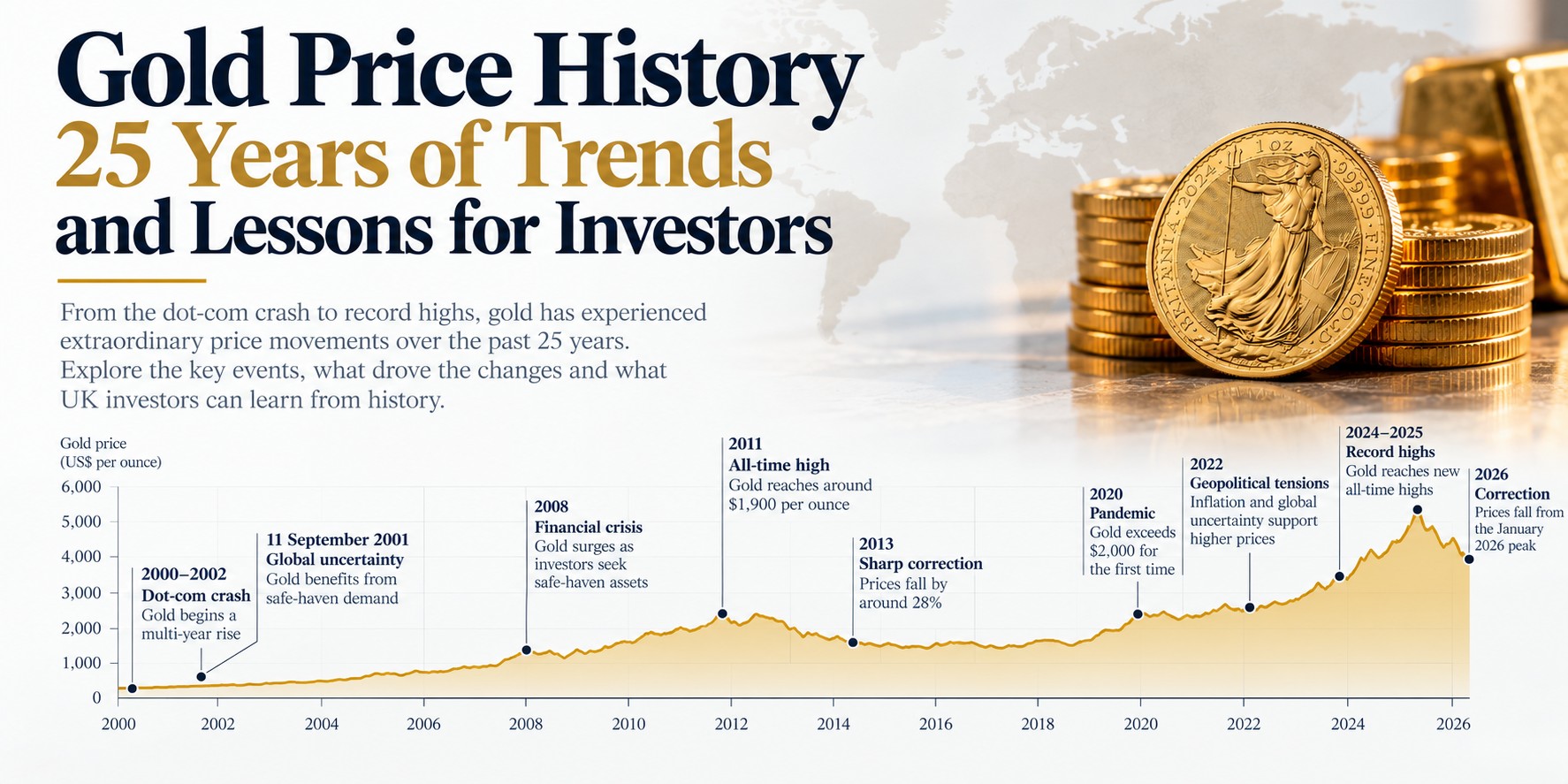
By the end of 2007, gold was trading above $800 per ounce – substantially higher than at the beginning of the decade.
Gold’s performance during this period demonstrates how changing economic conditions can transform sentiment towards an asset.
Investments that appear unfashionable during one market cycle can become increasingly attractive during another.
However, trying to identify precisely when that shift will happen is extremely difficult.
The practical lesson: Diversification is often more useful than attempting to predict which asset class will perform best next.
Our article exploring whether gold is better than keeping cash in the bank examines some of the different considerations involved in holding physical gold and cash savings.
The global financial crisis was one of the most significant events in modern financial history.
Problems in the US subprime mortgage market spread through the banking system, exposing weaknesses in financial products and institutions around the world.
In September 2008, Lehman Brothers collapsed, intensifying an already serious crisis of confidence.
Britain had experienced its own warning signs the previous year, when customers queued outside Northern Rock branches amid concerns about the bank’s financial position.
For many investors, the crisis challenged assumptions about the security of traditional financial assets.
Gold became increasingly attractive as an alternative store of value.
However, its performance during the crisis wasn’t entirely straightforward.
One of the most useful lessons from 2008 is that gold initially experienced considerable volatility.
During periods of acute financial stress, investors sometimes sell assets they would otherwise prefer to retain simply because they need immediate access to cash.
Gold was not immune to this behaviour.
Nevertheless, as central banks introduced extraordinary monetary measures and concerns about the financial system persisted, gold entered another powerful period of appreciation.
By September 2011, gold had reached approximately $1,900 per ounce.
The combination of low interest rates, sovereign debt concerns, currency uncertainty and investment demand helped support prices.

The Northern Rock bank run became one of the defining images of Britain's financial crisis. Gold subsequently attracted increasing interest from investors concerned about financial stability.
Gold has often attracted demand during periods of financial uncertainty, but it isn’t guaranteed to rise whenever stock markets fall.
Its relationship with other assets changes over time.
This is why investors should be cautious about treating gold as a perfect insurance policy against financial crises.
Instead, it may be more useful to view gold as an asset with different characteristics from shares, bonds and cash.
The practical lesson: Gold can contribute to diversification, but it remains subject to price volatility and should be considered within a wider investment strategy.
For additional historical context, see our seven lessons from the history of gold investment.
After the dramatic rise of the previous decade, gold experienced a substantial correction.
In 2013, its US dollar price fell by approximately 28%.
For investors who had become accustomed to rising gold prices, this was an uncomfortable reminder that even long-established safe-haven assets can suffer significant losses.
So, what changed?
Several factors contributed.
The US economy was recovering from the financial crisis, investor confidence in equities improved and expectations grew that the Federal Reserve would eventually reduce its extraordinary monetary support.
Gold also faced selling pressure from investment funds.
As the outlook for interest rates changed, some investors reassessed the appeal of holding an asset that doesn’t generate interest or dividends.
Gold exchange-traded funds had become an increasingly important part of the investment market.
These products allow investors to gain exposure to gold prices through securities rather than purchasing and storing bullion themselves.
Some gold ETFs are physically backed by gold held in professional vaults, while other gold-related investment products use different structures.
The distinction matters.
It would be inaccurate to assume that all gold ETFs are unbacked or that every unit represents gold sold repeatedly to different investors.
Nevertheless, ETF investment flows can affect physical gold demand and market sentiment.
During 2013, substantial outflows from gold-backed ETFs contributed to downward pressure on prices.
Investors interested in the differences can read our guide to buying gold through ETFs and electronic investment products.
Gold remained relatively subdued for several years before strengthening again towards the end of the decade.
By 2019, concerns about slowing economic growth, trade tensions and the direction of interest rates helped renew interest in the metal.
Gold doesn’t need an economic crisis to rise, and uncertainty alone doesn’t guarantee that it will perform well.
Market expectations are often just as important as current conditions.
If investors anticipate higher interest rates or stronger returns elsewhere, demand for gold may weaken.
The practical lesson: Avoid assuming that gold prices must rise simply because economic headlines appear negative.
And remember that long-term investors may experience several years of disappointing performance before market conditions change.
Use our portfolio builder to explore gold products based on your investment budget and objectives, including tax efficiency.
The COVID-19 pandemic created another extraordinary period for financial markets.
As countries introduced lockdowns and economic activity contracted, investors faced uncertainty about business closures, employment, government borrowing and the stability of the global economy.
Gold initially experienced volatility as markets adjusted.
However, falling interest rates, substantial monetary stimulus and growing demand for defensive assets helped push prices higher.
In August 2020, gold exceeded $2,000 per ounce for the first time.
The following years brought further challenges.
Inflation accelerated in many economies, while Russia’s invasion of Ukraine in 2022 increased geopolitical and energy-market uncertainty.
Yet gold’s performance remained uneven.
This is an important question.
Gold is frequently described as an inflation hedge, but its price doesn’t automatically move in line with consumer prices.
When inflation rises, central banks may respond by increasing interest rates.
Higher interest rates can make cash deposits and bonds more attractive relative to gold, which pays no income.
A stronger US dollar can also put downward pressure on the international gold price.
Consequently, gold can experience periods of weakness even when inflation remains elevated.
By 2023, renewed geopolitical concerns, central bank demand and changing expectations about monetary policy helped support gold prices again.
Gold’s relationship with inflation is more complicated than many investors realise.
Over extended periods, gold has sometimes helped preserve purchasing power. Over shorter periods, its performance can be inconsistent.
The practical lesson: Don’t buy gold solely because you expect the next inflation announcement to be higher.
Consider its potential role over your intended investment horizon rather than judging it against individual economic announcements.
The most recent period has brought some of the most dramatic movements in gold’s modern history.
Gold reached successive record highs during 2024 and 2025, supported by a combination of investment demand, geopolitical uncertainty, central bank purchases and changing expectations about interest rates.
One particularly interesting development has been the scale of official-sector buying.
According to the World Gold Council’s 2025 Gold Demand Trends report, central banks purchased a net 863 tonnes of gold during 2025.
Although below the exceptionally high totals recorded in the preceding three years, this remained well above the longer-term annual average.
Why does this matter?
Central banks generally hold reserves across different assets and currencies.
Gold can offer diversification because it isn’t a liability issued by another government or financial institution.
Some central banks have therefore increased their gold reserves as part of longer-term reserve-management strategies.
Gold’s rally continued into January 2026, when prices briefly exceeded $5,500 per troy ounce.
However, the market subsequently experienced a substantial correction.
By October 2026, gold was trading considerably below that peak, with changing interest-rate expectations, US dollar movements and investor positioning influencing the market.
The episode offers an important reminder.
Even when the long-term arguments for holding gold appear compelling, its price can move dramatically in either direction.
And the reasons investors bought gold at one price may not justify buying it at a much higher one.

Gold's long-term rise has included substantial corrections and periods of weaker performance.
There are two equally important messages from this period.
First, gold remains a significant asset in the international financial system, with demand extending well beyond individual investors.
Second, strong demand doesn’t eliminate the possibility of sharp price corrections.
The practical lesson: Don’t mistake a persuasive long-term investment argument for a guarantee of short-term price appreciation.
Looking back over 25 years, several recurring influences become apparent.
Understanding them won’t allow anyone to predict gold prices with certainty, but it can help explain why markets behave as they do.
Gold doesn’t pay interest.
When real interest rates rise, interest-bearing assets may become relatively more attractive. When real rates fall, the opportunity cost of holding gold may decrease.
However, the relationship is not absolute.
Gold is commonly priced in dollars, so changes in the dollar’s value can affect international demand and prices.
For British investors, sterling-dollar movements add another layer of complexity.
Investors may turn to gold when concerned about the long-term purchasing power of currencies.
However, inflation alone doesn’t determine gold’s direction.
Wars, political instability and concerns about financial systems can increase demand for assets perceived as relatively defensive.
But market reactions can be unpredictable and sometimes short-lived.
Purchases by central banks, institutions and private investors can influence the balance between supply and demand.
Investment flows into and out of gold-backed ETFs can also contribute to market movements.

One of the easiest mistakes UK investors can make is relying entirely on gold price movements quoted in US dollars.
Although gold is internationally traded in dollars, most UK investors buy and sell in sterling.
This means currency movements can amplify or reduce the effect of changes in the international gold price.
Imagine gold rises by 10% in dollars.
If sterling strengthens significantly against the dollar during the same period, the gain measured in pounds could be much smaller.
Conversely, a weaker pound could increase the sterling value of gold even when the international price is relatively stable.
This distinction is particularly relevant when comparing historical returns.
A claim that gold has increased by a certain percentage over 20 or 25 years may produce a different result depending on whether the calculation uses dollars or pounds.

Currency movements can make the investment experience of a UK gold buyer different from that of a US investor.
Gold’s history offers some useful practical lessons.
But perhaps the most important is that understanding the market and predicting it are two very different things.
Looking backwards, it can seem obvious when investors should have bought or sold.
At the time, those decisions were rarely so straightforward.
Here are five principles worth considering.
Gold has experienced powerful bull markets and prolonged corrections.
A recent rise isn’t proof of further gains, just as a recent fall doesn’t necessarily indicate that prices will continue declining.
For investors concerned about committing a substantial amount at one price, spreading purchases over time may be worth considering.
This can reduce reliance on a single entry point, although it doesn’t guarantee a better average purchase price.
Our article on the power of regular gold investment plans explores this approach in more detail.
Two investors buying the same quantity of gold at the same spot price may pay different amounts depending on the products they choose.
A lower-premium bullion coin or bar may provide a more cost-effective starting point than a higher-premium alternative.
However, premiums should be considered alongside recognisability, flexibility and resale options.
An investor holding several smaller coins can sell part of their holding without disposing of everything.
Someone holding a single large bar has less flexibility.
The right choice depends on budget, objectives and the likelihood of needing access to part of the investment.
Gold can be a useful component of a diversified portfolio, but it doesn’t generate dividends or interest, and its price can fall.
The amount an investor holds should reflect their wider circumstances rather than enthusiasm for recent market performance.
After examining decades of gold price movements, it’s tempting to conclude that successful investing depends on identifying the perfect moment to buy.
In practice, that is extraordinarily difficult.
Even experienced market commentators frequently disagree about the direction of gold prices.
For investors buying physical gold, there are other factors worth considering.
These include the premium above spot, the reputation of the dealer, the suitability of the product, storage arrangements, tax treatment and likely resale options.
For example, Best Value Gold Coins can be worth exploring if your priority is obtaining investment gold at competitive premiums rather than purchasing a particular design or year.
Similarly, Best Value Gold Sovereigns offer a smaller denomination and the potential Capital Gains Tax advantages associated with qualifying UK legal-tender coins.
Our Director’s Pick range provides another starting point for investors seeking competitively priced gold coins selected for their value.
There isn’t one perfect purchase for everyone.
The most suitable option depends on what you’re trying to achieve and how you expect to manage your holding over time.

Gold’s performance over the past 25 years has been remarkable, but its history is anything but a straight line.
Economic crises, changing monetary policy, inflation, currency movements and investment demand have all influenced prices.
And despite everything we know about these factors, the next major movement remains uncertain.
At Physical Gold, we believe the best starting point is understanding what you’re buying, why you’re buying it and how the costs could affect your eventual return.
Before making a purchase, you can:
Alternatively, call us on 020 7060 9992.
Our team can help explain current bullion pricing, premiums and product options so you can make a more informed decision.
Gold has risen substantially over the past 25 years, although the precise increase depends on the starting date, ending date and currency used. Returns calculated in pounds can differ significantly from those calculated in US dollars. Historical comparisons should use consistent dates and price data, and physical investors must also consider premiums and selling costs.
Several factors contributed, including changing investor sentiment after the dot-com crash, lower interest rates, US dollar movements, geopolitical uncertainty and increasing investment demand. The rise was driven by a combination of influences rather than one event.
Gold experienced a significant correction in 2013 as investor confidence in other assets improved, expectations about US monetary policy changed and substantial outflows occurred from gold-backed ETFs. The decline demonstrated that gold can fall sharply even after a prolonged period of strong performance.
No. Gold has sometimes performed strongly during recessions and financial crises, but it can also experience temporary or prolonged declines. Investors may sell gold to raise cash, while interest rates, currency movements and wider market expectations can affect its price.
International gold prices are commonly quoted in US dollars, while UK investors generally buy and sell in pounds. Changes in the sterling-dollar exchange rate therefore influence the UK price. Dealer premiums and selling spreads also affect the actual prices paid or received for physical bullion.
A lower price can make gold more attractive, but there’s no guarantee that prices won’t fall further. Investors should consider their objectives, investment horizon, available funds and the premiums charged on physical products rather than attempting to identify the exact market bottom.
Nobody can reliably predict future gold prices. Interest rates, inflation expectations, currency movements, central bank demand and geopolitical events can all influence the market. Historical performance offers useful context, but it cannot guarantee future returns.
Important information: Gold prices can rise or fall, and investors may receive less than they originally paid. This article is for general information and education, not personalised financial advice. Tax treatment depends on individual circumstances and may change.

Share this post on:


Latest Posts:
Live Gold Spot Price in Sterling. Gold is one of the densest of all metals. It is a good conductor of heat and electricity. It is also soft and the most malleable and ductile of the elements; an ounce (31.1 grams; gold is weighed in troy ounces) can be beaten out to 187 square feet (about 17 square metres) in extremely thin sheets called gold leaf.
Live Silver Spot Price in Sterling. Silver (Ag), chemical element, a white lustrous metal valued for its decorative beauty and electrical conductivity. Silver is located in Group 11 (Ib) and Period 5 of the periodic table, between copper (Period 4) and gold (Period 6), and its physical and chemical properties are intermediate between those two metals.