History of Gold Investment: 7 Lessons for Today’s Investors
20/10/2026Daniel Fisher

Accumulate gold coins on a regular basis for home delivery or storage.
Let our experts hand-pick a gold investment portfolio for you.
Free & fully insured UK Delivery. Learn more

Secure & flexible payments. Learn more

Buyback Guarantee Learn more

A cost-effective way to buy silver bullion with off-shore storage
Let our experts hand-pick a silver investment portfolio for you.
Free & fully insured UK Delivery. Learn more
Secure & flexible payments. Learn more
Buyback Guarantee Learn more
Free & fully insured UK Delivery. Learn more
Secure & flexible payments. Learn more
Buyback Guarantee Learn more


Accumulate gold coins on a regular basis for home delivery or storage.
Let our experts hand-pick a gold investment portfolio for you.
A cost-effective way to buy silver bullion with off-shore storage
Let our experts hand-pick a silver investment portfolio for you.
Free & fully insured UK Delivery. Learn more
Secure & flexible payments. Learn more
Buyback Guarantee Learn more
Free & fully insured UK Delivery. Learn more
Secure & flexible payments. Learn more
Buyback Guarantee Learn more
Gold has witnessed the rise and fall of empires, survived the collapse of monetary systems and played a central role in some of history’s biggest financial crises. Yet thousands of years after it first became a symbol of wealth, investors are still buying it for many of the same reasons.
So, what can the history of gold actually teach us about investing today?
Quite a lot, as it turns out.
From the end of the gold standard to the dramatic price swings of the 1970s, gold’s history reveals valuable lessons about inflation, market psychology, diversification and the importance of thinking long term.
For UK investors considering buying physical gold, understanding these lessons can help answer some important questions: When does gold perform well? What causes its price to fall? And how can you avoid the mistakes investors have made before?
Let’s explore seven lessons from gold’s fascinating history – and, more importantly, what they mean for your money today.
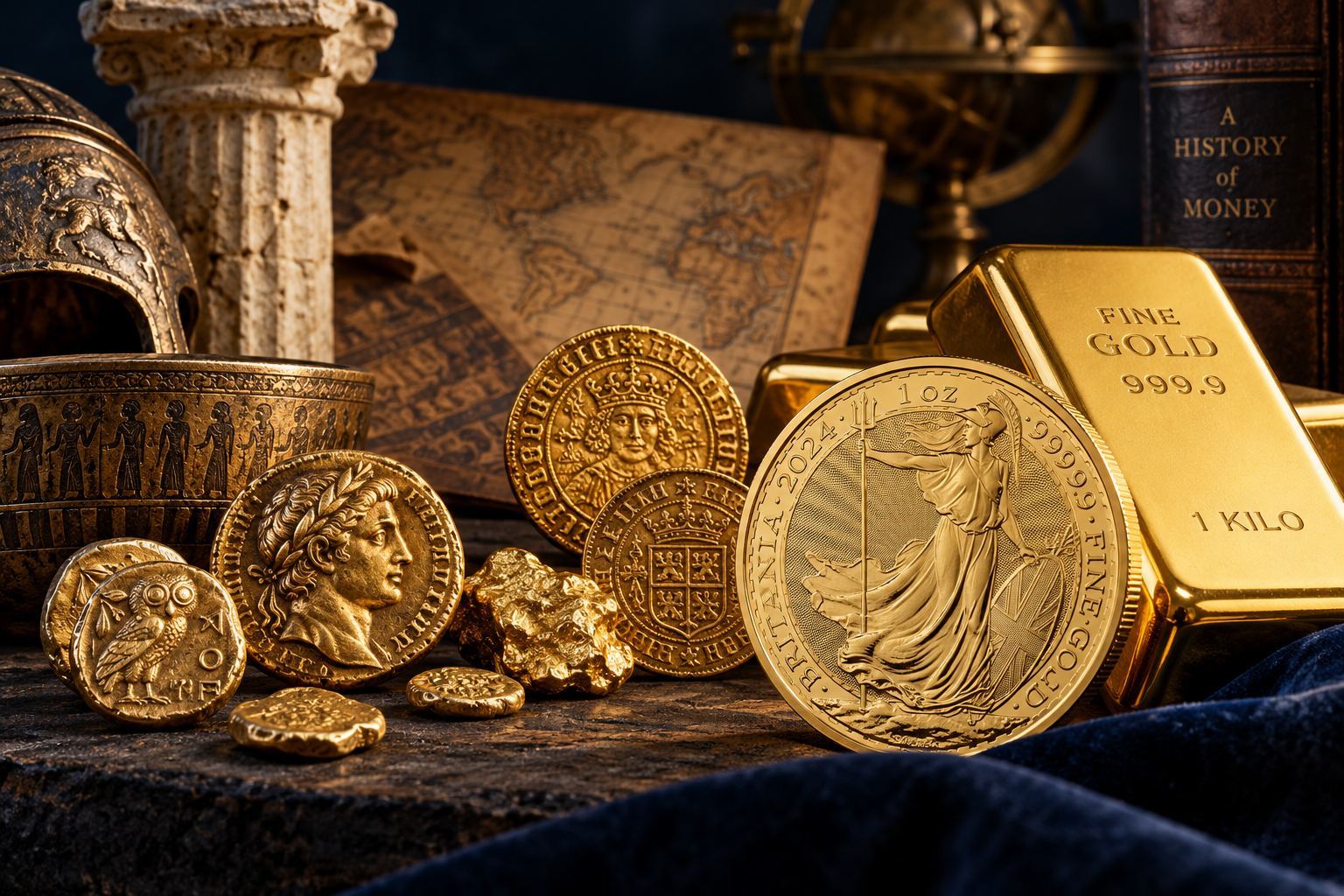
From ancient currency to modern bullion, gold has played an important role in preserving and transferring wealth.
Long before stock markets, central banks or even modern currencies existed, gold was already prized.
Ancient Egyptian rulers used it to demonstrate wealth and power. Civilisations across Asia, Europe and the Americas valued it for jewellery, religious objects and trade. Some of the earliest known gold coins were produced in Lydia, in what is now Turkey, during the seventh century BC.
What made gold so desirable?
Its physical characteristics certainly helped. Gold is relatively scarce, difficult to extract, easily recognisable and remarkably resistant to corrosion. Unlike many other materials, it doesn’t deteriorate with age.
But perhaps its greatest advantage has been something less tangible: trust.
Across different cultures and economic systems, people have repeatedly agreed that gold has value.
Britain’s own coinage history demonstrates this enduring appeal. Gold Sovereigns, for example, have evolved considerably since their earliest introduction in 1489, yet remain among the world’s most recognisable bullion coins.
For a closer look at how British currency has developed, explore our history of UK coins.
Gold’s scarcity and long history of acceptance help explain why it continues to attract investors seeking to preserve wealth over extended periods.
Unlike cash, gold cannot simply be created through monetary policy. Mining increases the available supply gradually, while jewellery, investment demand and central bank purchases influence how that supply is valued.
However, there’s an important distinction between something maintaining its relevance over centuries and its price remaining stable over shorter periods.
Gold can experience substantial price falls, sometimes lasting years.
The lesson: Gold’s enduring appeal is a reason to consider it as a long-term asset, not a guarantee that buying at any price will produce a positive return.
For investors, the question shouldn’t simply be whether gold will remain valuable. It should be whether the price you’re paying, your investment horizon and your wider financial circumstances make the purchase worthwhile.
For much of modern financial history, gold was more than a valuable commodity. It helped underpin the international monetary system.
Under the classical gold standard, which became prominent during the nineteenth century, participating countries linked their currencies to specified quantities of gold.
In theory, this created greater exchange-rate predictability and supported international trade.
However, it also restricted governments’ ability to respond independently to changing economic conditions.
The First World War disrupted the system, and attempts to restore gold-based monetary arrangements during the interwar years proved difficult. Britain abandoned the gold standard in 1931.
Following the Second World War, the Bretton Woods system established a new international framework. Major currencies were linked to the US dollar, while the dollar was convertible into gold for foreign monetary authorities at $35 per troy ounce.
But the arrangement eventually became unsustainable.
In August 1971, President Richard Nixon suspended the dollar’s convertibility into gold, an event often referred to as the Nixon Shock. By 1973, the system of fixed exchange rates had effectively broken down.
Gold was no longer tied to the dollar at an official fixed conversion rate in the same way. Its market price became increasingly influenced by investment demand, economic expectations and international trading.
Our detailed guide to what the gold standard was and how it worked explores the different systems, their advantages and why they were ultimately abandoned.

The gold standard evolved over more than a century before the international monetary system shifted towards floating currencies.
The gold standard illustrates something investors sometimes overlook: financial arrangements that appear permanent can change surprisingly quickly.
Interest-rate policies, currencies, government debt and international monetary relationships all evolve.
Gold offers a way to hold an asset whose existence does not depend on a government’s promise to repay a debt or maintain a particular exchange rate.
That doesn’t make it immune to financial developments. In fact, gold prices are heavily influenced by interest rates, currencies and investor confidence.
The transition from gold-backed money to today’s fiat currency system is a useful reminder that the way we define and manage money is not fixed forever.
The lesson: Avoid building an investment strategy around the assumption that today’s economic conditions will continue indefinitely.
For UK investors, physical gold can provide exposure to an internationally traded asset outside traditional bank deposits, shares and bonds.
Further reading: The end of gold convertibility – Federal Reserve History
Few periods demonstrate the dangers of investment excitement quite like the 1970s.
Following the breakdown of the Bretton Woods system, gold experienced an extraordinary rise.
Its official monetary price had been $35 per ounce under the previous arrangement. By January 1980, gold briefly traded above $800 per ounce.
Inflation, geopolitical tensions, economic uncertainty and growing investment demand all contributed to the surge.
For investors watching prices climb, it must have seemed that gold could do little wrong.
But what happened next provides an equally important lesson.
As inflationary pressures eased and interest rates rose, gold entered a prolonged period of weakness. Prices fell dramatically from their 1980 peak, and investors who bought near the top faced a lengthy wait to recover their investment in nominal US dollar terms.
Gold remained valuable throughout that period. That didn’t prevent some investors from suffering substantial losses.

Gold's dramatic rise during the 1970s was followed by a prolonged period of weaker prices, illustrating the risks of buying during speculative enthusiasm.
One of the biggest mistakes investors make is assuming that an asset which has recently performed well will continue doing so.
It’s understandable. When gold prices reach new highs and headlines predict further gains, the temptation to buy can be considerable.
But rising prices can also mean you’re paying substantially more for exactly the same quantity of gold.
Consider two investors who each buy a one-ounce gold coin.
One purchases when the underlying gold price is £2,000 per ounce. The other waits until it reaches £2,800.
Both own essentially the same amount of gold. Yet the second investor has committed 40% more money before accounting for dealer premiums.
If prices subsequently fall, their experiences could be very different.
The lesson: Don’t allow fear of missing out to dictate your investment decisions.
Rather than trying to predict the perfect entry point, consider whether buying in stages makes sense for your circumstances.
Spreading purchases across several months can reduce dependence on a single purchase price, although it won’t eliminate the risk of losses or guarantee a better overall return.
It’s also worth comparing premiums. An attractive gold price doesn’t automatically mean you’re getting good value if you’re paying significantly above the underlying metal value.
Gold has developed a reputation as a safe-haven investment, and history helps explain why.
During periods of financial instability, investors often become concerned about the reliability of banks, currencies and conventional financial assets.
Gold can become more attractive because it is a tangible asset with an established international market.
Consider the global financial crisis of 2008.
As confidence in financial institutions deteriorated, demand for gold increased. Although gold initially experienced selling pressure during the crisis, it subsequently benefited from investor concerns about the financial system and monetary policy.
A similar pattern of increased interest in gold emerged during the uncertainty surrounding the COVID-19 pandemic in 2020.
But there is an important qualification.
Gold doesn’t always rise when stock markets fall.
During severe market disruption, investors sometimes sell gold to raise cash or cover losses elsewhere. Changes in interest-rate expectations and currency movements can also outweigh demand for safe-haven assets.

Investors have frequently turned to gold during financial crises, although its performance has varied across different market conditions.
The real attraction of gold isn’t that it always moves in the opposite direction to shares.
It’s that the factors influencing gold can differ from those driving other investments.
A portfolio containing shares, bonds, cash and gold may therefore behave differently from one concentrated entirely in a single asset class.
For example, an investor heavily exposed to UK shares and property might consider whether an allocation to physical gold would introduce a useful additional source of diversification.
The appropriate allocation depends on the investor’s objectives, risk tolerance, time horizon and existing assets.
For a broader explanation of how gold fits alongside other assets, see our guide to what gold investment involves.
The lesson: Think of gold as a potential contributor to portfolio resilience, rather than an insurance policy that guarantees protection against every financial crisis.
And remember that physical gold itself has practical considerations, including storage, insurance and the difference between buying and selling prices.
One of the most common reasons people buy gold is to protect their purchasing power.
The logic is straightforward.
Over time, inflation reduces the amount of goods and services that a fixed sum of money can purchase.
Gold, meanwhile, has a limited supply and is traded internationally. Its price can adjust as currencies lose purchasing power.
The inflationary 1970s provide a striking example of gold performing strongly during a period of rapidly rising prices.
However, history also shows that the relationship between gold and inflation isn’t as simple as it first appears.
Gold doesn’t automatically rise whenever inflation increases.
Interest rates, currency strength, investor expectations and wider economic conditions can all influence its performance.
Indeed, research by the World Gold Council suggests that gold’s inflation-hedging characteristics are more convincing over longer periods than over short intervals.
It’s useful to distinguish between preserving purchasing power over decades and protecting against next month’s inflation figures.
If inflation rises by 5% over a year, that doesn’t mean gold will necessarily increase by 5%.
It might rise considerably more, increase less or fall.
For UK investors, there’s another factor to consider: sterling.
Gold is internationally priced in US dollars, but UK investors generally measure their returns in pounds.
Consequently, movements in the pound-dollar exchange rate can significantly affect the sterling gold price.
A weakening pound can increase the sterling value of gold even when its dollar price remains unchanged. A strengthening pound can have the opposite effect.
The lesson: Gold can play a role in a long-term wealth-preservation strategy, but it shouldn’t be treated as a precise, short-term inflation hedge.
Understanding the difference can help prevent unrealistic expectations.
It’s tempting to look at a historical gold price chart, see how much the metal has appreciated over several decades and conclude that holding gold is always profitable.
But averages can hide very different investor experiences.
Someone buying gold before a sustained price increase may enjoy strong returns.
Someone buying near a major peak might wait years before seeing the same result.
And an investor forced to sell during a downturn could realise a loss even if gold eventually recovers.
There are also costs that historical spot-price charts don’t capture.
When buying physical gold, investors generally pay a premium above the underlying metal value. When selling, they may receive less than the prevailing spot price.
The difference between the purchase and sale prices is commonly referred to as the spread.
If you’re unfamiliar with these terms, our gold buying terminology guide explains the language commonly used when purchasing bullion.
A simple example
Imagine an investor purchases gold when the spot price is £3,000 per ounce.
They pay a 5% premium, bringing the purchase cost to £3,150.
Some time later, the spot price rises to £3,300 – a 10% increase.
If the dealer’s buying price is 4% below spot, the investor receives £3,168.
Despite a 10% rise in the underlying gold price, the investor’s profit is just £18 before any storage or other costs.
The example is illustrative, but the principle is important.

A rising gold price doesn't automatically translate into an equivalent investment return once buying premiums and selling spreads are considered.
The lesson: The gold price is only one part of your investment return. The premium you pay and the price you can achieve when selling matter just as much.
This is particularly relevant when choosing between bullion coins, bars and specialist collectable coins.
Products with higher premiums may need a greater increase in value before an investor breaks even.
For investors primarily interested in gold content rather than rarity or collectability, lower-premium bullion products may offer better value.
One of the more interesting lessons from gold’s history is that its appeal has survived numerous changes in the way people buy, hold and trade it.
Gold has been held as jewellery, currency, bullion, central bank reserves and, more recently, through exchange-traded investment products.
Today, investors can choose between owning physical gold and gaining exposure to its price through financial instruments.
Both approaches have advantages and limitations.
For investors who prefer tangible ownership, physical gold offers something distinctive: an asset that can be held directly rather than simply represented by a financial claim.
However, the type of physical gold you buy can make a difference when it’s time to sell.
Gold coins have been used for centuries because they combine recognisable designs, established weights and the ability to divide wealth into smaller units.
Those characteristics remain useful today.
For example, someone holding ten one-ounce gold coins can sell a portion of their holding without disposing of the entire investment.
An investor holding a single ten-ounce bar has less flexibility if they only need to release a relatively small amount of money.
On the other hand, larger gold bars often carry lower percentage premiums than smaller coins.
Neither option is universally better.
For UK investors, there are also tax considerations.
Qualifying investment gold is generally exempt from UK VAT, while UK legal-tender gold coins such as qualifying Sovereigns and Britannias can benefit from Capital Gains Tax exemption.
That makes gold Sovereigns and gold Britannias particularly interesting options for some UK investors.
However, tax treatment depends on the product and individual circumstances, and rules can change.

Gold coins can provide greater flexibility when selling smaller quantities, while larger bars often offer lower premiums per gram.
The lesson: Think about how you might eventually sell your gold before deciding what to buy.
Liquidity, divisibility, premiums and tax treatment can all influence the suitability of a particular product.
The cheapest gold per gram isn’t necessarily the best choice if it doesn’t fit your intended selling strategy.
Use our portfolio builder to explore gold products based on your investment budget and objectives, including tax efficiency.
Gold’s past offers plenty of useful lessons, but it doesn’t provide a reliable forecast of what prices will do next.
The factors influencing gold are constantly changing.
Central bank purchases, interest rates, inflation expectations, geopolitical developments, currency movements and investor sentiment all play a role.
The challenge is that these forces don’t always work in the same direction.
For example, geopolitical uncertainty might increase demand for gold, while rising interest rates could make interest-bearing assets more attractive.
Both developments can occur simultaneously.
Rather than trying to predict exactly where gold prices will be in six months or a year, investors may find it more productive to focus on the factors they can control.
These include how much they invest, which products they choose, the premiums they pay, how they store their gold and when they might need to sell.
Five practical principles worth remembering
History suggests that investors benefit from understanding risk, remaining adaptable and avoiding unnecessary speculation.
Those principles are just as relevant today as they were fifty or a hundred years ago.

Understanding gold’s history is useful. Knowing how to apply those lessons when choosing what to buy is even more valuable.
At Physical Gold, we believe investors should look beyond the headline gold price and consider the complete picture.
That means understanding the difference between coins and bars, comparing premiums, considering UK tax treatment and thinking about how easily an investment could be sold in the future.
For some investors, Best Value Gold Coins may offer an attractive way to acquire gold at competitive premiums.
Others may prefer Best Value Gold Sovereigns for their recognisability, smaller denomination and potential UK tax advantages.
And for investors who would prefer help identifying competitively priced coins, our Director’s Pick range is another useful starting point.
There isn’t one perfect gold investment for everyone.
The right approach depends on your objectives, budget and priorities.
Gold has delivered substantial gains over some long periods and has maintained its relevance as a store of value for centuries. However, returns vary considerably depending on when investors buy and sell. Gold has also experienced extended periods of falling or stagnant prices. Its suitability depends on investment objectives, time horizon and risk tolerance.
Gold has been valued for thousands of years, initially for decoration, religious purposes, wealth storage and trade. Some of the earliest known gold coins were produced in Lydia during the seventh century BC. Gold investment in its modern form developed alongside financial markets, particularly following the end of the international gold-convertibility system in the twentieth century.
The breakdown of the Bretton Woods monetary system, high inflation, geopolitical uncertainty and growing investment demand contributed to gold’s dramatic rise during the 1970s. Prices subsequently fell sharply as economic conditions changed, demonstrating that even assets with long-term appeal can experience major speculative cycles.
No. Although gold has sometimes performed strongly during periods of financial uncertainty, it can also fall as investors sell assets to raise cash or respond to changing interest rates and currency movements. Gold should be considered a potential diversifier rather than a guaranteed source of protection.
Gold has historically helped preserve purchasing power over certain extended periods, but its relationship with inflation is inconsistent over shorter timescales. Interest rates, currency movements and investment demand also affect its price. Investors should not assume that gold will automatically rise in line with inflation.
There is no single historical return figure that applies to every investor. Performance depends on the dates measured, the currency used and whether returns are adjusted for inflation. Physical gold investors must also account for purchase premiums, selling spreads and any storage costs. Historical returns do not guarantee future performance.
The most suitable option depends on budget, investment objectives and anticipated holding period. Gold Sovereigns and Britannias are popular choices because of their established markets, recognisability and potential Capital Gains Tax advantages. Gold bars can offer competitive premiums, particularly in larger sizes. Comparing the total cost of ownership and likely resale options is important before purchasing.
Important information: Gold prices can rise or fall, and investors may receive less than they originally paid. The information in this article is educational and should not be regarded as personalised financial advice. Tax treatment depends on individual circumstances and may change.

Share this post on:


Latest Posts:
Live Gold Spot Price in Sterling. Gold is one of the densest of all metals. It is a good conductor of heat and electricity. It is also soft and the most malleable and ductile of the elements; an ounce (31.1 grams; gold is weighed in troy ounces) can be beaten out to 187 square feet (about 17 square metres) in extremely thin sheets called gold leaf.
Live Silver Spot Price in Sterling. Silver (Ag), chemical element, a white lustrous metal valued for its decorative beauty and electrical conductivity. Silver is located in Group 11 (Ib) and Period 5 of the periodic table, between copper (Period 4) and gold (Period 6), and its physical and chemical properties are intermediate between those two metals.