
Gold vs Property Investment: How Do They Compare?
27/08/2026Daniel Fisher

Accumulate gold coins on a regular basis for home delivery or storage.
Let our experts hand-pick a gold investment portfolio for you.
Free & fully insured UK Delivery. Learn more

Secure & flexible payments. Learn more

Buyback Guarantee Learn more

A cost-effective way to buy silver bullion with off-shore storage
Let our experts hand-pick a silver investment portfolio for you.
Free & fully insured UK Delivery. Learn more
Secure & flexible payments. Learn more
Buyback Guarantee Learn more


Free & fully insured UK Delivery. Learn more
Secure & flexible payments. Learn more
Buyback Guarantee Learn more


Accumulate gold coins on a regular basis for home delivery or storage.
Let our experts hand-pick a gold investment portfolio for you.
A cost-effective way to buy silver bullion with off-shore storage
Let our experts hand-pick a silver investment portfolio for you.
Free & fully insured UK Delivery. Learn more
Secure & flexible payments. Learn more
Buyback Guarantee Learn more
Free & fully insured UK Delivery. Learn more
Secure & flexible payments. Learn more
Buyback Guarantee Learn more
Gold and property are two very different ways of holding tangible assets. Property can provide rental income as well as potential capital growth, while physical gold is generally easier to buy and sell, requires a lower initial investment and does not involve the responsibilities associated with owning property.
The two assets also differ significantly in their tax treatment, ongoing costs, liquidity and exposure to economic conditions.
In this guide, we compare gold and property investment across the factors that matter most, including historical performance, entry costs, potential returns, liquidity, tax and ongoing costs.
Gold and property have both delivered periods of substantial long-term price growth, but their performance can differ considerably depending on the timeframe being measured and wider economic conditions.
UK property values are influenced by a range of factors, including interest rates, mortgage availability, employment, housing supply and regional demand. Property performance can also vary significantly across different parts of the UK.
For an up-to-date picture of residential property prices, the UK House Price Index from HM Land Registry tracks changes in residential property values across England, Scotland, Wales and Northern Ireland. The index is regularly updated, making it more useful than including a fixed house-price figure that can quickly become outdated.
Importantly, changes in house prices only tell part of the story for property investors. An investment property may also generate rental income, while costs such as mortgage interest, maintenance, insurance, management fees and tax can reduce the overall return.
Physical gold does not generate rental income, interest or dividends. Its investment return therefore depends primarily on movements in the gold price, together with any premium associated with a particular coin or product.
The gold price can be influenced by factors including interest rates, currencies, inflation expectations, central-bank demand, investor sentiment and geopolitical uncertainty. Physical Gold’s gold price chart allows investors to compare the gold price over different time periods and in pounds sterling, US dollars and euros.
Gold and property can therefore behave differently through changing economic conditions. There will be periods when gold outperforms property and periods when the reverse is true. Past performance of either asset should not be treated as a guarantee of future returns.
A direct comparison between gold and property needs to consider more than price growth alone. Property can potentially provide both capital appreciation and rental income, whereas physical gold provides capital appreciation only.
Property investors also need to account for transaction costs, financing, maintenance and tax, while physical gold may involve premiums, storage and insurance costs.
For that reason, rather than asking which asset has produced the highest return over a particular short period, it is more useful to compare how gold and property differ in terms of returns, liquidity, costs, tax treatment and risk. We explore each of these factors below.

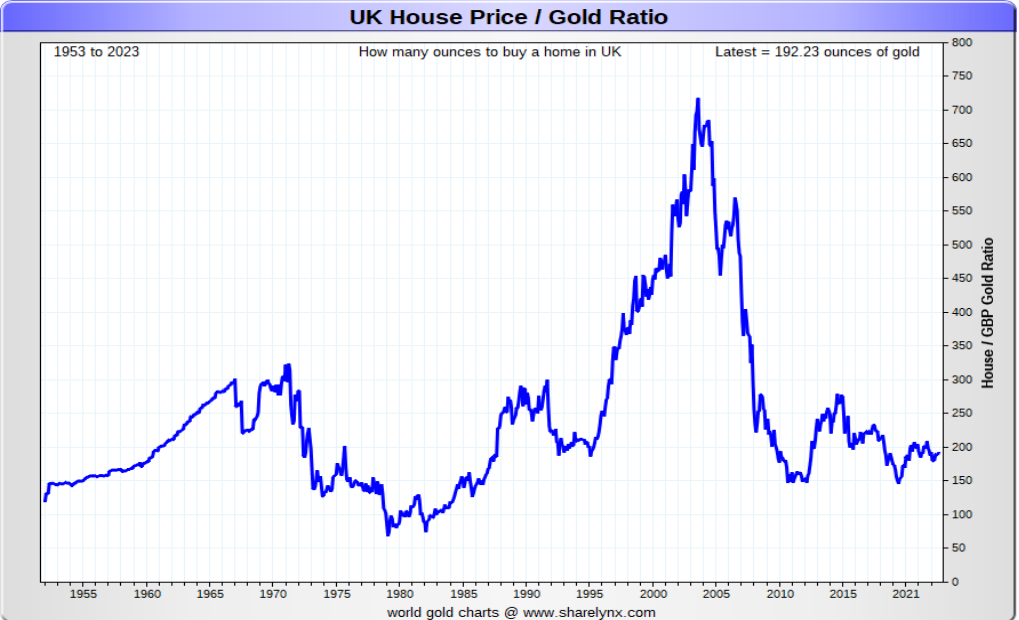
One way of comparing the relative value of gold and property is to calculate how many ounces of gold would be required to buy an average UK home.
The calculation is straightforward:
Average UK house price ÷ gold price per ounce = ounces of gold required to buy an average house
For example, if an average property cost £300,000 and gold was £2,500 per ounce, the ratio would be 120 – meaning 120 ounces of gold would have the same value as the average property.
A higher ratio means property is relatively more expensive compared with gold, while a lower ratio means gold is relatively more valuable compared with property.
Looking at this ratio over time can provide useful historical context because it shows the changing relationship between the two assets. However, it does not include factors such as rental income, property ownership costs or the costs associated with buying and holding gold, so it should not be treated as a comparison of total investment returns.
Direct property investment generally requires considerably more initial capital than buying physical gold. Buyers may need to fund a deposit as well as transaction costs such as Stamp Duty Land Tax where applicable, legal fees, surveys and mortgage fees.
Borrowing can reduce the amount of capital required upfront, but it also introduces financing costs and exposure to changes in mortgage rates.
Physical gold has a much lower entry point because investors can purchase individual gold coins or smaller gold bars rather than having to finance a single high-value asset.
Fractional bullion coins and smaller bars provide additional choice for those wishing to purchase physical gold in smaller amounts.
Investment property can potentially provide two forms of return – rental income and capital appreciation. However, the net return will depend on costs including mortgage interest, maintenance, insurance, management fees, tax and periods when the property is unoccupied.
Physical gold does not produce income. Any investment return therefore comes from changes in the value of the gold itself and, for certain coins, potentially from an additional collectable or numismatic premium.
This is an important distinction: property can be an income-producing asset, whereas physical gold is primarily held for capital exposure and diversification.
Property is relatively illiquid. Selling usually involves marketing the property, finding a buyer, legal work and completing the transaction. The time required can vary considerably according to location, price and market conditions.
Widely recognised bullion coins and bars generally have an established secondary market and can usually be sold more quickly than property. This liquidity is one of the key differences when comparing gold with cash and other assets.
The price available when selling will depend on the prevailing gold price, the type of product and the dealer’s buying rate. This can make physical gold more liquid than direct property ownership, although the value realised when selling is not guaranteed.
Tax treatment can have a significant impact on the overall return from both property and gold.
UK investment property can potentially involve several taxes, including Stamp Duty Land Tax on purchase in England and Northern Ireland, Income Tax on rental profits and Capital Gains Tax when an investment property is sold at a gain. The precise treatment depends on the property, ownership structure and individual circumstances.
Property investors should check the current GOV.UK guidance on tax when renting out property, as tax rates, allowances and rules can change.
Qualifying investment-grade gold is exempt from VAT in the UK.
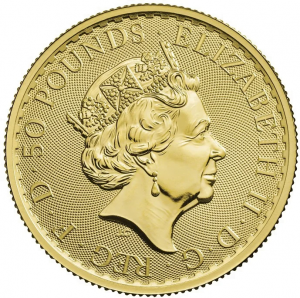
Capital Gains Tax treatment depends on the type of gold owned. UK legal-tender gold coins, including Gold Britannias and Gold Sovereigns, are exempt from CGT. Gold bars and non-UK bullion coins do not benefit from this legal-tender exemption.
Property ownership can involve continuing costs including repairs and maintenance, buildings insurance, mortgage interest and management fees. Landlords may also incur costs associated with safety requirements, compliance and periods when the property is unoccupied.
Physical gold generally requires less active management, although secure storage and insurance need to be considered.
Smaller holdings can be stored privately where appropriate, while larger holdings may be placed in professional insured vault storage. The cost will depend on the provider and value of the gold being stored.
Use our automated portfolio builder to get suggestions based on various investment objectives.
Both gold and property can fall in value, and neither provides guaranteed returns.
Property risks can include changes in house prices, interest rates and rental demand, as well as unexpected maintenance costs, periods without tenants and the difficulty of selling quickly.
Gold risks include fluctuations in the gold price, the absence of regular income and the need to store physical bullion securely. Investors buying coins with substantial collectable premiums may also find that those premiums are not fully recovered when selling.
Holding either asset therefore involves different trade-offs rather than one being inherently lower risk than the other.
We’re here to provide as much or as little guidance as you need
Gold and property have very different characteristics, so the choice does not necessarily need to be one or the other.
Property can provide rental income as well as potential capital growth, and borrowing allows investors to use leverage. However, it requires considerably more capital, can involve substantial ongoing costs and is relatively difficult to sell quickly.
Physical gold does not generate income, but it has a lower entry point, requires relatively little ongoing management and is generally more liquid than property. Qualifying investment gold is also VAT exempt, while UK legal-tender gold coins such as Britannias and Sovereigns benefit from CGT exemption.
Which characteristics matter most will depend on an investor’s objectives, finances, time horizon and attitude to risk.
If you’re considering adding physical gold to your portfolio, explore our gold coins and gold bars or use our Portfolio Builder to compare options.
If you have decided gold investment is for you, then look no further than Physical Gold. Why not call our experts on 020 7060 9992 today?
Neither gold nor property is inherently better for every investor. Property can generate rental income and offers the possibility of using mortgage finance, but requires more capital and ongoing management. Physical gold has a lower entry point and is generally more liquid but produces no regular income. The choice depends on investment objectives and circumstances.
Gold is a tangible asset that can form part of a diversified investment portfolio, but its price can rise or fall and it does not produce income. Investors should consider factors including their objectives, investment timeframe, risk tolerance and the type of gold being purchased.
Some investors buy gold during periods of high inflation because it is a finite physical asset and is not directly tied to the value of a particular currency. However, gold does not always rise when inflation increases, and its price is influenced by many other factors including interest rates, currencies and investor demand.

Share this post on:


Latest Posts:
Live Gold Spot Price in Sterling. Gold is one of the densest of all metals. It is a good conductor of heat and electricity. It is also soft and the most malleable and ductile of the elements; an ounce (31.1 grams; gold is weighed in troy ounces) can be beaten out to 187 square feet (about 17 square metres) in extremely thin sheets called gold leaf.
Live Silver Spot Price in Sterling. Silver (Ag), chemical element, a white lustrous metal valued for its decorative beauty and electrical conductivity. Silver is located in Group 11 (Ib) and Period 5 of the periodic table, between copper (Period 4) and gold (Period 6), and its physical and chemical properties are intermediate between those two metals.