Gold is facing higher interest rates. So why is it holding up?
23/09/2026Daniel Fisher

Accumulate gold coins on a regular basis for home delivery or storage.
Let our experts hand-pick a gold investment portfolio for you.
Free & fully insured UK Delivery. Learn more

Secure & flexible payments. Learn more

Buyback Guarantee Learn more

A cost-effective way to buy silver bullion with off-shore storage
Let our experts hand-pick a silver investment portfolio for you.
Free & fully insured UK Delivery. Learn more
Secure & flexible payments. Learn more
Buyback Guarantee Learn more
Free & fully insured UK Delivery. Learn more
Secure & flexible payments. Learn more
Buyback Guarantee Learn more


Accumulate gold coins on a regular basis for home delivery or storage.
Let our experts hand-pick a gold investment portfolio for you.
A cost-effective way to buy silver bullion with off-shore storage
Let our experts hand-pick a silver investment portfolio for you.
Free & fully insured UK Delivery. Learn more
Secure & flexible payments. Learn more
Buyback Guarantee Learn more
Free & fully insured UK Delivery. Learn more
Secure & flexible payments. Learn more
Buyback Guarantee Learn more
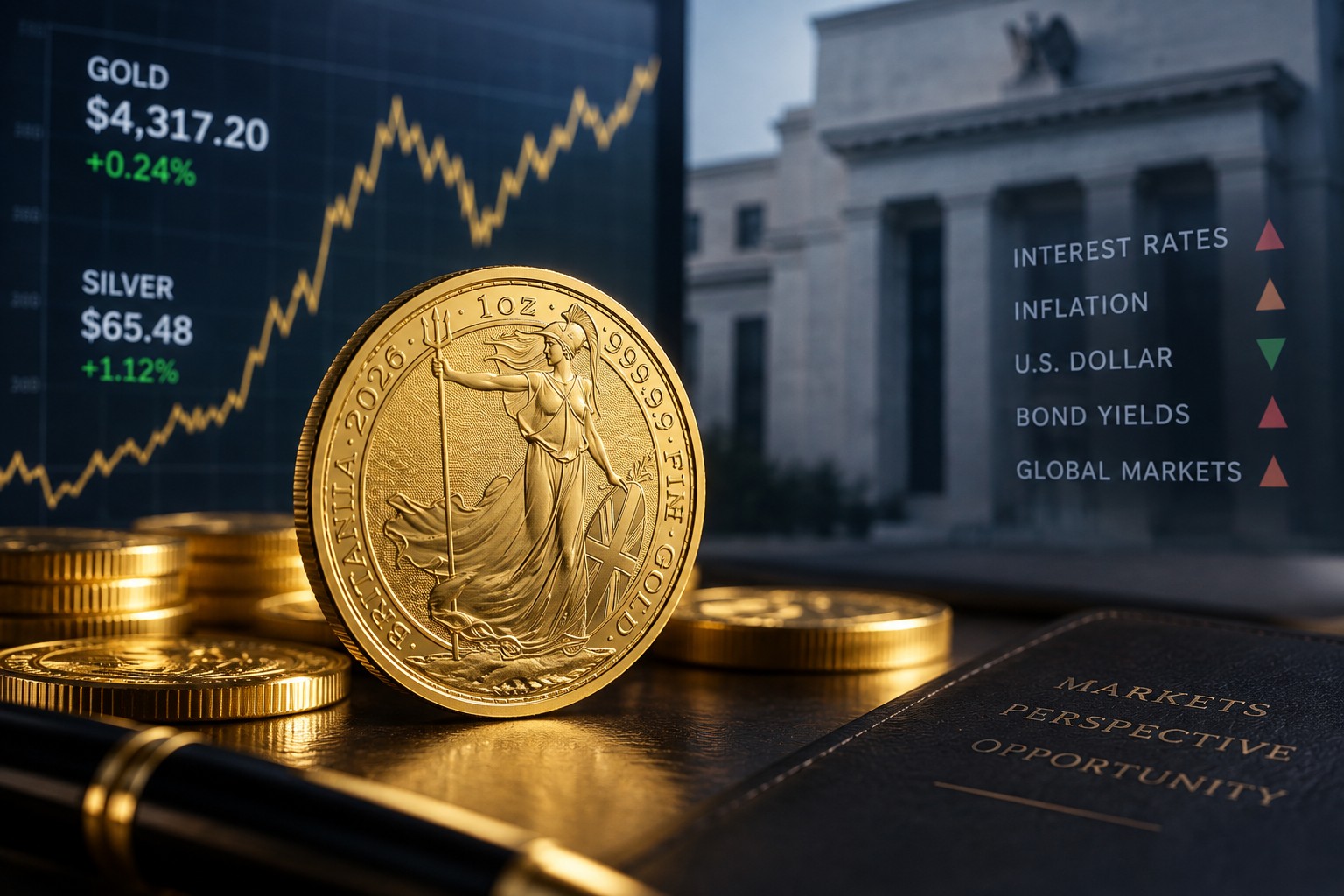
For decades, one of the simplest rules of thumb in the gold market has been that higher interest rates are bad for gold.
Gold pays no interest. So when cash and government bonds offer increasingly attractive returns, the opportunity cost of holding bullion rises. Higher US interest rates can also strengthen the dollar, creating another potential headwind for the gold price.
That relationship hasn’t disappeared. But recent market movements suggest it no longer tells the whole story.
Following an extraordinary few years for precious metals, gold is now being tested by a renewed shift towards tighter monetary policy. Yet the gold price remains above $4,300 an ounce, despite significant volatility.
So what’s supporting it – and what should physical gold investors be watching next?
You can follow the latest movements in both sterling and US dollars on our live gold price chart.
On 16 September, the US Federal Reserve raised its benchmark interest rate by 0.25 percentage points to a range of 3.75% to 4.00%.
The decision came as the Fed continued to grapple with inflation above its 2% target. Its accompanying statement said that inflation remained elevated and that the rate increase was intended to support a return to price stability.
In isolation, that’s hardly an ideal backdrop for gold.
Higher interest rates increase the returns available on interest-bearing assets. They can push bond yields higher and support the US dollar – all factors that can reduce the relative attraction of a non-yielding asset such as gold.
But what happened next was more interesting.
On 17 September, gold rebounded by more than 2%, reaching around $4,360 an ounce as the US dollar and Treasury yields weakened. Silver rose even more sharply, gaining 4.2% to $65.60 an ounce.
That didn’t mark the end of the volatility.
By 22 September, gold had eased back to around $4,325 an ounce as markets increasingly anticipated that US interest rates could remain higher for longer.
This tells us something important.
Interest rates and the dollar clearly still matter to gold. But despite these headwinds, gold remains at historically elevated levels.
Why?
One important part of the answer may lie in who is buying gold.
Central banks have become an increasingly significant source of demand.
According to the World Gold Council’s latest Gold Demand Trends data, central banks bought a net 289 tonnes of gold during the second quarter of 2026 – 62% more than during the equivalent quarter of 2025.
That’s important because central banks don’t necessarily approach gold in the same way as a private investor deciding whether a bond yield looks attractive.
Gold can serve as a reserve asset that carries no credit risk and isn’t another country’s liability. For reserve managers seeking greater diversification, those characteristics can matter independently of whether US interest rates move up or down.
And the longer-term numbers are striking.
The World Gold Council’s 2026 Central Bank Gold Reserves Survey reports that central banks have accumulated an average of approximately 1,000 tonnes of gold a year over the past four years, compared with around 500 tonnes annually over the preceding decade.
That’s potentially an important structural change in the gold market.
Central banks aren’t the only part of the equation.
The World Gold Council reported total gold demand of 1,269 tonnes in the second quarter of 2026, taking first-half demand to 2,522 tonnes – 2% higher year on year.
Interestingly, demand hasn’t been uniform.
Gold-backed ETFs experienced net outflows of 45 tonnes during the second quarter, whereas bar and coin investment remained relatively resilient at 307 tonnes – just 3% below the equivalent period in 2025.
Looking ahead, the World Gold Council expects investment to remain the principal source of demand growth through the remainder of 2026, with Asian investment and over-the-counter activity expected to make a greater contribution.
This matters because it suggests the gold price isn’t being driven by a single story.
Interest rates may be creating a headwind at the same time as central-bank diversification, private investment demand, inflation concerns and geopolitical uncertainty create support.
For investors considering owning the metal directly, our guide to buying physical gold explains the different options available, including coins and bars.
There’s another complication.
Usually, higher interest rates are interpreted as negative for gold because they imply tighter monetary conditions.
But why rates are rising matters too.
The Federal Reserve’s September rate increase came against a backdrop of persistent inflation. Fed officials have continued to highlight inflation risks, with Boston Fed President Susan Collins saying that a more restrictive policy stance was needed to return inflation sustainably towards the central bank’s 2% objective.
That leaves investors facing an unusual combination: higher interest rates on one side, but continuing inflationary and geopolitical uncertainty on the other.
These forces can pull gold in opposite directions.
Higher rates increase the opportunity cost of holding it. Persistent concerns about inflation, currencies or financial and geopolitical risk can simultaneously increase demand for an asset traditionally used as a store of value.
It helps explain why interpreting gold purely through the lens of “rates up, gold down” can be too simplistic.
For UK investors, there’s another layer to the story.
The international gold price is normally quoted in US dollars, but British investors ultimately care about the sterling gold price.
That means movements in GBP/USD can amplify or offset changes in the headline dollar price of gold.
A strengthening pound can reduce the sterling value of gold even if the dollar gold price is unchanged. Conversely, sterling weakness can increase the UK gold price without any corresponding rise in the international dollar price.
This is one reason British investors shouldn’t rely exclusively on headlines quoting gold in dollars when assessing the performance of their holdings.
Our live gold price chart allows you to track the gold price and compare its performance over different periods.
Silver is worth watching particularly closely.
Unlike gold, silver sits somewhere between a precious metal and an industrial commodity. Investment demand matters, but so does demand from manufacturing and technologies such as electronics and solar energy.
That can contribute to greater price volatility.
We saw a good example immediately after the September Fed decision. On 17 September, silver rose by 4.2% in a single session, roughly twice gold’s percentage gain that day.
One useful way of comparing the two metals is the gold:silver ratio – the number of ounces of silver theoretically required to buy one ounce of gold at their respective spot prices.
Physical Gold’s live gold:silver ratio chart tracks this relationship and allows investors to compare current and historical levels.
But the ratio shouldn’t be viewed as a simple signal that one metal is “cheap” or “expensive”. The forces driving gold and silver demand are different, and UK buyers also need to account for their different tax treatment.
You can read more about this distinction in our guide to the tax implications of gold and silver. Qualifying investment gold is exempt from VAT in the UK, whereas physical silver bought for delivery will generally attract VAT.
Rather than trying to predict the next daily move in the gold price, there are several indicators worth following over the coming months:
US interest rates and bond yields
Further tightening could continue to create a headwind for non-yielding gold. Markets will be watching closely for signs of where US rates go next.
Inflation
If inflation proves more persistent than expected, it could create competing forces for gold – increasing the likelihood of higher interest rates while potentially supporting demand for assets perceived as stores of value.
The US dollar
A stronger dollar can put pressure on the international gold price, while dollar weakness can provide support.
Central-bank demand
Continued official-sector buying could remain an important longer-term influence. The sharp increase in the pace of central-bank accumulation over recent years makes this particularly important to watch.
Geopolitical risk
Political, military and financial uncertainty can alter investor behaviour rapidly and has remained an important part of the precious-metals backdrop.
Sterling
UK investors should consider GBP/USD alongside the international gold price. What happens to gold in dollars isn’t necessarily what happens to gold in pounds.
Silver
Movements in silver and the gold:silver ratio can provide another perspective on precious-metals sentiment.
None of these variables operates independently, which is precisely why gold’s behaviour can sometimes appear counter-intuitive.
The most interesting feature of the current market isn’t simply that gold is expensive by historical standards.
It’s that gold has remained above $4,300 an ounce despite the return of an environment that conventional wisdom says should be difficult for it.
That doesn’t mean interest rates have stopped mattering. Recent price movements provide ample evidence that expectations for rates, bond yields and the dollar can still move gold significantly in either direction.
Instead, today’s gold price appears to be shaped by a broader set of competing forces – monetary policy, central-bank buying, investment demand, inflation, currencies and geopolitical uncertainty.
For physical gold investors, that’s arguably the more useful lesson.
Rather than asking whether a single economic announcement is “good or bad for gold”, understanding why gold is moving – and which buyers are driving the market – can provide a much clearer picture of what’s happening beneath the headline price.
If you’re considering adding physical precious metals to your portfolio, explore our current ranges of investment gold and physical silver.
Market information correct as at 23 September 2026. This article is for general information only and does not constitute investment, tax or financial advice. Precious-metal prices can rise as well as fall.

Live Gold Spot Price in Sterling. Gold is one of the densest of all metals. It is a good conductor of heat and electricity. It is also soft and the most malleable and ductile of the elements; an ounce (31.1 grams; gold is weighed in troy ounces) can be beaten out to 187 square feet (about 17 square metres) in extremely thin sheets called gold leaf.
Live Silver Spot Price in Sterling. Silver (Ag), chemical element, a white lustrous metal valued for its decorative beauty and electrical conductivity. Silver is located in Group 11 (Ib) and Period 5 of the periodic table, between copper (Period 4) and gold (Period 6), and its physical and chemical properties are intermediate between those two metals.


