Gold vs Oil Prices in 2026: Implications for Investors Amid Middle East War
13/03/2026Daniel Fisher

Accumulate gold coins on a regular basis for home delivery or storage.
Let our experts hand-pick a gold investment portfolio for you.
Free & fully insured UK Delivery. Learn more

Secure & flexible payments. Learn more

Buyback Guarantee Learn more

A cost-effective way to buy silver bullion with off-shore storage
Let our experts hand-pick a silver investment portfolio for you.
Free & fully insured UK Delivery. Learn more
Secure & flexible payments. Learn more
Buyback Guarantee Learn more
Free & fully insured UK Delivery. Learn more
Secure & flexible payments. Learn more
Buyback Guarantee Learn more


Accumulate gold coins on a regular basis for home delivery or storage.
Let our experts hand-pick a gold investment portfolio for you.
A cost-effective way to buy silver bullion with off-shore storage
Let our experts hand-pick a silver investment portfolio for you.
Free & fully insured UK Delivery. Learn more
Secure & flexible payments. Learn more
Buyback Guarantee Learn more
Free & fully insured UK Delivery. Learn more
Secure & flexible payments. Learn more
Buyback Guarantee Learn more
In summary
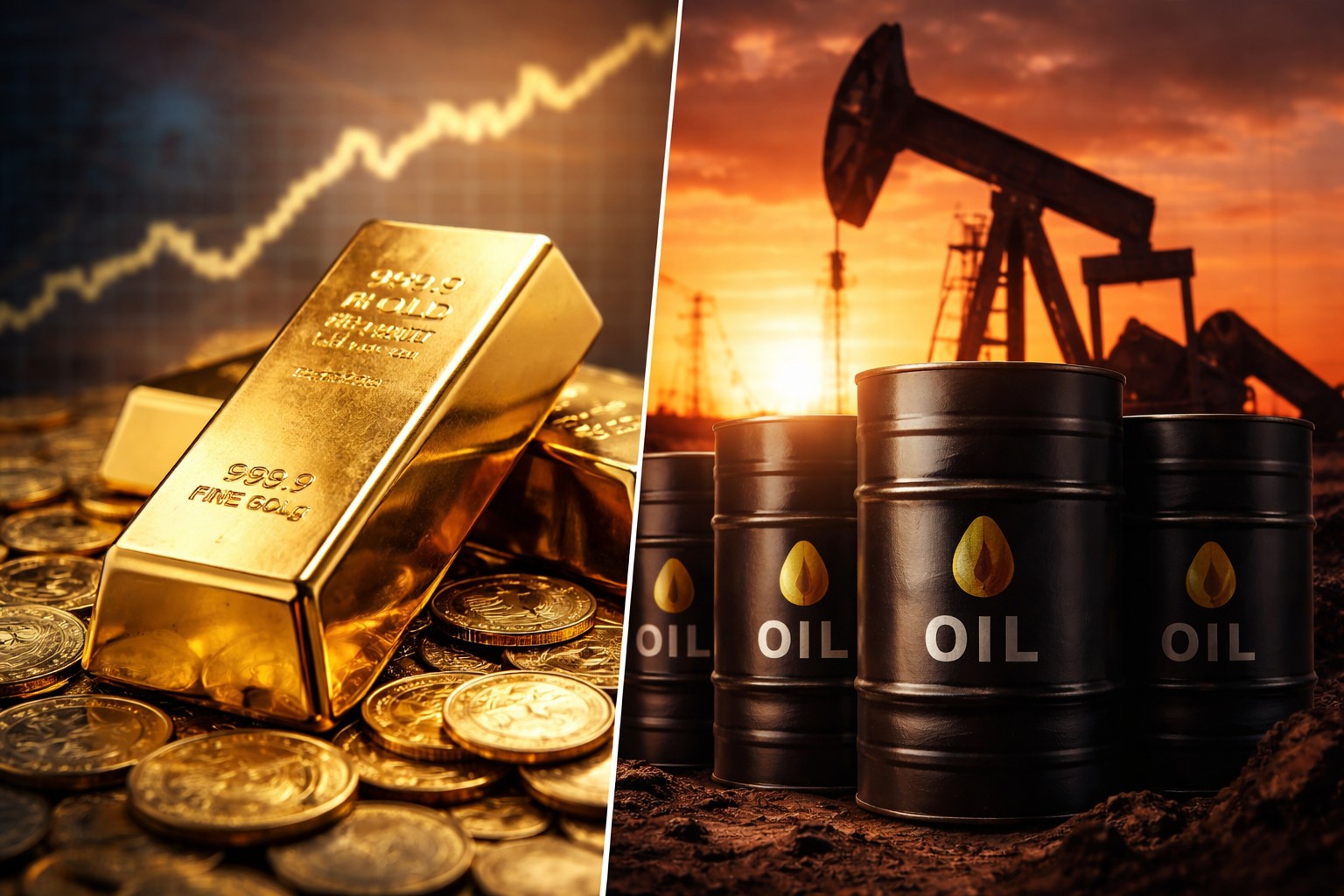
Gold and oil are often discussed together, but they do not play the same role in a portfolio. Oil is the world’s most important energy commodity and is heavily influenced by supply disruptions, transport chokepoints and industrial demand. Gold, by contrast, is primarily a monetary and defensive asset. Bought for wealth preservation, diversification and protection when confidence in markets weakens.
In 2026, that distinction matters more than ever. Gold has continued to trade at or near record highs, supported by safe-haven demand, central bank buying and persistent geopolitical stress.
Oil has also surged sharply as the war in the Middle East has threatened shipping routes and global supply. That combination tells investors something important. When both oil and gold are rising together, markets are often signalling a dangerous mix of inflation risk, geopolitical fear and economic uncertainty.
For precious metals investors, understanding the relationship between oil and gold prices can add useful context to short-term market moves and help explain what moves gold prices in periods of heightened global tension.
Gold and oil are connected through the broader macroeconomic environment rather than through direct substitution. Oil matters because it feeds into transport costs, manufacturing costs, utility prices and inflation expectations. In other words, high oil prices are likely to affect the prices of almost everything. Gold matters because it tends to respond to those inflation fears, to interest-rate expectations and to wider investor anxiety.
When oil prices rise because the global economy is strong, gold does not always keep pace. In a growth-led environment, higher oil can simply reflect stronger demand for energy, while investors may prefer equities and other risk assets over defensive holdings.
But when oil rises because of war, supply shocks or transport disruption, the effect is different. Higher oil prices can raise inflation fears at the same time as conflict pushes investors towards safe-haven assets.
That link becomes even clearer when you consider how inflation affects the price of precious metals. If rising energy costs begin feeding through into the broader economy, investors often become more concerned about the future purchasing power of cash, which in turn can support gold demand. That is one reason oil shocks have historically mattered far beyond the energy market itself.
For investors, the key point is simple: oil often tells you what the market thinks about supply, growth and inflation, while gold tells you what the market thinks about confidence, monetary risk and protection.

Gold price vs Brent oil price: key market shocks from Covid to the 2026 Middle East war
One of the simplest ways to track the relationship between gold and oil prices is through the gold/oil ratio. This measures how many barrels of oil one ounce of gold can buy.
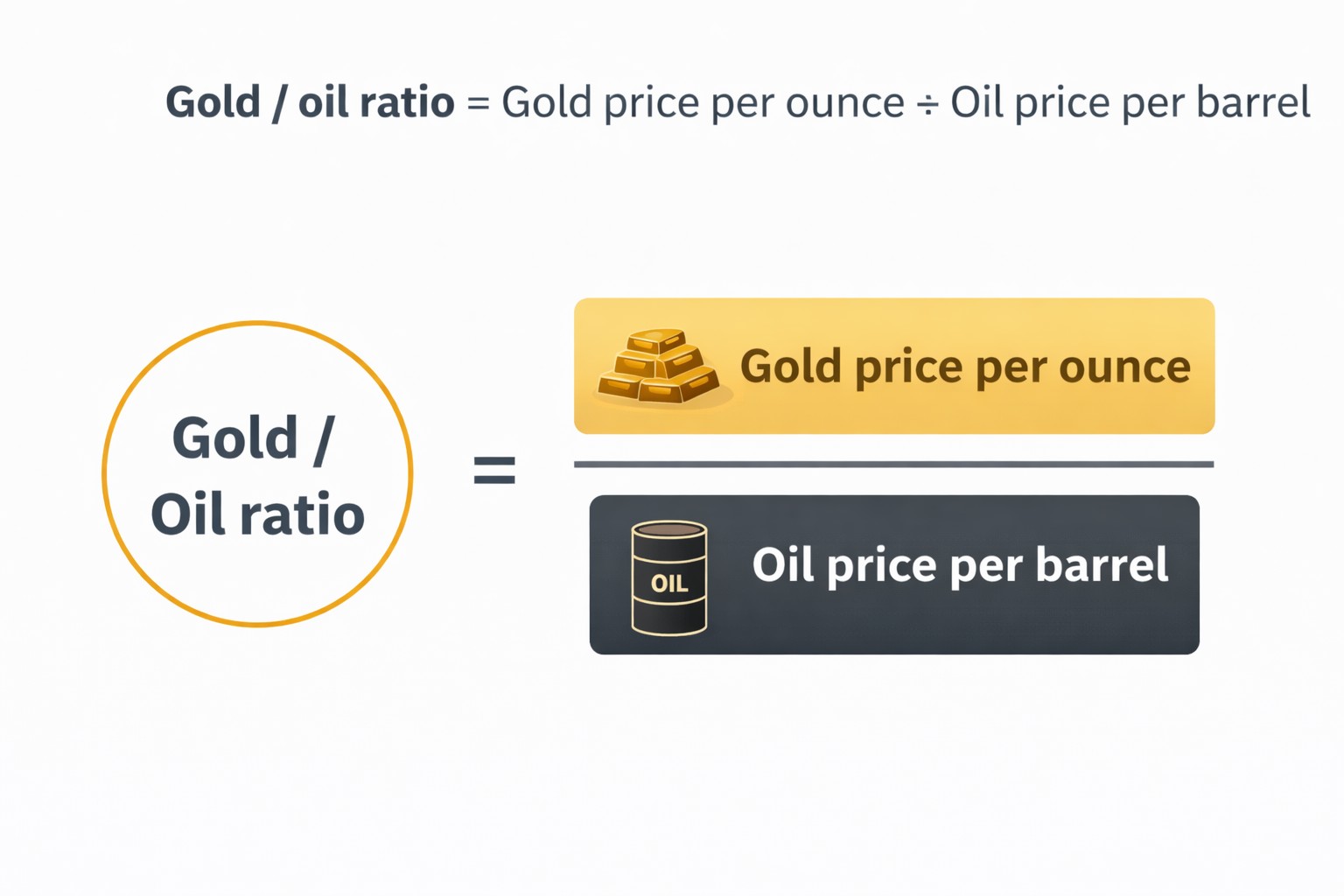
If gold is trading at a very high level relative to oil, the ratio rises. In plain English, that means gold is expensive relative to oil – or, put differently, that the market is paying a very large premium for monetary safety compared with energy.
This matters because extreme readings in the gold/oil ratio often appear when markets are under stress. A high ratio can suggest that investors are more worried about preserving capital than chasing economic growth. A lower ratio usually points to stronger confidence in global demand, industry and cyclical assets.
In 2026, the ratio appears elevated because two trends are colliding at once: oil is being supported by war and supply concerns, while gold is being supported by safe-haven demand, longer-term monetary concerns and strong investor appetite for protection. Even with oil rising, gold’s strength has remained pronounced.
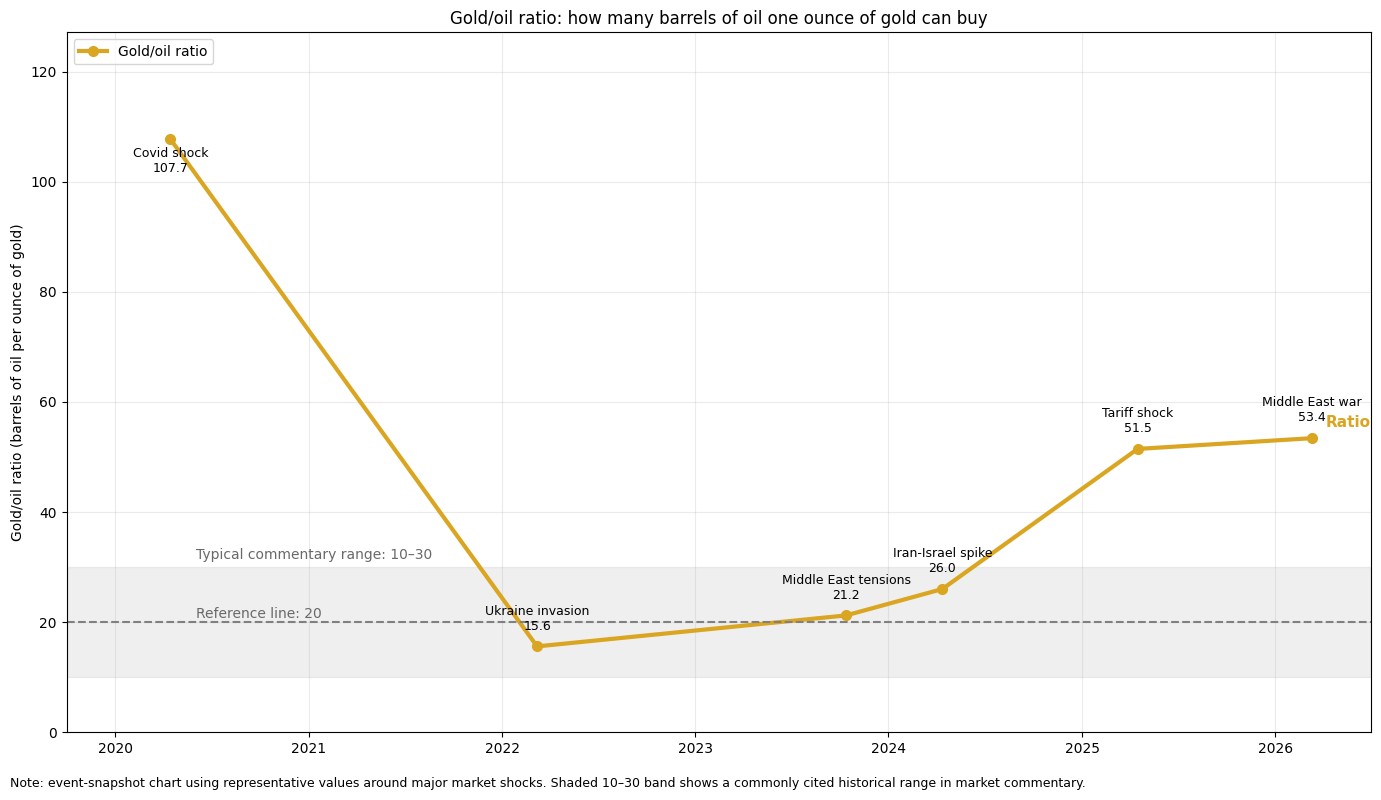
Gold/oil ratio: how many barrels of oil one ounce of gold can buy

The current Middle East conflict impacts both assets as the region remains central to global oil supply and maritime energy transport, and Iran sits at the heart of that risk.
Iran is both a major oil producer and the state that borders the Strait of Hormuz – the narrow shipping lane through which roughly 20.9 million barrels a day moved in the first half of 2025, equivalent to about 20% of global petroleum liquids consumption and around one-quarter of the world’s seaborne oil trade. Any disruption there matters immediately to global energy markets. (U.S. Energy Information Administration)
That is why traders react so sharply to escalation involving Iran. When markets fear attacks on tankers, export infrastructure or the Strait itself, they are not just pricing in a regional event – they’re pricing in the possibility that a critical artery for global oil flows could be constrained. Reuters reported on 12 March 2026 that Brent surged back to about $100 a barrel as Iran vowed to keep the Strait of Hormuz closed, while Goldman Sachs said a prolonged disruption there could keep prices materially higher than previously expected.
Importantly, the current oil price – around $100 per barrel – is still well below the spike seen after Russia’s invasion of Ukraine, when Brent reached about $127.98 in March 2022. That comparison matters because it suggests the market may still not be pricing a full worst-case Hormuz disruption. In other words, if the conflict deepens further or shipping constraints persist, there may still be upside risk in oil from current levels.
But the same conflict also supports gold. Gold tends to benefit when investors are worried about escalation, market volatility, inflation persistence or a broader loss of confidence. That makes it especially relevant in 2026, when geopolitical instability is influencing both energy markets and broader investor behaviour.
This is why conflict in the Middle East can push both oil and gold higher at the same time, even though they serve very different purposes. Oil rises because investors fear reduced supply, particularly through Iran and the Strait of Hormuz. Gold rises because investors fear the consequences.
Free ultimate guide for keen precious metals investor
For investors, the relationship between gold and oil prices is useful because it helps distinguish between different types of market stress.
If oil is rising but gold is flat, the market may be focused more on growth, production and energy demand than on systemic fear.
If gold is rising but oil is weak, the market may be signalling concern about financial instability, recession risk or falling confidence rather than inflationary expansion.
If both are rising together, as they have in 2026, that often points to a more uncomfortable combination: inflation concerns, geopolitical risk and fragile sentiment.
That does not mean investors should trade every move in the ratio or assume one commodity must immediately catch up with the other. It does mean the relationship can improve portfolio decision-making.
For gold investors, the current environment suggests three broad conclusions.
First, gold is still being treated as strategic insurance. The fact that gold has remained strong even as oil has also jumped shows that investors are not simply buying commodities indiscriminately – they are paying for protection.
Second, higher oil prices complicate the inflation outlook. If energy costs remain elevated, central banks may find it harder to declare victory over inflation, and that can have a meaningful effect on bullion. The interaction between inflation, yields and monetary policy is one reason the gold price and interest rate relationship remains so important in 2026.
Third, a very high gold/oil ratio can be a warning against assuming that recent moves will continue in a straight line. Gold can remain strong for good reasons, but when it becomes extremely expensive relative to oil, investors should be careful about over-extrapolating headlines. A disciplined accumulation strategy usually makes more sense than trying to time geopolitics.

For most private investors, gold and oil are not interchangeable decisions.
Oil is a volatile, event-driven commodity exposed to politics, production policy, inventories and transport risk. It can move violently in either direction and is difficult for most long-term wealth-preservation investors to hold directly with confidence.
Gold is different. It is less about consumption and more about monetary protection. Investors typically buy gold to diversify portfolios, hedge against systemic stress and hold an asset with no credit risk. For UK investors, owning UK gold coins also benefits from being a CGT-free investment.
That is why, in a year like 2026, gold is usually the more relevant asset for long-term private investors. Oil may tell you something important about inflation and geopolitical stress, but gold is usually the asset investors hold in response to those risks.
Short-term market pricing can also be influenced by positioning and speculation, especially in derivatives markets. For readers who want to understand that side of the picture in more depth, it is worth exploring the gold futures market, which helps explain why paper-market activity can amplify price moves even when the long-term investment case remains unchanged.
In other words, oil often explains the problem -gold is often part of the solution.

Investors do not need to become commodity traders to benefit from this relationship. The most practical way to use it is as a context tool. Investment in gold should always be considered on a long term horizon and based on fundamentals. Oil prices can help fine tune shorter term timing.
A rising oil price can tell you that inflation risks may not be fully contained.
A rising gold price can tell you that confidence remains fragile.
A high gold/oil ratio can tell you that markets are assigning a heavy premium to safety over growth.
Taken together, those signals can help investors decide whether current gold strength looks speculative, cyclical or structural. In 2026, the evidence points more towards structural support than a fleeting spike. Gold is not rising in isolation. It is being supported by geopolitical instability, persistent investor caution and a macro backdrop in which oil shocks can quickly revive inflation fears.
The relationship between oil and gold prices matters because it offers a window into how markets are pricing fear, inflation and economic confidence all at once.
In 2026, that relationship has become especially important. The war in the Middle East has driven renewed oil-market stress, while gold has remained near record highs as investors seek protection. For investors, the message is not that one must immediately fall or the other must surge. It is that the market is still paying up for resilience.
Oil may continue to move on war headlines and supply fears, but gold remains the clearer long-term defensive asset for those concerned about inflation, geopolitical instability and preserving purchasing power.
In that sense, watching oil can help explain why gold is moving. But owning gold is how many investors choose to respond.
Gold and oil prices can move together because both respond to major macroeconomic and geopolitical events. When oil rises on supply disruption or conflict, investors often worry about inflation and economic instability. That can increase demand for gold as a safe-haven asset.
The gold/oil ratio shows how many barrels of oil one ounce of gold can buy. It is calculated by dividing the gold price per ounce by the oil price per barrel. Investors use it as a simple way to compare whether gold looks expensive or cheap relative to oil.
The Middle East matters because it is central to global oil production and energy transport. Tensions involving Iran or the Strait of Hormuz can raise fears of supply disruption, which pushes oil prices higher. At the same time, conflict increases uncertainty and risk aversion, which often supports gold.
The Strait of Hormuz is one of the world’s most important oil shipping chokepoints. A large share of global seaborne oil passes through it, so any threat to vessels, exports or regional stability can quickly lead to higher oil prices as traders price in supply risk.
Not always. Oil can rise because of stronger economic growth and energy demand, while gold may remain weaker if investors are confident and prefer risk assets. Gold tends to respond more strongly when higher oil prices are linked to inflation fears, war or broader market stress.
For many private investors, gold is the more practical long-term defensive asset. Oil can be highly volatile and is more directly tied to supply shocks, producer decisions and short-term geopolitical headlines. Gold is more commonly held as a store of value and portfolio hedge during periods of uncertainty.
A high gold/oil ratio means gold is expensive relative to oil. This often suggests that investors are placing a premium on safety and protection rather than on growth and industrial demand. In periods of elevated geopolitical risk, that can reflect strong demand for gold as a safe haven.
Yes. If conflict worsens, shipping through the Strait of Hormuz is disrupted, or markets begin pricing in a more severe supply shock, oil could move higher. The fact that oil around $100 per barrel is still below the spike seen after Russia’s invasion of Ukraine suggests there may still be upside risk if tensions escalate.
The gold/oil ratio is best used as a context tool rather than a trading signal. It can help investors understand whether markets are more focused on inflation, conflict and safety, or on growth and energy demand. It should be used alongside wider analysis of interest rates, inflation, geopolitics and investor sentiment.
The main takeaway is that oil can help explain why gold is moving, but gold remains the more relevant long-term asset for investors seeking protection against inflation, geopolitical instability and market uncertainty.

Share this post on:


Latest Posts:
Live Gold Spot Price in Sterling. Gold is one of the densest of all metals. It is a good conductor of heat and electricity. It is also soft and the most malleable and ductile of the elements; an ounce (31.1 grams; gold is weighed in troy ounces) can be beaten out to 187 square feet (about 17 square metres) in extremely thin sheets called gold leaf.
Live Silver Spot Price in Sterling. Silver (Ag), chemical element, a white lustrous metal valued for its decorative beauty and electrical conductivity. Silver is located in Group 11 (Ib) and Period 5 of the periodic table, between copper (Period 4) and gold (Period 6), and its physical and chemical properties are intermediate between those two metals.